
Catastrophic Floods and Collapse of Moche San José de Moro
Catastrophic El Niño floods around 750 CE destroyed the Moche irrigation systems at San José de Moro, triggering social collapse and catalyzing the rise of the resilient Sican culture in northern Peru
The Hydraulic Heart of the Moche
By the mid-8th century CE, the Moche civilization had established itself as the dominant political and cultural force along the arid northern coast of Peru. Their society was fundamentally engineered around water; in a region receiving less than 50 millimeters of rainfall annually, they constructed an intricate network of canals, aqueducts, and reservoirs that transformed desert valleys into agricultural powerhouses. San José de Moro, located in the Jequetepeque Valley, emerged as one of the most significant ceremonial and administrative centers during this Late Moche period (c. 600–750 CE). Unlike earlier sites such as Huaca de la Luna or the Sun, which had waned in prominence, San José de Moro flourished as a hub for priestly elites who managed the complex irrigation systems essential for survival. The site's architecture, characterized by massive adobe platforms and elaborate tombs filled with gold and silver, reflected a society confident in its ability to master the environment through ritual and engineering.
The Onset of Climatic Volatility
Around 750 CE, this delicate equilibrium was shattered by a series of catastrophic El Niño-Southern Oscillation (ENSO) events. Paleoclimatic records from ice cores in the Andes and sediment layers in coastal lagoons indicate that these were not ordinary seasonal anomalies but extreme, multi-year climatic oscillations. The region experienced a violent shift from prolonged, devastating droughts to torrential rains that caused rivers to swell beyond their banks. The Moche hydraulic infrastructure, designed for controlled water distribution, was ill-equipped to withstand such extremes. Rivers like the Jequetepeque overflowed with unprecedented force, breaching canal embankments and washing away centuries of agricultural terracing. Simultaneously, the preceding droughts had likely depleted groundwater reserves, leaving crops vulnerable before the deluge even arrived.
The Destruction of San José de Moro
The impact on San José de Moro was immediate and total. Archaeological evidence reveals a layer of sediment and debris covering the site's ceremonial precincts, indicating rapid abandonment rather than gradual decline. The flooding destroyed the very canals that sustained the city's food supply, leading to acute famine and social fragmentation. Excavations at the site have uncovered signs of hurried burials and a cessation of elite ritual activity, suggesting that the priestly class lost their authority as they could no longer guarantee water or harvests. The massive adobe structures, vulnerable to water saturation, began to collapse under the weight of mud and debris. Within a few decades, the city was effectively depopulated, its inhabitants scattering to higher ground or migrating toward more resilient communities in the northern valleys.
Social Unrest and Political Fragmentation
The environmental catastrophe triggered a profound crisis of legitimacy for the Moche state. The ruling ideology, which linked the elite's power to their ability to mediate with natural forces through ritual, collapsed alongside the irrigation systems. As resources vanished, internal strife likely erupted between competing factions vying for control over the remaining arable land and water sources. This period marked the end of the unified Moche political entity that had dominated the region for nearly a millennium. The centralization of power dissolved into localized chiefdoms, each struggling to adapt to the new climatic reality. The cultural homogeneity that defined the Moche—evident in their art, pottery styles, and religious iconography—began to fracture as communities isolated themselves to survive.
The Rise of Sican and Regional Shift
In the aftermath of the collapse, political and cultural重心 shifted northward toward the Lambayeque Valley. Here, a new culture began to coalesce, eventually known as the Sican (or Lambayeque) civilization. The Sican people learned from the Moche's failures, developing more sophisticated water management techniques that were better suited to the volatile climate. They constructed larger reservoirs and utilized different agricultural strategies that allowed them to thrive where the Moche had faltered. While San José de Moro remained a ghost town, the legacy of the Moche was not entirely lost; it was absorbed and transformed by these emerging groups. The transition from the Late Moche to the Early Sican period represents one of the most significant cultural evolutions in pre-Columbian South America, driven directly by the need to adapt to environmental stress.
Legacy and Historical Significance
The collapse of San José de Moro serves as a poignant case study in the vulnerability of complex societies to climate change. It illustrates how even highly advanced civilizations, with sophisticated engineering and rigid social hierarchies, can be undone by environmental forces beyond their control. The event marks a definitive turning point in Andean history, ending the Moche era and paving the way for the diversity of cultures that would characterize the region until the Inca expansion centuries later. Today, the ruins of San José de Moro stand as a silent testament to this resilience and fragility, offering modern researchers critical insights into how ancient populations responded to extreme weather events—a lesson with enduring relevance in an era of contemporary climate volatility.
It illustrates how extreme climate events can destabilize complex pre-Columbian societies.
Where it happened
Lambayeque Valley, Peru — see it on the interactive map →
Explore related history
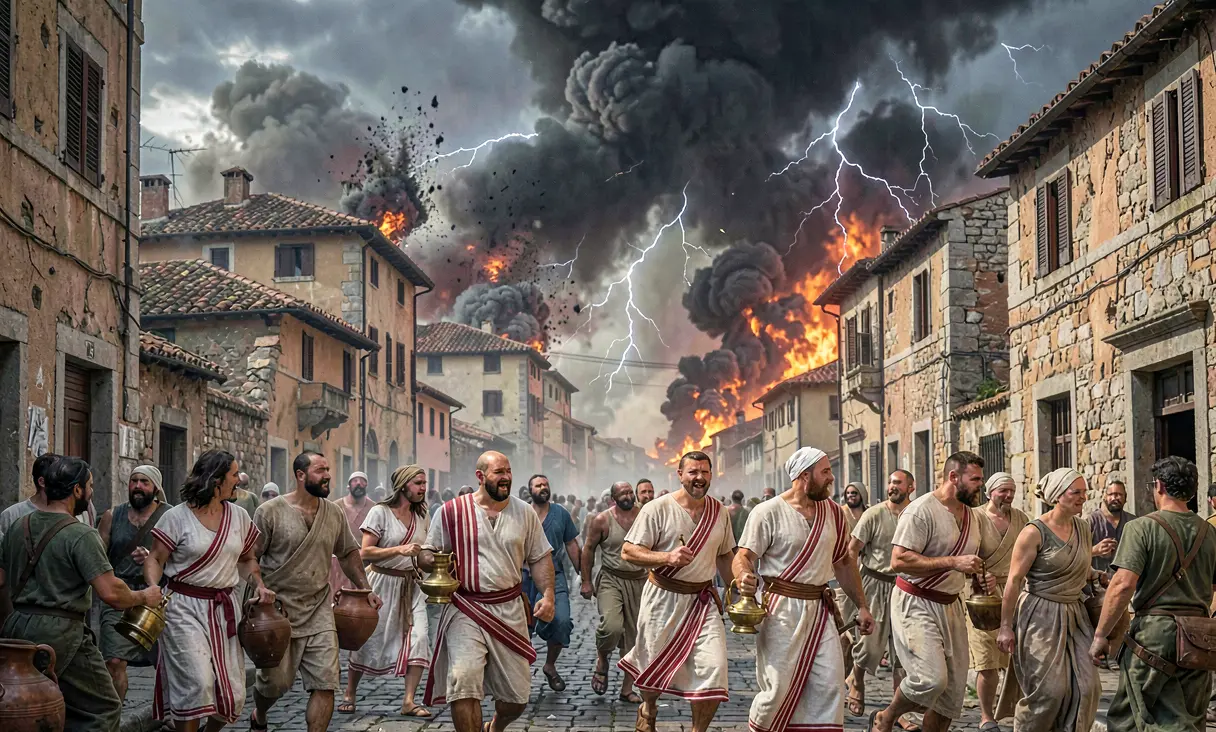 DisasterEruption of Mount VesuviusAugust 24, 79 CE · Pompeii, ItalyVolcano destroys Roman cities preserving them in ash for modern discovery.
 CivilizationRise of the Etruscan League in Central Italyc. 750 BCE · Tarquinia (Cerveteri), ItalyEtruscan city-states form a powerful confederation dominating central Italy and influencing Rome.
 WarKushite Conquest of Egypt (25th Dynasty)c. 747 BCE · Thebes, EgyptKing Piye of Kush conquers Upper and Lower Egypt, establishing the first African-led dynasty in Egyptian history.
 ScienceEstablishment of the Babylonian Astronomical Observatoriesc. 747 BCE · Babylon, IraqBabylonian priests begin systematic nightly recording of planetary movements and eclipses.
Discussion
Loading…