
End of Zheng He's Voyages and Ming Isolationism
The death of Zheng He in 1433 triggered a Ming court purge of naval power, leading to the destruction of the world's largest fleet and centuries of self-imposed isolation that ceded global maritime do
The Zenith of Ming Naval Power
In the early 15th century, the Ming Dynasty under the Yongle Emperor orchestrated a maritime undertaking unprecedented in Chinese history. Between 1405 and 1433, Admiral Zheng He commanded seven colossal expeditions that traversed the South China Sea, crossed the Indian Ocean, and reached the Swahili Coast of East Africa. These fleets, comprising hundreds of ships including massive 'treasure vessels' estimated at over 120 meters in length, projected Chinese soft power across a sphere encompassing Southeast Asia, India, Persia, Arabia, and East Africa. The voyages were not merely exploratory but diplomatic and tributary missions designed to reassert the Ming court's centrality in the known world, demanding recognition of the Emperor's supremacy from distant rulers.
The Seventh Voyage and the Admiral's Death
Zheng He's final expedition departed Nanjing in 1431, aiming to re-establish tributary relations that had waned during the brief reign of the Xuande Emperor. The fleet sailed as far as Hormuz and likely reached Mecca, fulfilling the Hajj pilgrimage obligations for Muslim members of the crew. However, upon the return journey in late 1433, Zheng He fell ill and died at sea or shortly after docking in Calicut (Kozhikode), India. His death removed the most capable advocate for continued maritime expansion from the imperial court just as the political winds were shifting decisively against such endeavors.
The Ascendancy of Isolationist Faction
With Zheng He gone, the balance of power within the Ming bureaucracy tipped irrevocably toward the Confucian scholar-officials who viewed naval expeditions as fiscally irresponsible and culturally unnecessary. Led by figures such as Liu Daxia, these officials argued that the treasure voyages drained the imperial treasury without yielding tangible economic returns, contrasting them with the existential land threats posed by the Mongols in the north. They successfully lobbied the Xuande Emperor's successors to halt further exploration, framing the vast fleets not as instruments of glory but as symbols of wasteful extravagance and a dangerous distraction from internal governance.
The Great Ban and Destruction of the Fleet
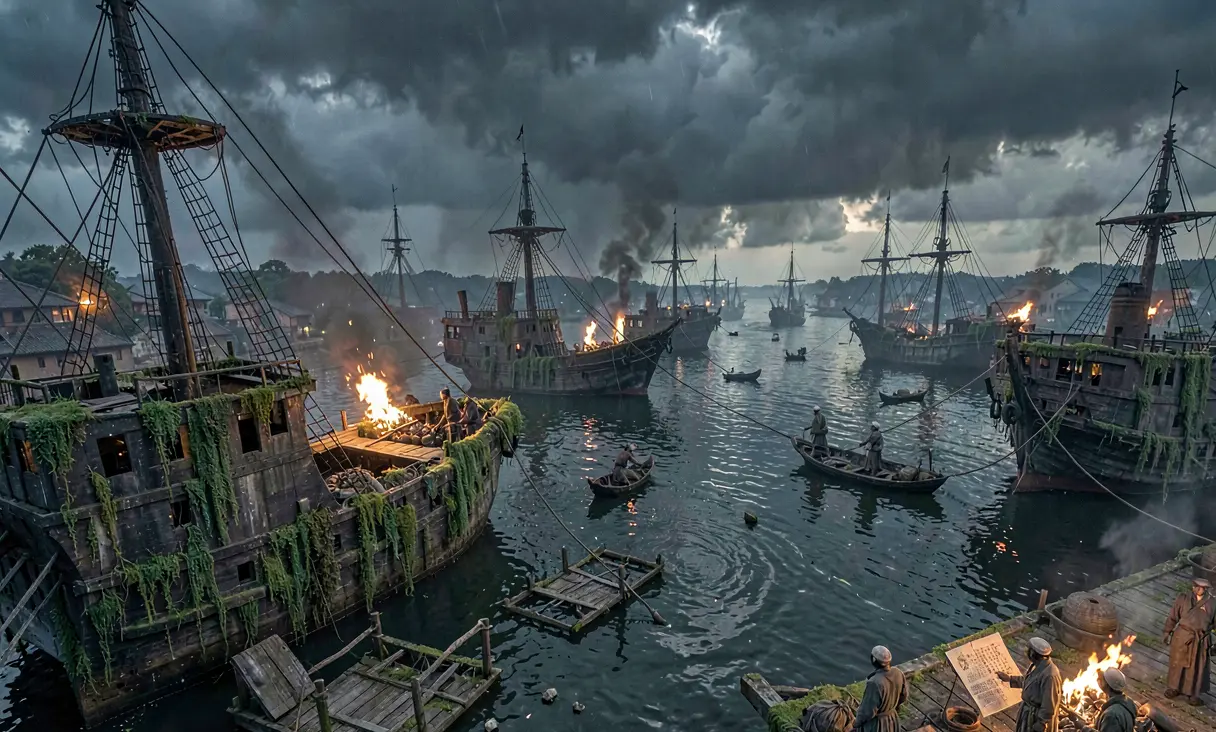
By 1435, the Ming court had enacted strict prohibitions against large-scale oceanic voyages. The Haijin (sea ban) laws were reinforced, criminalizing private maritime trade and restricting coastal movement to prevent piracy and foreign contact. In a symbolic act of erasure, the massive treasure ships were left to rot in their docks at Nanjing or were systematically dismantled for timber and iron. Historical records indicate that attempts to preserve the shipbuilding archives were met with resistance; the naval blueprints were allegedly burned by officials who viewed them as dangerous knowledge that might encourage future insurrections or unauthorized foreign contact.
Strategic Pivot to Land Defense
The cessation of the voyages marked a fundamental strategic realignment for the Ming Dynasty. Resources previously dedicated to projecting power across the Indian Ocean were redirected toward fortifying the northern frontier against Mongol incursions, culminating in the massive reconstruction of the Great Wall. The navy was reconfigured from an expeditionary force into a coastal defense unit tasked primarily with suppressing wokou pirates along the southeastern coast. This inward-looking posture effectively ceded the Indian Ocean to Arab and later Portuguese traders, ending China's role as the dominant arbiter of intercontinental maritime trade.
Legacy of a Closed Door
The decision to abandon the treasure fleet in 1433 stands as one of the most consequential turning points in global history. While Europe was on the cusp of its own Age of Discovery, China retreated into a period of maritime isolation that would last for centuries. This policy contributed to a technological stagnation in naval architecture and navigation within China, leaving the empire vulnerable when European powers eventually arrived with superior firepower in the 16th century. The loss of Zheng He's charts and ships meant that the knowledge required to replicate such voyages vanished, severing China from the global stage until the forced opening of the mid-19th century.
The cessation of Zheng He's voyages marked a pivotal turn toward isolationism, halting China's potential for global maritime expansion centuries before European arrival.

Where it happened
East Africa / China Coast — see it on the interactive map →
Explore related history
 ExplorationLapita Expansion into the Bismarck Archipelagoc. 1500 BCE · Bismarck Archipelago, Papua New GuineaLapita people migrate from Island Melanesia into the Bismarck Archipelago, establishing distinct pottery traditions.
 ExplorationGreat Zimbabwe Dominates Gold Trade with Kilwac. 1400 CE · Great Zimbabwe, ZimbabweArchaeological evidence confirms extensive gold trade between Great Zimbabwe and Swahili coastal cities.
 ExplorationFounding of Tenochtitlán on Lake Texcococ. 1325 CE · Lake Texcoco, Mexico City, MexicoThe Mexica establish their capital on an island in Lake Texcoco.
 WarExpansion of the Solomonic Empire under Zara Yaqobc. 1434 CE · Lake Tana, EthiopiaEmperor Zara Yaqob launches military campaigns to consolidate the Solomonic dynasty and suppress heresy.
 WarConquest of the Chanka by Pachacutic. 1438 CE · Cusco, PeruPachacuti defeats the Chanka invasion and transforms Cusco into an empire.
 WarLam Son Uprising Begins Against Ming China1418 CE · Lam Son, Thanh Hoa, VietnamLe Loi launches a rebellion against Ming occupation, founding the Later Le Dynasty.
Discussion
Loading…