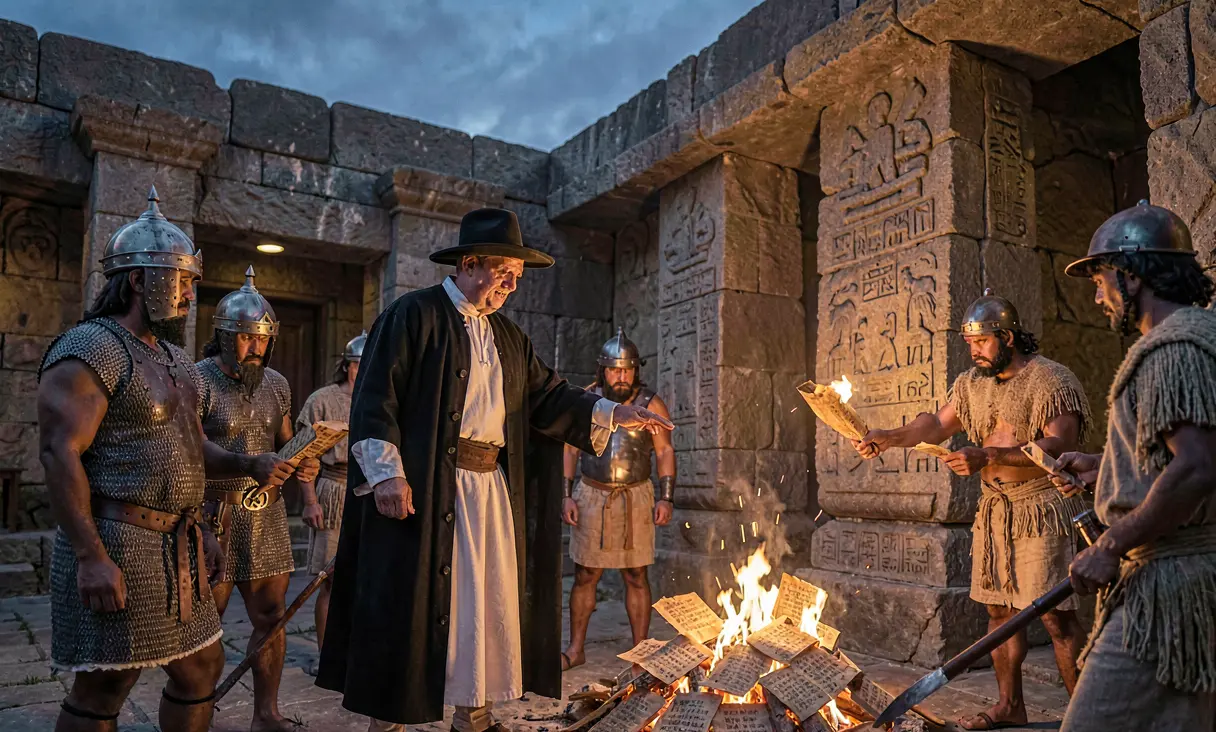
Burning of Maya Codices by Bishop Landa
In July 1562, Bishop Landa's auto-da-fé at Mani incinerated nearly all Maya codices, obliterating vast amounts of astronomical and historical knowledge and leaving only four fragile books to survive t
The Clash of Worlds in Colonial Yucatán
By the mid-16th century, the Spanish conquest of the Maya civilization was well underway, yet the spiritual resistance of the indigenous population remained formidable. Bishop Diego de Landa Calderón arrived in Yucatán in 1549 with a zealous mandate to eradicate what he perceived as idolatry and replace it with Catholic orthodoxy. While earlier missionaries had adopted a more gradual approach to conversion, Landa viewed Maya religious practices not merely as superstition but as the direct work of the devil, necessitating total annihilation. The tension between the syncretic survival of ancient traditions and the rigid demands of the Inquisition created a volatile atmosphere in the province.
The Auto-da-fé at Mani
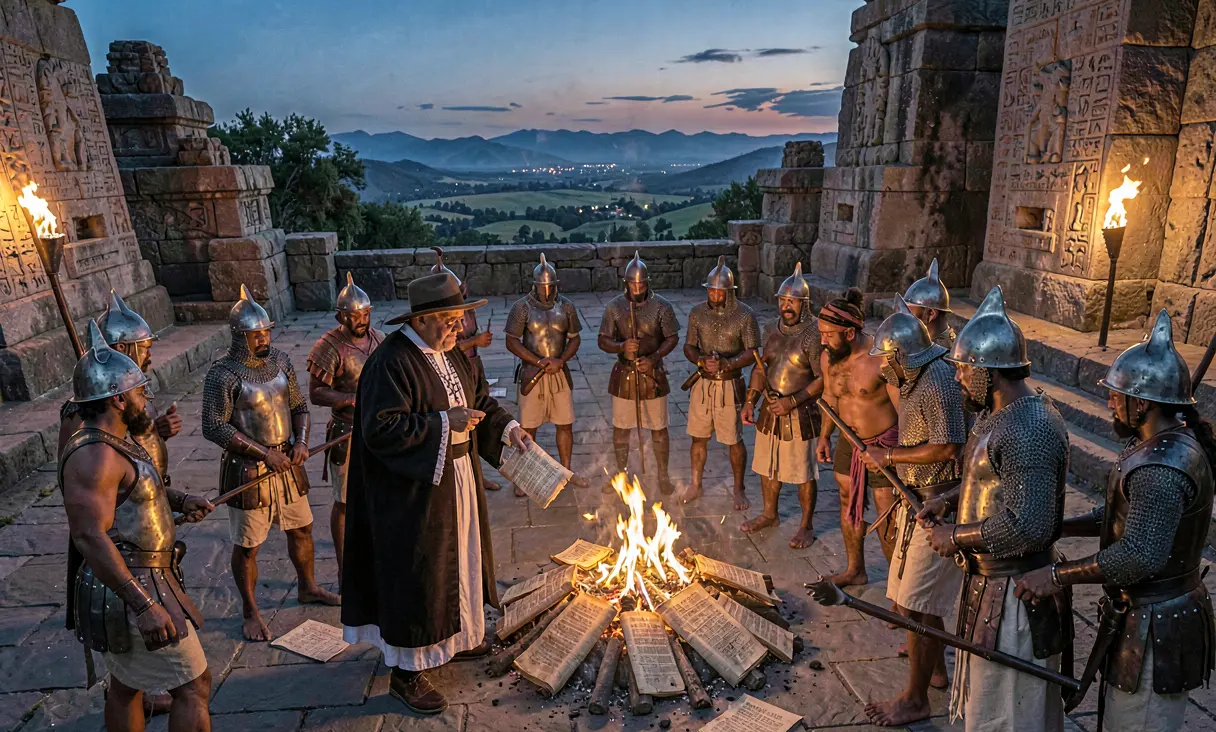
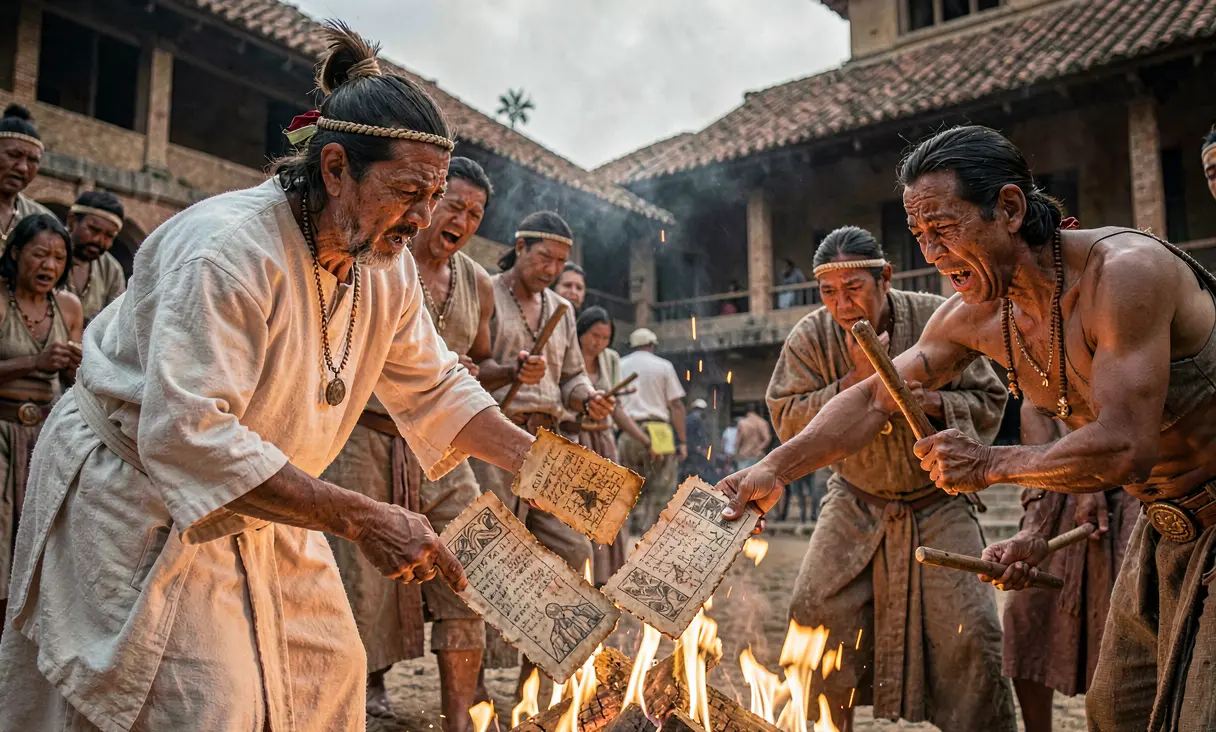
On July 12, 1562, this tension culminated in a catastrophic event at the town of Mani. Landa presided over an auto-da-fé (act of faith) that would become one of the most devastating cultural purges in human history. In the central plaza, amidst a gathering of thousands of terrified Maya and Spanish soldiers, Landa ordered the destruction of every codex, idol, and religious artifact he could find. The flames consumed centuries of accumulated knowledge, including astronomical charts, genealogical records, and mythological narratives written on bark paper treated with lime. Estimates suggest that nearly all known pre-Columbian Maya books were destroyed in this single afternoon.
The Irony of the Destroyer as Historian
Ironically, the primary source for our understanding of Maya culture today is the man who destroyed it: Bishop Diego de Landa. In his later years, perhaps driven by a need to justify his actions or simply out of scholarly curiosity, he wrote 'Relación de las cosas de Yucatán.' This text provides an invaluable, albeit biased, account of Maya religion, calendar systems, and writing. However, the document is marred by its context; it was written after Landa had tortured indigenous informants to extract confessions about their 'idolatrous' practices. His detailed descriptions of what he burned serve as a haunting testament to the magnitude of the loss.
The Catastrophic Loss of Knowledge
The burning of the codices represented an irreparable rupture in the continuity of Maya intellectual history. These books were not merely religious texts; they were encyclopedias containing precise astronomical calculations, historical chronicles of dynastic wars, and complex literary works. The destruction left a gaping void in the archaeological record. While stone inscriptions on stelae and temple walls survived to tell fragments of the story, the nuance, the daily life, and the full scope of their cosmology were largely erased. Modern scholars are forced to piece together a fragmented puzzle, relying heavily on post-conquest Spanish translations and the few surviving pre-Columbian manuscripts.
The Four Survivors
Miraculously, four Maya codices escaped the flames at Mani, likely because they were hidden by indigenous priests or taken to Europe before Landa's purge. These are now known as the Dresden Codex, the Madrid Codex, the Paris Codex, and the Grolier Codex (the authenticity of which has been debated but is increasingly accepted). The Dresden Codex, in particular, remains a masterpiece of Maya science, containing detailed tables for predicting eclipses and the movements of Venus. These four fragile books stand as the only direct windows into the pre-Hispanic Maya mind, serving as the primary keys that have allowed modern epigraphers to finally decipher the hieroglyphic script.
Legacy and Cultural Genocide
The event at Mani is frequently cited by historians as a definitive act of cultural genocide. It was not merely an act of religious intolerance but a systematic attempt to decapitate the intellectual heritage of a civilization. The consequences extended far beyond the loss of books; it shattered the authority of the traditional priestly class and forced the Maya into a syncretic existence where their history had to be memorized orally or hidden in coded forms. The burning of 1562 remains a symbol of the fragility of human knowledge against the forces of dogmatic destruction, reminding us that the loss of a single library can silence a civilization for centuries.
It represents one of the greatest losses of indigenous knowledge in human history.
Where it happened
Mani, Yucatan, Mexico — see it on the interactive map →
Explore related history
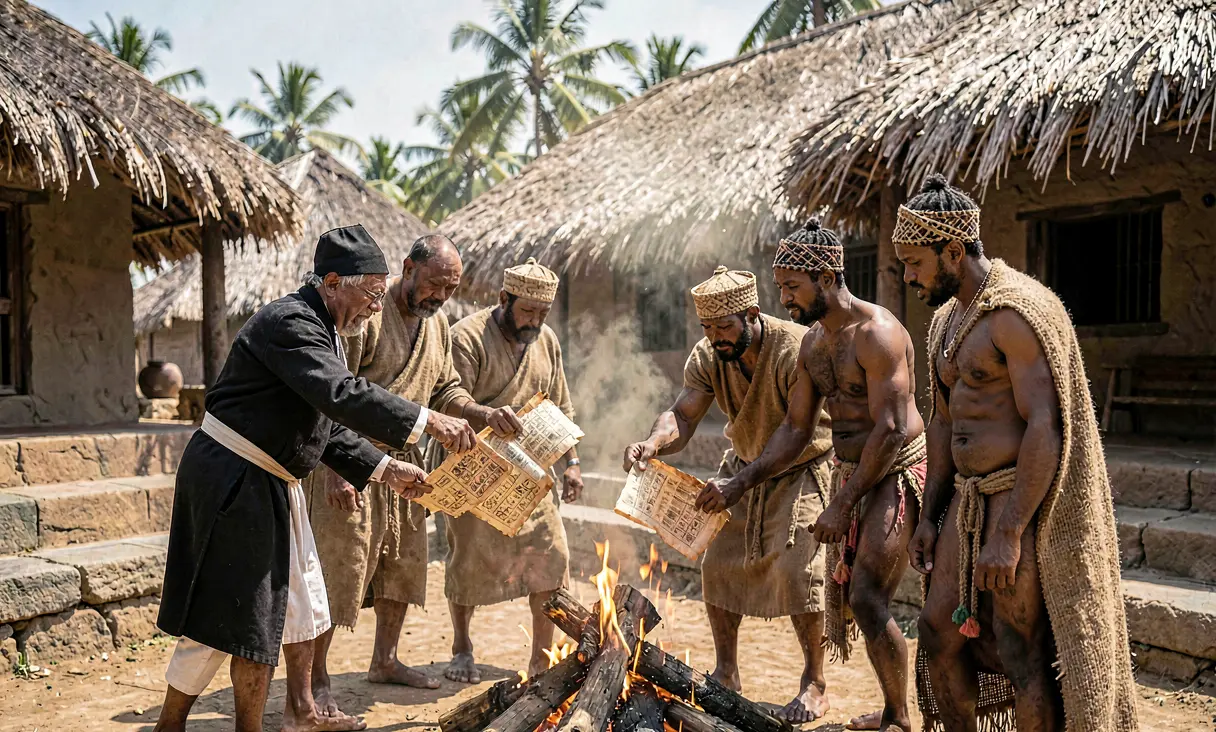 DisasterDestruction of Maya Codices by Bishop LandaJuly 12, 1562 · Maní, Yucatán, MexicoSpanish friars burn nearly all surviving Maya books in a purge of idolatry.
 DisasterGreat Fire of LondonSeptember 2, 1666 · London, EnglandCatastrophic fire destroys medieval London, leading to major urban reconstruction.
 DisasterLisbon Earthquake and TsunamiNovember 1, 1755 CE · Lisbon, PortugalMassive quake and fire destroy capital city challenging Enlightenment optimism.
 WarBattle of Talikota and Fall of Vijayanagarac. 1565 CE · Talikota, Karnataka, IndiaThe Deccan Sultanates defeat the Vijayanagara Empire in a decisive battle, leading to the sack of Hampi and the empire's collapse.
 PoliticsFounding of Fatehpur Sikric. 1571 CE · Fatehpur Sikri, Uttar Pradesh, IndiaAkbar establishes Fatehpur Sikri as the new capital of the Mughal Empire to honor his spiritual guide and centralize administration.
 ArtMichelangelo Paints the Last JudgmentNovember 1541 · Vatican City, RomeMichelangelo completes the massive fresco on the altar wall of the Sistine Chapel.
Discussion
Loading…