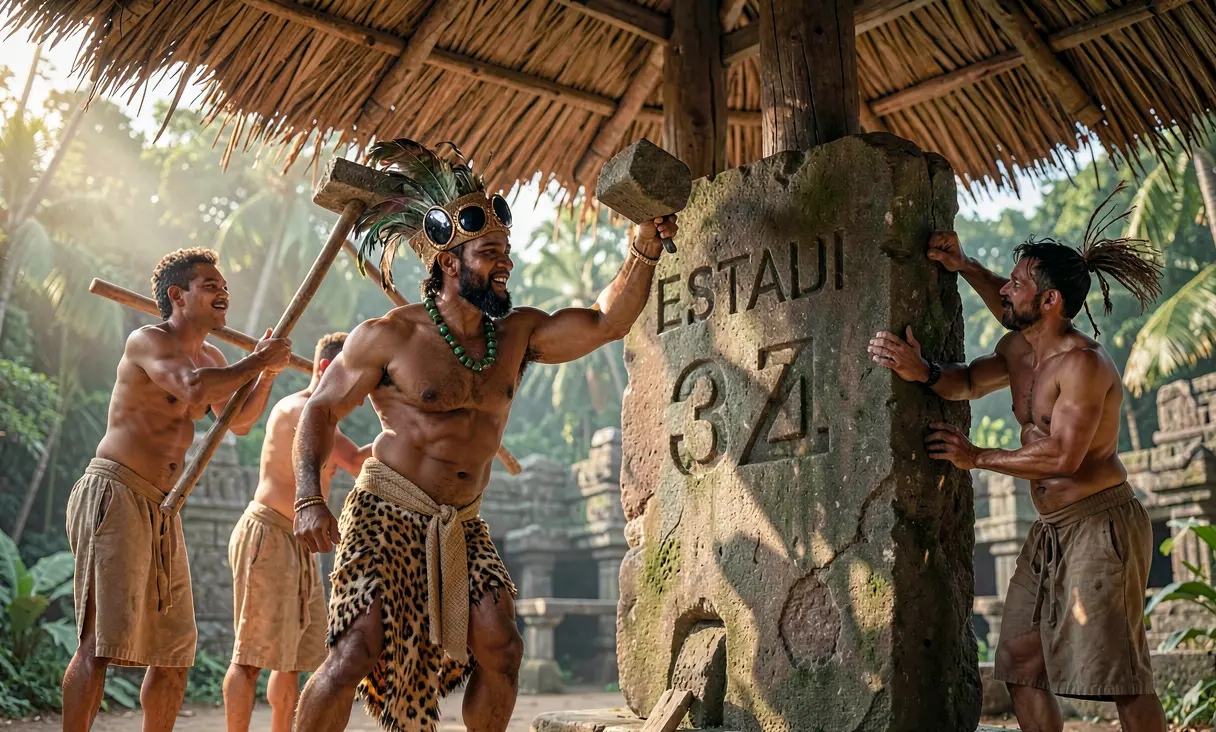
Erection of Stela 31 at Tikal
Stela 31 legitimized Tikal's hybrid Maya-Teotihuacan dynasty, cementing its dominance in the southern lowlands and launching the city's Golden Age of power.
The Teotihuacan Intervention and Political Upheaval
By the late fourth century CE, the Maya lowlands were engulfed in a geopolitical crisis precipitated by the arrival of forces from central Mexico. In 378 CE, a warlord known as Siyaj K'ak' (Born of Fire), likely an envoy or general of the great metropolis Teotihuacan, arrived at Tikal and orchestrated the overthrow of the reigning dynasty, ending the rule of Chak Tok Ich'aak I. This event, often termed the 'Teotihuacan Intervention,' installed a new ruler, Yax Nuun Ayiin I (Spearthrower Owl's son), who claimed lineage from both the local royal house and the distant central Mexican power. For nearly seven decades, Tikal operated under this hybrid political identity, navigating a delicate balance between indigenous Maya traditions and foreign Teotihuacan influence.
The Commissioning of Stela 31
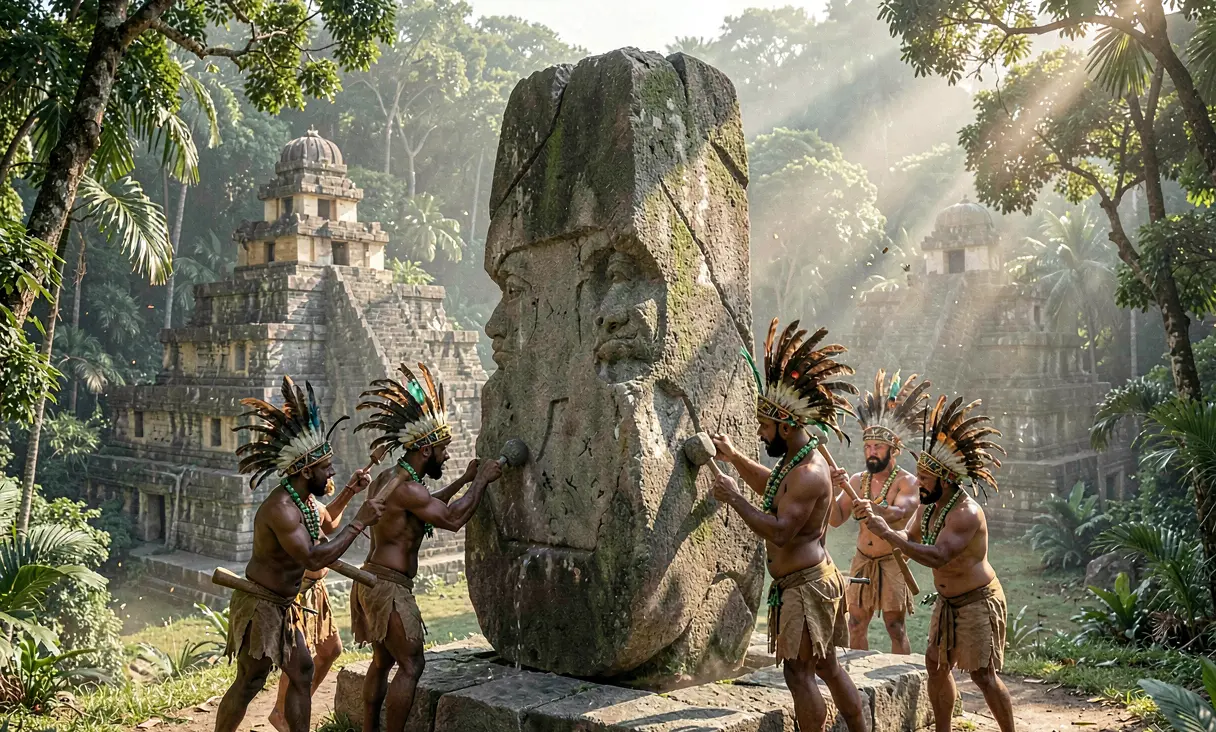
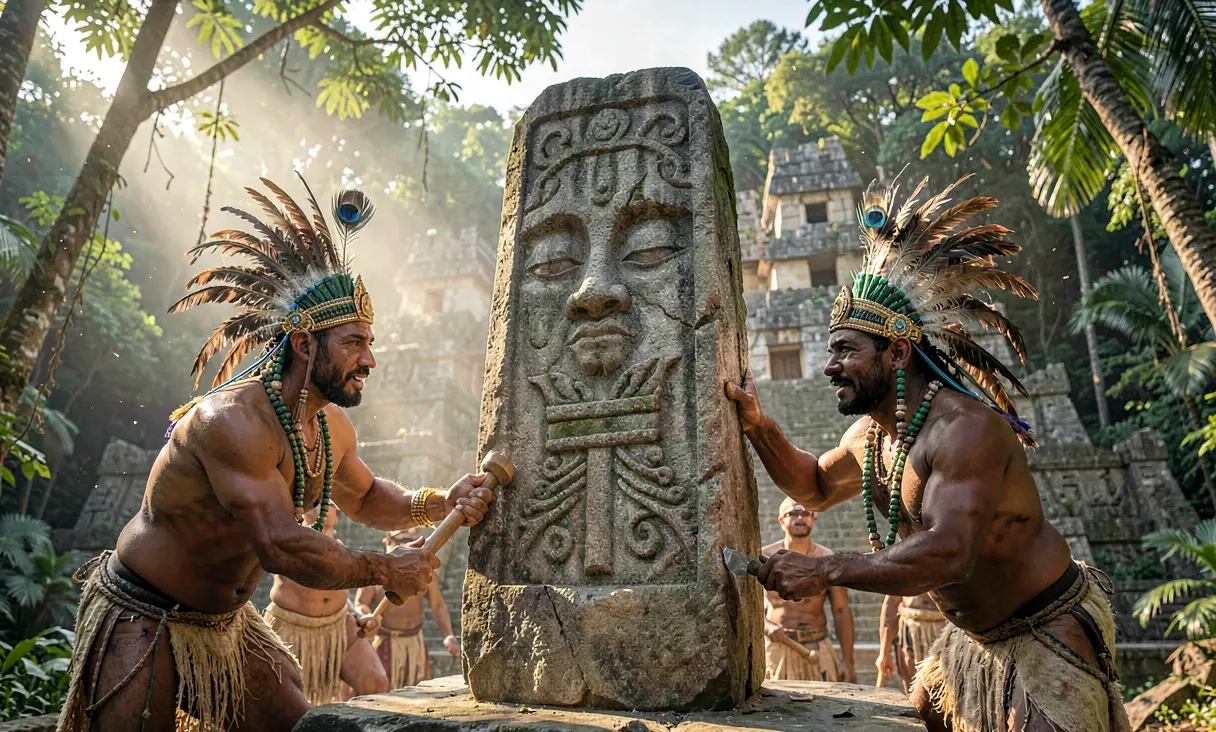
Around 450 CE, Yax Nuun Ayiin I commissioned Stela 31 to legitimize his reign and codify the history of this transformative era. Unlike earlier monuments that adhered strictly to classical Maya stylistic norms, Stela 31 represents a bold artistic synthesis. The stela depicts the king in full regalia, standing atop a captured enemy, yet his attire incorporates distinct Teotihuacan elements such as the talud-tablero architectural motif and specific headdress styles associated with central Mexico. This visual language was not merely decorative; it served as a political manifesto, asserting that Tikal's power was derived from a divine mandate that bridged the gap between the Petén basin and the highlands of Central Mexico.
Iconography of Victory and Lineage
The inscriptions on Stela 31 provide critical historical data regarding Tikal's military expansion. The text details the defeat of rival city-states, specifically naming the capture of lords from sites such as Uaxactun and perhaps others in the southern lowlands. Crucially, the monument traces Yax Nuun Ayiin I's genealogy back to Siyaj K'ak', effectively rewriting the dynastic history to present a continuous line of authority that justified his rule despite the violent overthrow of his predecessor. The imagery portrays the king not just as a local chieftain but as a universal ruler, wielding the authority of both the Maya cosmos and the military might of Teotihuacan.
Consolidation of Power in the Southern Lowlands
The erection of Stela 31 marked the culmination of a seventy-year process of consolidation following the initial intervention. By 450 CE, Yax Nuun Ayiin I had successfully integrated the foreign influence into a distinctively Tikal identity, transforming the city into the undisputed hegemon of the southern lowlands. The stela served as a public declaration that the era of instability was over and that Tikal now commanded a vast network of vassals and allies. This period saw the standardization of administrative practices and the expansion of trade routes, securing the flow of obsidian, jade, and cacao that fueled the city's economic engine.
The Dawn of the Classic Golden Age
The political stability heralded by Stela 31 paved the way for Tikal's 'Golden Age,' a period of unprecedented architectural and demographic growth. Following this era, Tikal would engage in centuries of intense rivalry with its northern neighbor, Calakmul, leading to the famous 'Star War' conflicts that defined the late Classic period. However, the foundations laid by Yax Nuun Ayiin I allowed Tikal to survive these existential threats. The city's ability to project power through monumental art and military force, as codified on Stela 31, became the template for Maya statecraft for generations.
Legacy of Hybrid Identity
Stela 31 remains one of the most significant artifacts in Mesoamerican history, offering a rare glimpse into the complex interplay between local traditions and external influences. It stands as a testament to the adaptability of Maya civilization, which absorbed foreign elements without losing its core identity. The monument's survival allows modern historians to reconstruct the narrative of the Teotihuacan intervention with remarkable clarity, challenging earlier notions of isolated city-states and revealing a dynamic, interconnected political landscape that spanned from the Gulf Coast to the Pacific.
It documents the rise of Tikal as a major military power through strategic alliances.
Where it happened
Tikal, Guatemala — see it on the interactive map →
Explore related history
 PoliticsFounding of Dur-Sharrukin by Sargon IIc. 717 BCE · Khorsabad (Dur-Sharrukin), IraqSargon II builds a new capital city to project Assyrian power and administrative control.
 PoliticsReign of Emperor Taizong and the Zhenguan Era626 CE · Chang'an, ChinaLi Shimin ascends the throne after the Xuanwu Gate Incident, ushering in a golden age of governance.
 PoliticsRise of the Sixteen Mahajanapadasc. 600 BCE · Gangetic Plain (modern Uttar Pradesh/India)Sixteen great kingdoms and republics emerge across the Gangetic plain, marking the transition from tribal chiefdoms to state-level societies.
 architectureConstruction of the Parthenon Begins447 BCE · Athens Acropolis, GreecePericles commissions the Doric temple dedicated to Athena Parthenos.
 ReligionParinirvana of the Buddhac. 483 BCE · Kushinagar (modern Uttar Pradesh/India)Siddhartha Gautama passes away, entering final Nirvana and leaving his disciples with the Dharma to guide them.
 ReligionFirst Buddhist Council at Rajgirc. 483 BCE · Rajgir (modern Bihar/India)Monks gather to recite and codify the Buddha's teachings after his death, preserving the Dharma for future generations.
Discussion
Loading…