
Raden Wijaya Founding of Majapahit Empire
In 1293, Raden Wijaya outmaneuvered both a Javanese usurper and Kublai Khan's Mongol invasion to establish Majapahit, creating Indonesia's last great Hindu-Buddhist empire.
The Collapse of Singhasari and the Mongol Threat
By the late 13th century, the political landscape of Java was in turmoil. The Kingdom of Singhasari, which had risen to prominence under Kertanagara, faced a catastrophic internal betrayal in 1292 when Jayakatwang, the ruler of Kediri and a former vassal, launched a surprise attack on the capital. Kertanagara was killed, and his son-in-law, Raden Wijaya, narrowly escaped execution by fleeing into the dense forests of North Java. Simultaneously, the Yuan Dynasty under Kublai Khan had dispatched a massive naval expedition to punish Kertanagara for refusing tribute. The Mongol fleet, commanded by generals Shi Bi, Gao Xing, and Yisihai, arrived in early 1293 with an army estimated at over 20,000 men, expecting to find a defeated kingdom they could easily subjugate.
The Unlikely Alliance
Raden Wijaya seized upon the Mongol presence not as an occupation force, but as a strategic instrument for his own restoration. Emerging from hiding, he approached the Yuan commanders with a proposition: he would guide them to Jayakatwang's stronghold in exchange for their military support and recognition of his sovereignty over the remnants of Singhasari. The Mongols, eager to secure a foothold in Java and fulfill Kublai Khan's mandate, agreed to this temporary alliance. Wijaya provided local intelligence and logistical support, leading the Yuan-Javanese coalition on a grueling march toward Kediri. In April 1293, the combined forces decisively defeated Jayakatwang, capturing the usurper and effectively ending his short-lived regime.
The Betrayal at Bubat
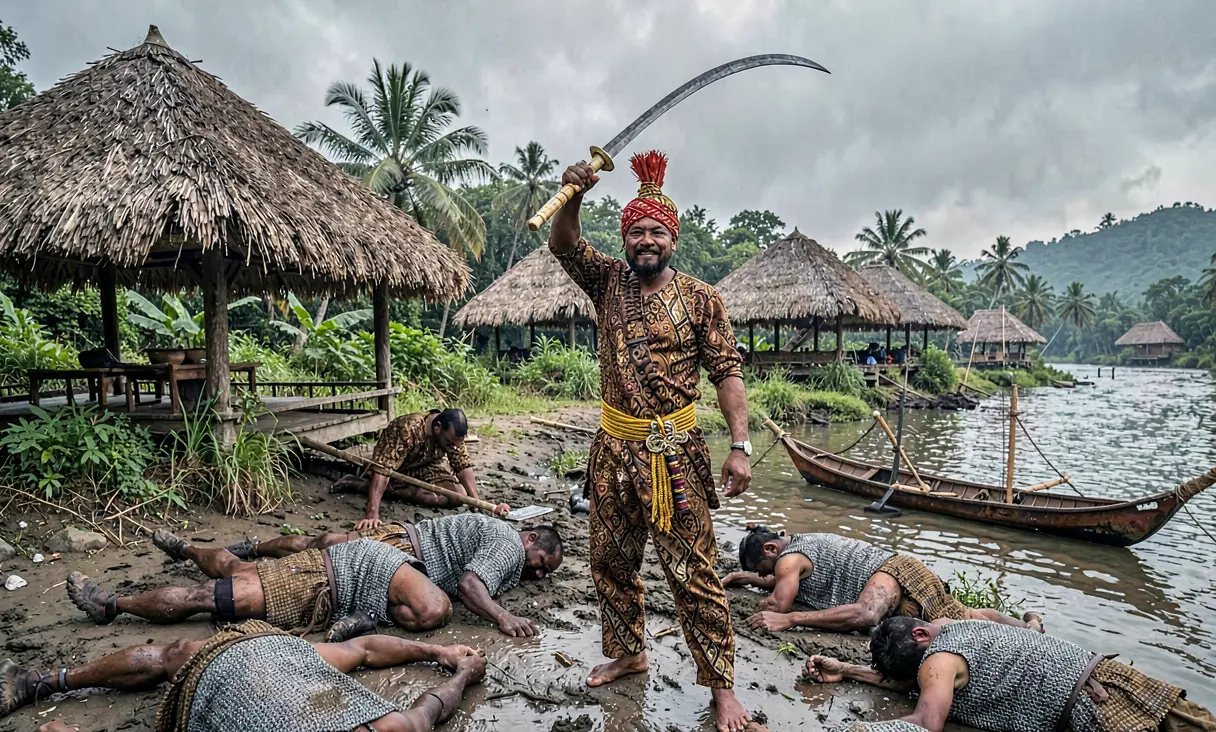
With Jayakatwang vanquished, Raden Wijaya's true political acumen was revealed. He immediately pivoted from ally to adversary against the Mongol occupiers. Citing a need to gather tribute and resources for the Yuan court, he requested permission to return to his base in Majapahit, a village in the Brantas River valley, to prepare the necessary goods. The Mongol commanders, wary but confident in their military superiority, granted him leave, expecting a compliant vassal. However, Wijaya used this interval to mobilize his own forces and set an ambush. As the Yuan troops advanced toward Majapahit to collect the tribute, they were lured into a trap. In a sudden and brutal engagement, Wijaya's army decimated the Mongol forces, forcing the survivors to retreat to their ships and sail back to China within weeks of their arrival.
Founding of Majapahit
Following the expulsion of the Yuan expeditionary force in late 1293, Raden Wijaya formally established his new capital at Trowulan. He adopted the regnal name Kertarajasa Jayawardhana, symbolizing a synthesis of his lineage and the legitimacy he claimed from both the Singhasari heritage and his victory over foreign invaders. The site chosen for Majapahit was strategic, located in the fertile Brantas delta which facilitated agriculture and controlled key trade routes between the interior and the sea. Wijaya spent the remainder of his reign consolidating power, suppressing remaining rivals such as Ranggalawe and Sora, and establishing a centralized administration that blended indigenous Javanese traditions with elements of Indianized statecraft.
Consolidation and Imperial Expansion
The immediate aftermath of Wijaya's founding saw the stabilization of Java under a single authority for the first time in decades. While Wijaya himself ruled until 1309, his true legacy was the foundation he laid for the empire's golden age. His successors, particularly his grandson Hayam Wuruk (ruled 1350–1389) and the formidable Prime Minister Gajah Mada, transformed Majapahit from a regional kingdom into a maritime hegemony. Through a series of military campaigns and diplomatic marriages, known as the Palapa Oath, Gajah Mada expanded Majapahit's influence across much of the Indonesian archipelago, claiming suzerainty over territories ranging from Sumatra to New Guinea.
Legacy and National Identity
The founding of Majapahit in 1293 marks a pivotal turning point in Southeast Asian history. It represents the zenith of Hindu-Buddhist civilization in Indonesia before the eventual rise of Islamic sultanates and European colonial powers. The empire's sophisticated bureaucracy, its vast trade networks, and its cultural synthesis are immortalized in the *Nagarakretagama*, an epic poem written by Prapanca that details the grandeur of Hayam Wuruk's court. In modern times, Majapahit serves as a potent symbol of Indonesian unity and sovereignty. The state philosophy of Pancasila and the national motto 'Bhinneka Tunggal Ika' (Unity in Diversity) are often traced back to the pluralistic and tolerant ethos that characterized the Majapahit era.
Wijaya's expulsion of the Mongols established a powerful indigenous empire that unified the Indonesian archipelago under a single political banner for the first time.

Where it happened
Trowulan, Java, Indonesia — see it on the interactive map →
Explore related history
 PoliticsSargon of Akkad Establishes the First Empirec. 2334 BCE · Akkad (Location uncertain, near Baghdad, Iraq)Sargon unifies Sumerian city-states to create the world's first multi-ethnic empire.
 PoliticsPromulgation of the Code of Ur-Nammuc. 2100 BCE · Ur, Southern Mesopotamia (Iraq)The earliest known surviving law code is established in the Sumerian city of Ur.
 PoliticsNelson Mandela Elected President of South AfricaApril 27, 1994 · Cape Town, South AfricaSouth Africa holds its first democratic election, ending the apartheid regime and establishing a multiracial government.
 WarDai Viet Repels Third Mongol Invasion1288 CE · Bach Dang River, VietnamTran Hung Dao defeats the Mongol fleet using stakes and tidal knowledge at Bach Dang.
 CivilizationFoundation of Lamu as a Swahili City-Statec. 1300 CE · Lamu, KenyaThe city of Lamu is founded as a major trading port connecting the African interior to the Indian Ocean.
 ArtEstablishment of Lapita Pottery Traditionc. 1300 BCE · New Britain, Papua New GuineaLapita potters develop distinctive dentate-stamped decoration techniques that define their culture.
Discussion
Loading…