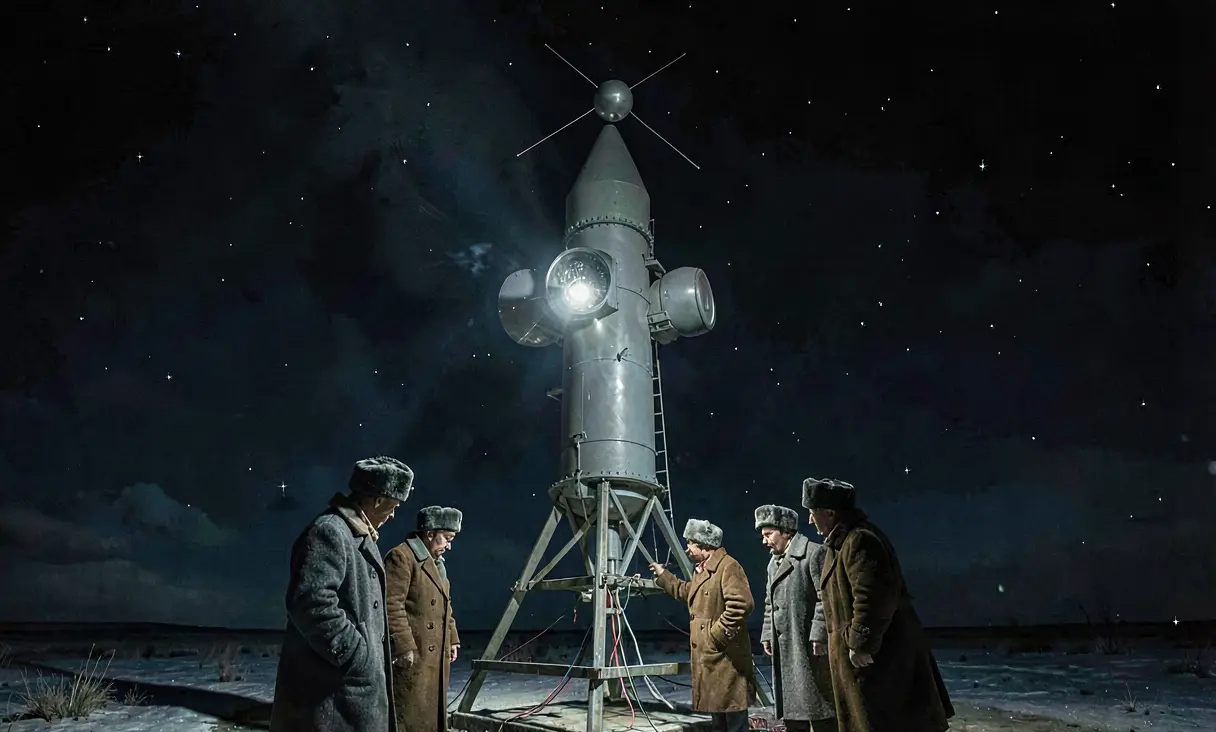
Launch of Sputnik 1
The October 1957 launch of Sputnik 1 shattered American technological supremacy, igniting the Space Race and triggering a global revolution in science, education, and space exploration.
The Geopolitical Tinderbox
By the mid-1950s, the Cold War had solidified into a tense standoff between the United States and the Soviet Union, characterized by ideological rigidity and an accelerating arms race. While both superpowers possessed nuclear capabilities, the strategic advantage lay in the ability to deliver warheads across intercontinental distances. The International Geophysical Year (IGY), scheduled from July 1957 to December 1958, provided a scientific pretext for this competition; both nations had pledged to launch artificial satellites during this period of global cooperation. For the United States, the Vanguard program was the chosen vehicle, a project heavily publicized but plagued by technical delays. Conversely, the Soviet Union, led by Chief Designer Sergei Korolev, operated in secrecy, prioritizing military utility over public relations.
The Architect of the Cosmos
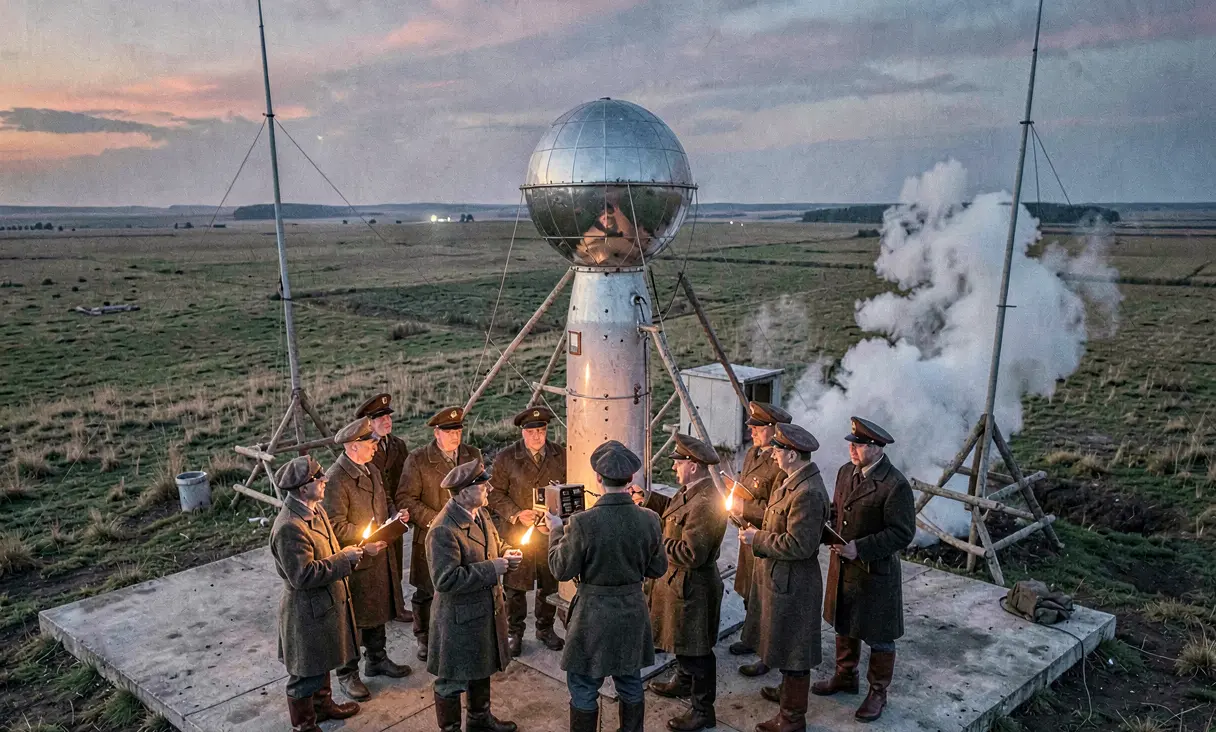
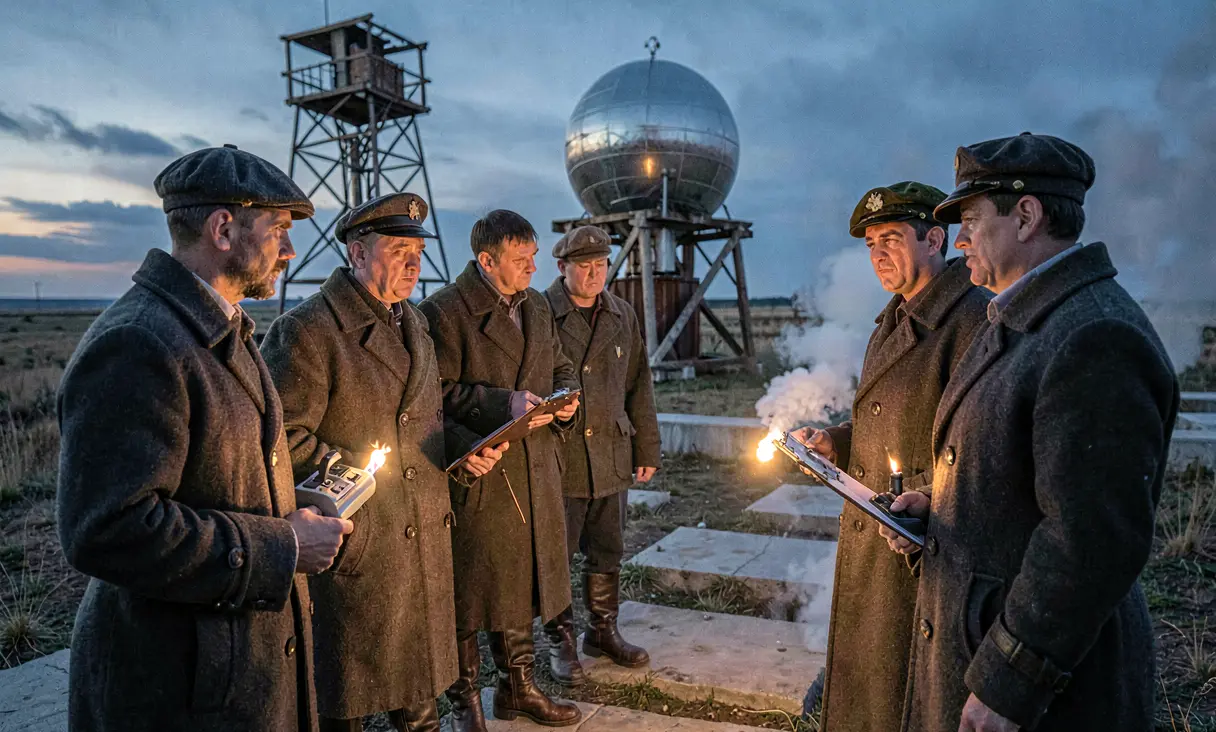
The driving force behind the launch was Sergei Pavlovich Korolev, a brilliant but shadowy figure whose identity remained classified until his death. Having survived the Gulag under Stalin's purges, Korolev emerged as the chief architect of the Soviet space program, adapting the R-7 Semyorka intercontinental ballistic missile (ICBM) for orbital flight. His team at OKB-1 in Kaliningrad (now Korolyov) worked with relentless precision to modify the massive rocket, stripping it of its warhead and attaching a small, spherical payload. The satellite itself was a marvel of minimalist engineering: a polished aluminum sphere 58 centimeters in diameter, weighing 83.6 kilograms, equipped with four whip antennas designed to transmit radio pulses.
Ignition at Baikonur
On the night of October 4, 1957, under a clear sky at the Tyuratam launch site in the Kazakh SSR (later renamed the Baikonur Cosmodrome), the R-7 rocket stood poised for history. The countdown proceeded without major incident, and at 22:28 Moscow Time, the engines ignited, lifting the vehicle into the darkness. The ascent was flawless; the first stage separated as planned, followed by the second, placing the satellite into a highly elliptical orbit with a perigee of 215 kilometers and an apogee of 939 kilometers. Unlike previous suborbital tests, this object did not fall back to Earth immediately but continued its revolution around the planet, completing one orbit every 96 minutes.
The Beep Heard Round the World
As Sputnik 1 circled the globe, it emitted a rhythmic radio signal at frequencies of 20.005 and 40.002 MHz, audible to amateur radio operators worldwide as a steady 'beep-beep' sound. This simple tone carried profound implications: it proved that the Soviet Union possessed not only the theoretical knowledge but the practical engineering capability to launch heavy payloads into orbit. The signal was detectable even by the public in Western nations, shattering the illusion of American technological invincibility. In Washington, D.C., the reaction was immediate and visceral; President Dwight D. Eisenhower was briefed on the success while dining with his family, realizing that the same rocket technology could now deliver nuclear warheads to any point on Earth.
The Sputnik Crisis
The aftermath of the launch triggered a profound psychological and political shockwave in the United States, known as the 'Sputnik Crisis.' American media portrayed the event as a national humiliation, with headlines questioning the competence of U.S. science education and military leadership. The failure of the Vanguard TV3 attempt just weeks later, which exploded on the launch pad amidst global mockery, intensified the panic. In response, the Eisenhower administration overhauled its approach to defense and education, creating the National Aeronautics and Space Administration (NASA) in 1958 and passing the National Defense Education Act to funnel billions into STEM fields. The space race was no longer a scientific curiosity but a central pillar of national security.
A New Era of Exploration
Sputnik 1 remained in orbit for three months, burning up upon re-entry on January 4, 1958, after completing approximately 1,400 revolutions. Its legacy, however, was permanent; it marked the dawn of the Space Age and fundamentally altered human history. The event catalyzed a global surge in scientific investment, leading directly to the Apollo program and the eventual landing on the Moon by Neil Armstrong in 1969. Beyond the geopolitical rivalry, Sputnik demonstrated that humanity could transcend its planetary cradle, opening the door to modern satellite communications, weather forecasting, and deep-space exploration. It remains the singular event where technology irrevocably shifted the balance of power and human destiny.
It marked the beginning of the Space Age and intensified the Cold War competition for technological supremacy.
Where it happened
Baikonur Cosmodrome, Kazakhstan (USSR) — see it on the interactive map →
Explore related history
 TechnologyInvention of the TransistorDecember 23, 1947 · Bell Labs, New Jersey, USAScientists create the transistor, enabling modern electronics and computing.
 ScienceDiscovery of DNA StructureFebruary 28, 1953 CE · Cambridge, EnglandWatson and Crick identify the double helix structure of DNA revealing genetic code.
 WarAtomic Bombing of HiroshimaAugust 6, 1945 CE · Hiroshima, JapanUS drops the first nuclear weapon on a city, ending WWII and starting the atomic age.
 PoliticsFounding of the United NationsOctober 24, 1945 · San Francisco, USA (Charter signed)UN Charter ratified to prevent future global conflicts and promote cooperation.
Discussion
Loading…