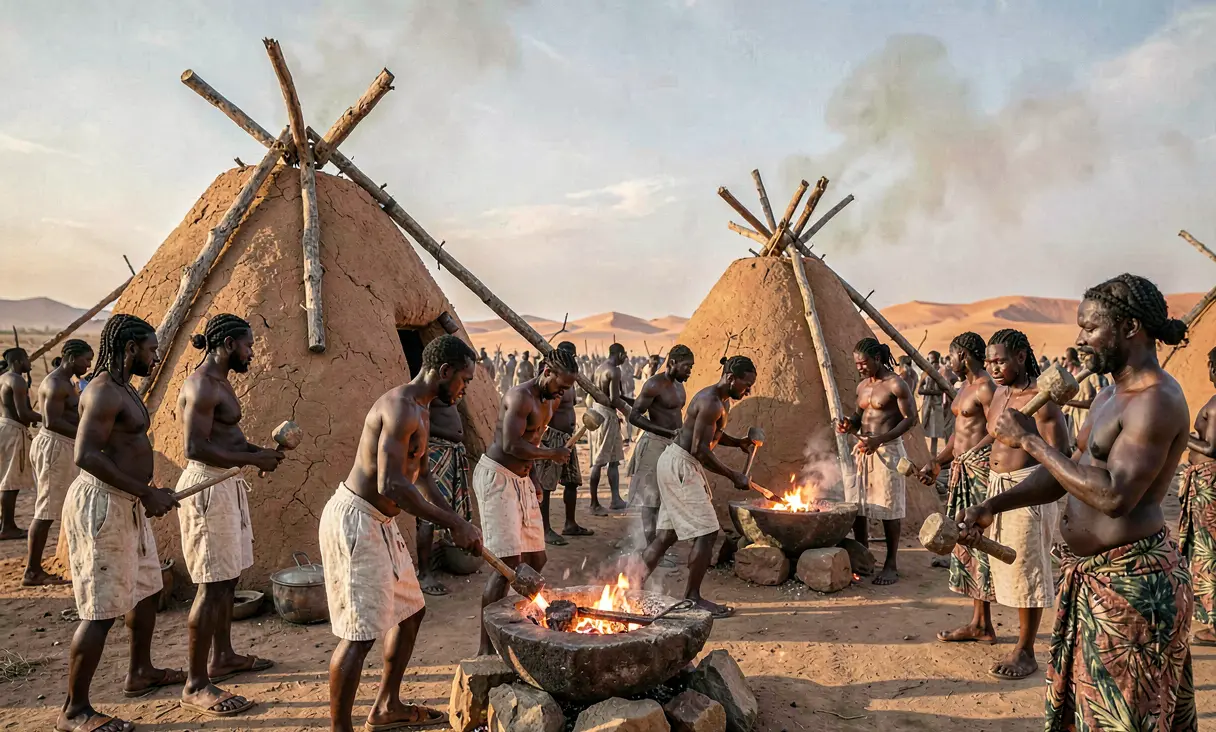
Meroitic Iron Smelting Industry Flourishes
Around 500 BCE, Meroe transformed into a global iron powerhouse using advanced blast furnaces, fueling Kushite military dominance and securing African economic independence from Egypt.
The Rise of the Black Pharaohs
By the mid-first millennium BCE, the Kingdom of Kush had decisively shifted its political and economic center from Napata to Meroe, a location strategically situated between the Nile's Fifth and Sixth Cataracts. This migration was not merely administrative but industrial; Meroe offered abundant deposits of iron ore, vast acacia forests for charcoal production, and favorable trade winds that facilitated commerce with the Red Sea and the interior of Africa. Unlike its predecessor in Napata, which remained culturally tethered to Egyptian traditions, Meroe began to cultivate a distinct identity rooted in local resources and technological innovation. The kingdom's rulers, often referred to by Greek historians as 'Ethiopian' kings, sought to break Egypt's long-standing monopoly on high-value metal goods, setting the stage for an industrial revolution that would redefine African geopolitics.
Technological Mastery and Blast Furnaces
The cornerstone of Meroitic prosperity was its mastery of iron smelting, a process that reached unprecedented scales around 500 BCE. Archaeological excavations at sites such as Begrawiya North and the industrial zones surrounding the royal city have uncovered massive slag heaps covering hectares, evidence of continuous, high-volume production. The Meroites utilized advanced forced-draft blast furnaces, constructed from clay and stone, which could reach temperatures sufficient to produce liquid iron or high-quality wrought iron directly. These furnaces were fed by charcoal derived from the dense acacia woodlands that once blanketed the region, a resource so heavily exploited that historical geologists suggest it contributed significantly to local deforestation. The resulting metallurgy was not merely functional; Meroitic smiths produced tools and weapons of superior hardness and durability compared to many contemporary Mediterranean counterparts.
The Scale of Industrial Output
By 500 BCE, the iron industry at Meroe had evolved from a craft guild into a state-sponsored industrial complex. The sheer volume of waste material—slag—found in the region indicates that production was measured in tons rather than pounds, suggesting an output capable of supplying entire armies and supporting a robust export economy. This industrial capacity allowed Kush to equip its military forces with standardized iron weaponry, including spears, daggers, and axes, providing a tactical advantage over neighbors who still relied heavily on bronze or stone tools. The economic implications were profound; Meroe became the primary supplier of iron goods for the African interior and the Red Sea trade networks, effectively creating an economic independence from Egypt that had dominated the region for centuries.
Military Expansion and Economic Sovereignty
The proliferation of iron technology directly fueled the military ambitions of the Meroitic kings. With a steady supply of durable weapons, Kushite armies were able to project power southward into the Blue Nile region and maintain a formidable defensive posture against northern threats, including the Ptolemaic Kingdom of Egypt. The wealth generated from iron exports funded the construction of monumental architecture, including the distinctive Nubian pyramids that still dot the landscape today, and supported a complex bureaucracy. This era marked a definitive shift in the balance of power; where Egypt had once been the sole source of advanced metallurgy in Northeast Africa, Meroe now stood as a rival superpower, its economy no longer dependent on Nile Valley tribute but driven by indigenous industrial might.
Legacy and Environmental Cost
The Meroitic iron industry remained the engine of the kingdom's power for nearly six centuries, until the rise of Aksumite Ethiopia in the 4th century CE eventually led to its decline. The legacy of this industrial boom is etched into the Sudanese landscape, where the ruins of ancient furnaces and mountains of vitrified slag serve as silent testaments to a lost age of African engineering. However, the environmental cost was severe; the relentless demand for charcoal likely accelerated desertification in the region, contributing to the eventual ecological fragility that would later plague Meroe. Despite this, the period around 500 BCE stands as a high point of pre-colonial African technological achievement, challenging historical narratives that often overlook the sophistication of ancient sub-Saharan civilizations.
Global Significance
In the broader context of world history, the flourishing of Meroitic iron smelting represents a critical node in the global diffusion of metallurgical technology. While Europe was transitioning from the Bronze Age to the Iron Age, and China was refining its own cast-iron techniques, Meroe operated a unique industrial model that combined local resource abundance with advanced furnace design. This era demonstrates that the Industrial Revolution was not a singular European phenomenon but a series of parallel developments across different cultures. The Meroitic example proves that by 500 BCE, Africa possessed the capacity for large-scale manufacturing and international trade, fundamentally altering our understanding of ancient economic networks and technological parity.
Established Meroe as a major center of industrial iron production that predated similar developments elsewhere.
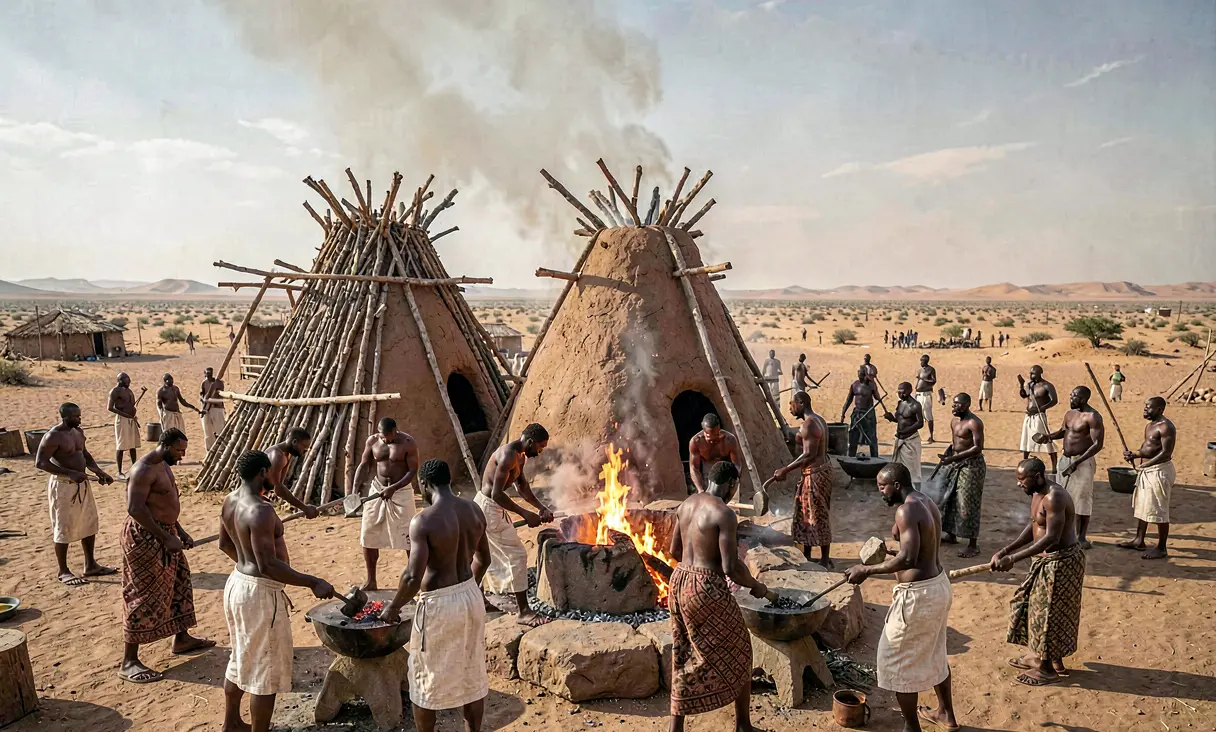

Where it happened
Meroe, Sudan — see it on the interactive map →
Explore related history
 TechnologyGrand Canal of China Connects North and South610 CE · Luoyang to Hangzhou, ChinaEmperor Yang completes the massive waterway linking the Yellow and Yangtze rivers for transport and grain.
 TechnologyConstruction of the Great Cloaca Maxima in Romec. 500 BCE · Rome, ItalyEarly Romans build the massive Cloaca Maxima sewer system to drain marshes and manage waste.
 TechnologyDevelopment of the Polynesian Star Compass Systemc. 500 BCE · Society Islands, French PolynesiaPolynesian navigators memorize star paths to traverse the Pacific without instruments.
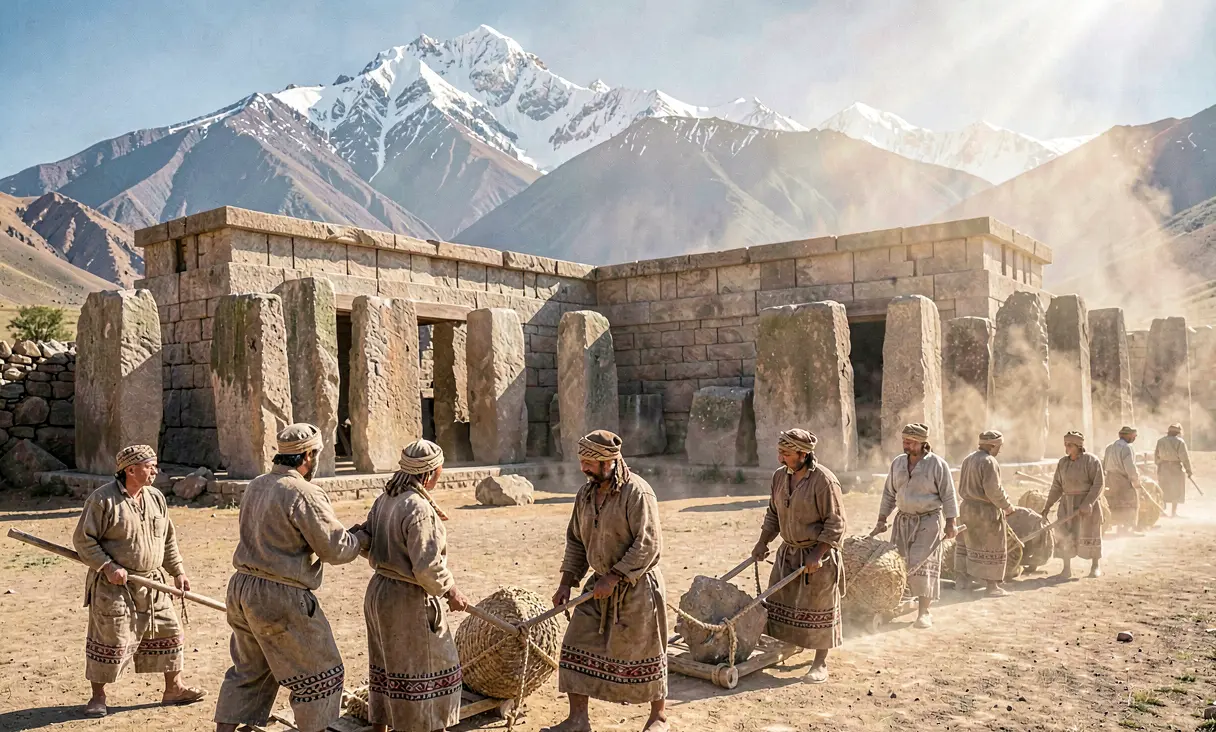 ReligionConstruction of Kalasasaya Temple at Tiwanakuc. 500 CE · Tiwanaku, BoliviaThe Kalasasaya temple is built with monolithic stones for solar observance.
 PoliticsExpulsion of Tarquinius Superbus from Romec. 509 BCE · Rome, Latium (Italy)The Roman monarchy is overthrown, leading to the establishment of the Republic.
 ReligionParinirvana of the Buddhac. 483 BCE · Kushinagar (modern Uttar Pradesh/India)Siddhartha Gautama passes away, entering final Nirvana and leaving his disciples with the Dharma to guide them.
Discussion
Loading…