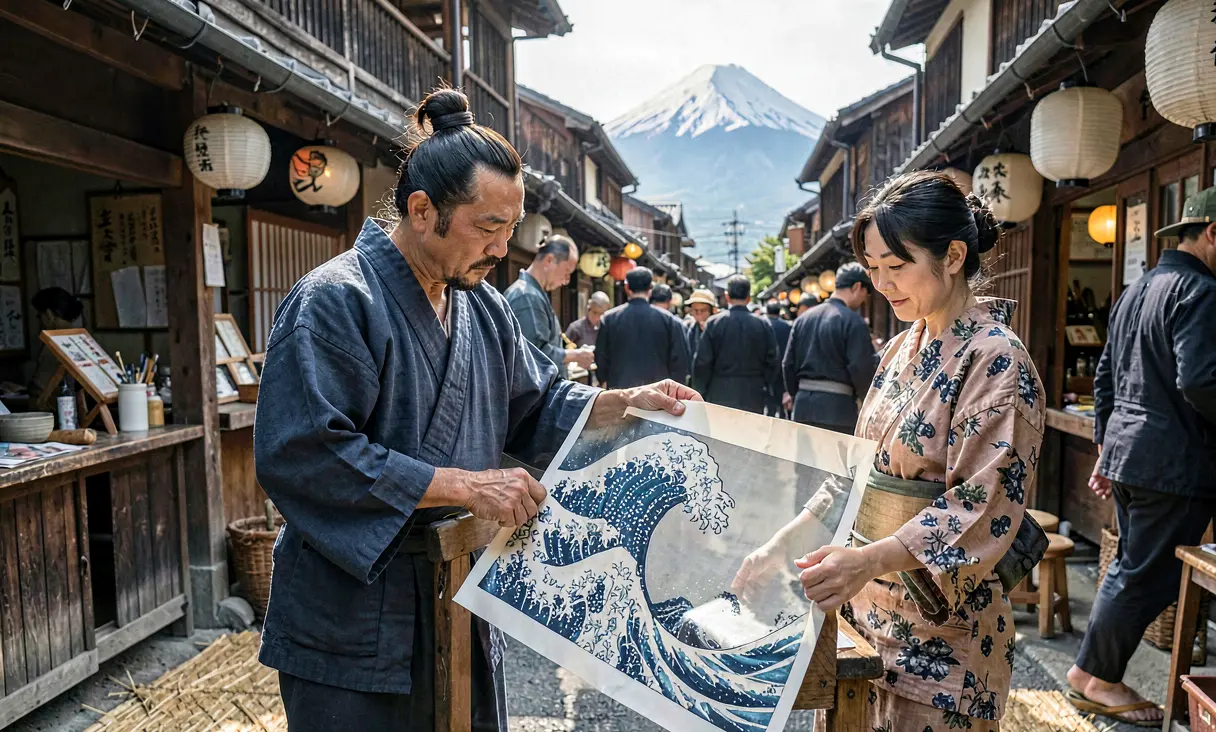
Publication of Hokusai's Great Wave
Hokusai's 1831 masterpiece introduced Prussian blue and radical perspective to Japanese art, becoming a global icon that fundamentally reshaped Western Impressionism.
The Edo Context and the Rise of Ukiyo-e
By the early 19th century, Edo (modern-day Tokyo) had evolved into one of the world's largest cities, boasting a population exceeding one million. The rigid social hierarchy of the Tokugawa shogunate paradoxically fostered a vibrant merchant class with disposable income and a hunger for cultural expression. This era, known as the Bakumatsu period's precursor, saw the flourishing of *ukiyo-e*, or 'pictures of the floating world,' a genre dedicated to capturing ephemeral pleasures: kabuki actors, courtesans, and travel scenes. While woodblock printing had existed for centuries, it was during this time that the medium matured into a sophisticated collaborative art form involving the publisher (*hanmoto*), the artist (*eshi*), the carver (*horishi*), and the printer (*surishi*).
The Commission: Thirty-Six Views of Mount Fuji
Around 1830 or 1831, the publisher Nishimuraya Yohachi commissioned Katsushika Hokusai to create a series of landscape prints. This was a novel concept at the time; while landscapes existed in Japanese art, they were typically secondary to human subjects. The resulting series, *Thirty-Six Views of Mount Fuji* (Fugaku sanjūrokkei), aimed to depict Japan's most sacred mountain from various vantage points and seasons. Hokusai, then in his early seventies, approached the project with a renewed vigor that would define the final decade of his life. The series was an immediate commercial success, prompting the addition of ten extra prints to reach a total of forty-six, though the core thirty-six remain the most celebrated.
The Event: Printing The Great Wave
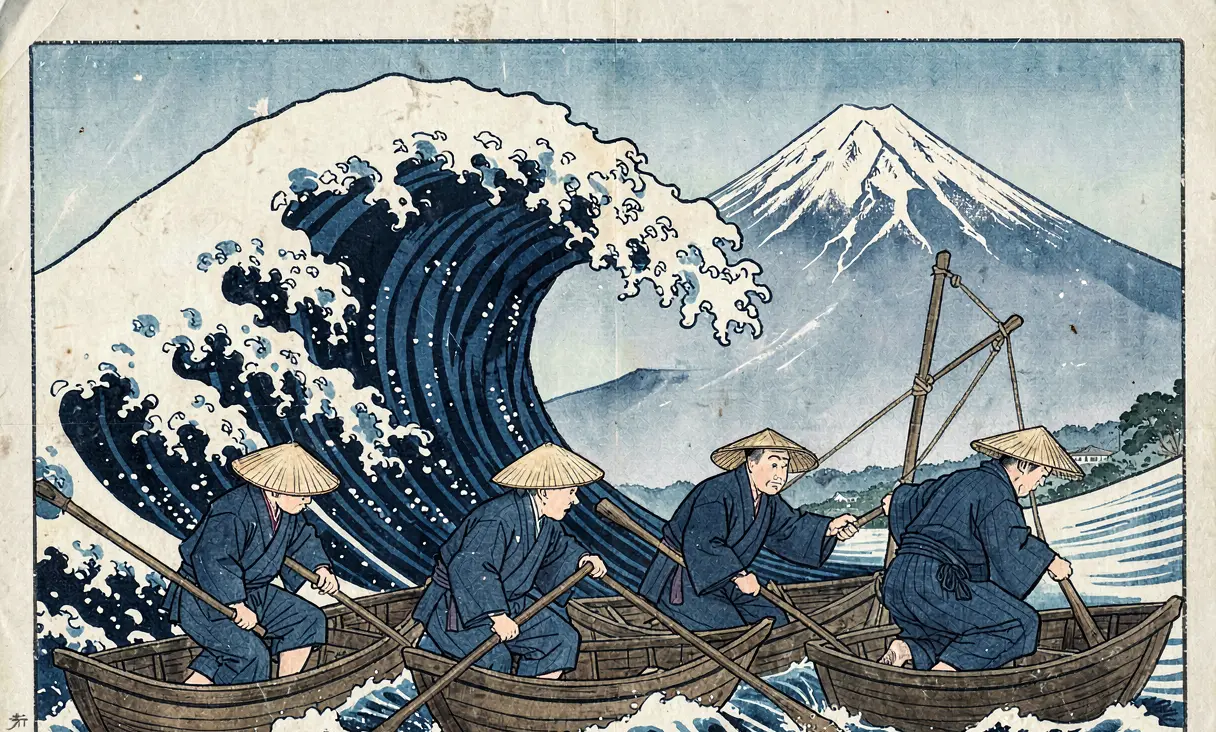
Among these prints, *Under the Wave off Kanagawa* (Kanagawa-oki nami ura), popularly known as 'The Great Wave,' emerged as the centerpiece. Produced circa 1831 using the multi-block *nishiki-e* technique, the image depicts three fishing boats from the Sagami Bay region battling a towering, claw-like wave. In the background, the serene, snow-capped cone of Mount Fuji provides a stark contrast to the chaotic foreground. The technical execution was revolutionary; Hokusai utilized up to thirty separate woodblocks for color registration in some prints within the series, but specifically for this image, he leveraged the newly imported Prussian blue (*bero-ai*). This synthetic pigment, derived from iron and cyanide compounds, offered a depth and vibrancy that traditional Japanese indigo could not match.
Artistic Innovation and Symbolism
The composition of *The Great Wave* is a masterclass in dynamic tension. Hokusai employed the Western concept of linear perspective, placing Mount Fuji at the vanishing point to create depth, while the wave's crest mimics the shape of the mountain itself, suggesting nature's cyclical power and the insignificance of humanity against it. The use of Prussian blue was not merely aesthetic; it signaled a shift in Japanese visual culture toward brighter, more durable colors that appealed to the urban populace. The boats, identified as oshiokuri-bune used for transporting live fish, are rendered with precarious realism, their crews crouching low, emphasizing the fragility of human endeavor against the sublime force of the ocean.
Immediate Reception and Circulation
Upon its release in 1831, the print became an instant sensation within Edo. The affordability of woodblock prints meant they were accessible to a broad spectrum of society, from merchants to samurai, democratizing high art. *The Great Wave* was reproduced in vast quantities; while exact numbers are lost to history, it is estimated that hundreds of thousands of impressions were made over the following decades. Unlike unique paintings, these prints could be mass-produced, allowing Hokusai's vision to permeate the daily lives of Edo citizens. The image appeared on everything from souvenir postcards to decorative screens, cementing its status as a cultural icon within Japan long before it crossed international borders.
Global Legacy and Influence on Western Art
The true global impact of *The Great Wave* occurred decades later when Japanese art began flooding into Europe following the opening of Japan in 1853. French Impressionists and Post-Impressionists, including Vincent van Gogh, Claude Monet, and Edgar Degas, were captivated by the bold outlines, flattened perspectives, and vivid colors of *ukiyo-e*. Van Gogh famously copied the wave and the surrounding sea grasses in his own work, while Monet collected Japanese prints and incorporated their compositional techniques into his series paintings. The image became a symbol of Japonisme, fundamentally altering the trajectory of modern Western art by challenging academic conventions of realism and perspective.
Enduring Significance
Today, *The Great Wave off Kanagawa* remains arguably the most recognizable Japanese artwork in history. It transcends its origins as a commercial print to serve as a universal symbol of nature's power and human resilience. Museums such as the British Museum, the Metropolitan Museum of Art, and the Tokyo National Museum hold original impressions that continue to draw millions of visitors annually. Its influence extends beyond fine art into popular culture, appearing on everything from album covers to merchandise, ensuring that Hokusai's vision of the 1830s remains a living part of the global consciousness.
The Great Wave is one of the most recognizable works of art globally, symbolizing the power of nature and Japanese aesthetics.
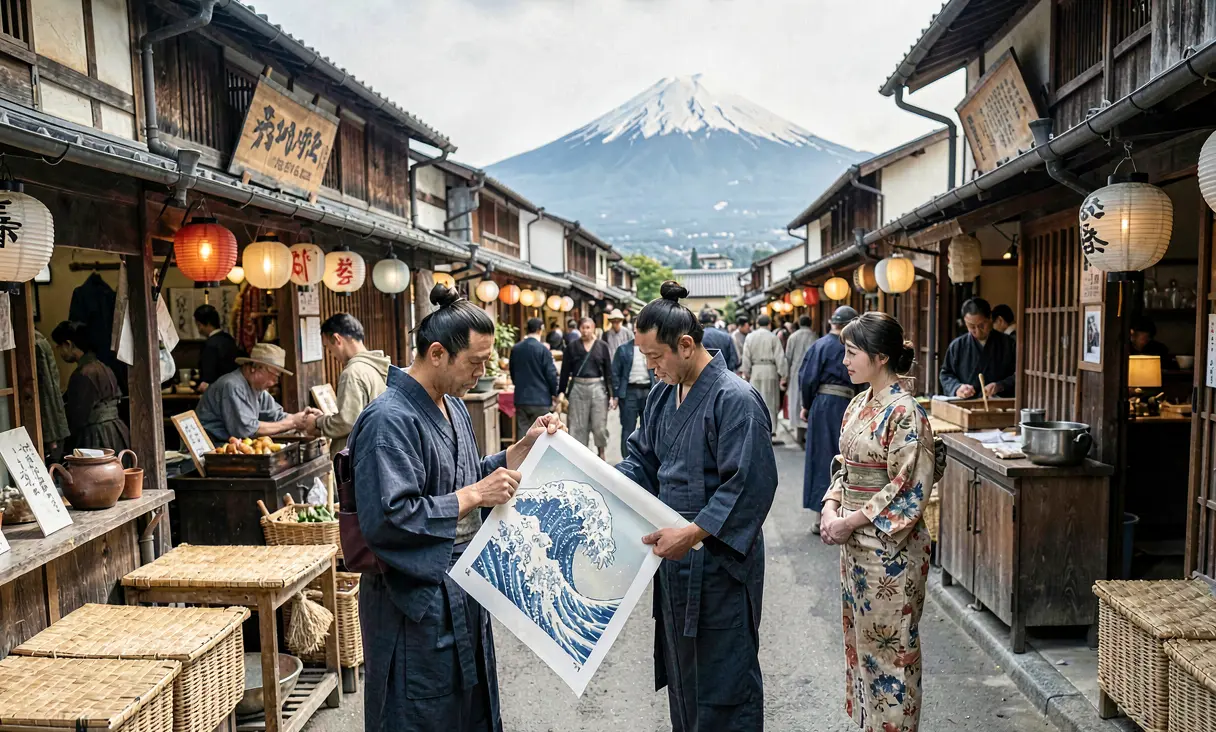
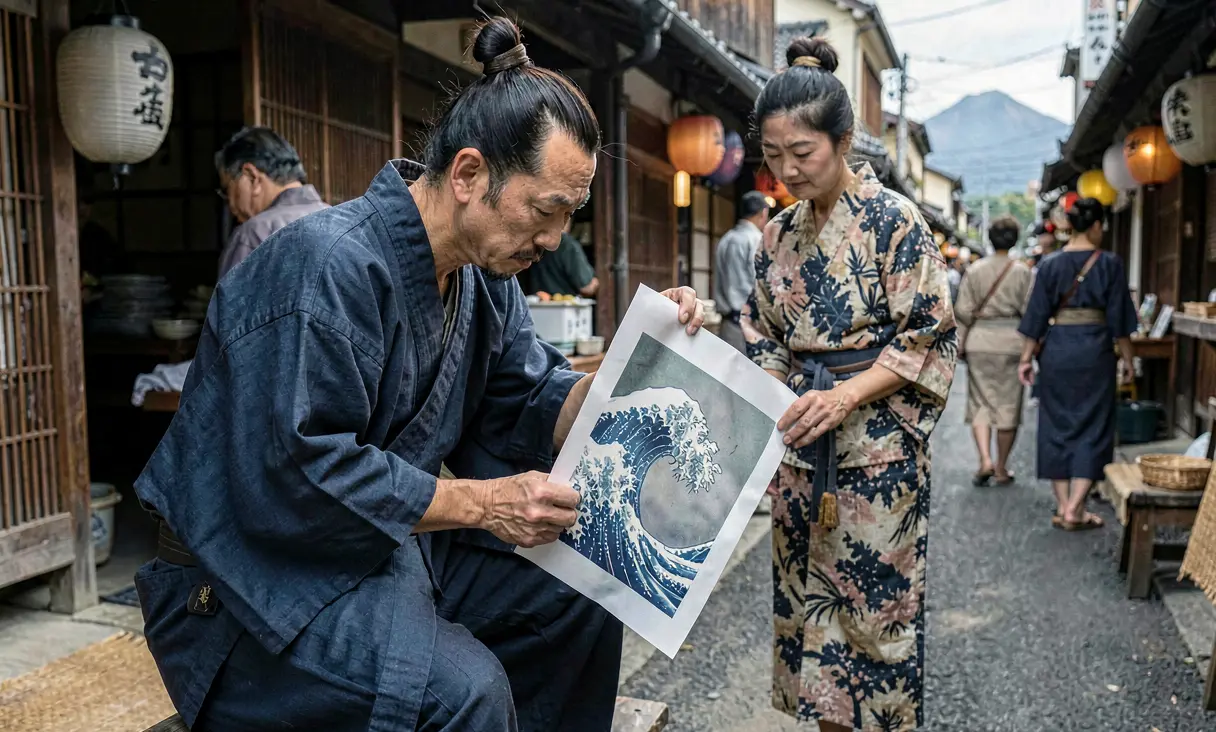
Where it happened
Edo (Tokyo), Japan — see it on the interactive map →
Explore related history
 ArtCreation of The Great Wave off Kanagawac. 1831 CE · Kanagawa, JapanHokusai produces iconic woodblock print influencing Western art movements.
 ArtCreation of The Starry NightJune 1889 · Saint-Rémy-de-Provence, FranceVincent van Gogh paints his most famous masterpiece from an asylum window.
 ArtFounding of the Bengal School of Artc. 1905 CE · Calcutta (Kolkata), IndiaAbanindranath Tagore pioneers a new indigenous Indian art style.
 WarFirst Opium War BeginsSeptember 4, 1839 · Guangzhou, ChinaBritain forces open Chinese trade via war, beginning the Century of Humiliation.
 WarBattle of WaterlooJune 18, 1815 · Waterloo, BelgiumNapoleon Bonaparte is defeated, ending the Napoleonic Wars.
 SciencePublication of Origin of SpeciesNovember 24, 1859 CE · London, EnglandCharles Darwin proposes natural selection as the mechanism for evolution of life.
Discussion
Loading…