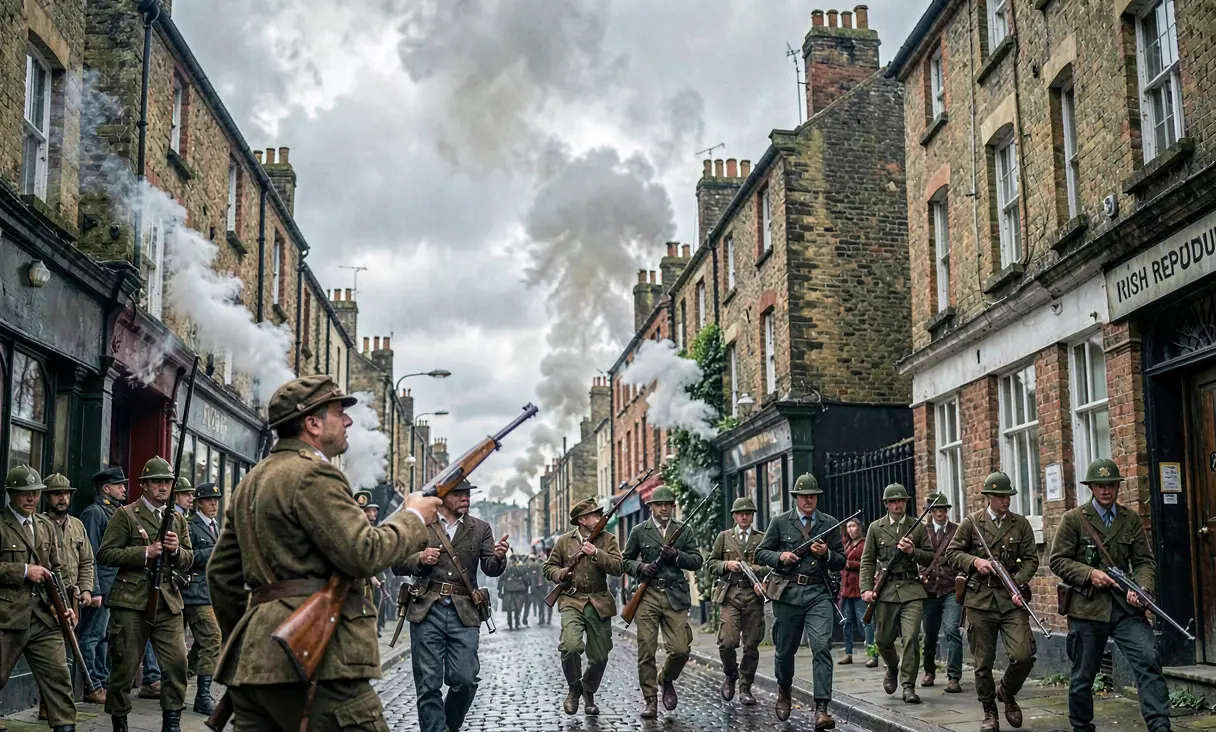
Easter Rising in Ireland
The 1916 Easter Rising was a failed military insurrection that, through the British execution of its leaders, ignited Irish nationalism and directly catalyzed the War of Independence.
The Shadow of War and the Quest for Sovereignty
By 1916, Ireland was a nation fractured by the Great War. While thousands of Irishmen fought alongside British forces on the Western Front under the banner of Home Rule, a radical minority within the Irish Republican Brotherhood (IRB) viewed the global conflict as 'England's difficulty is Ireland's opportunity.' The IRB, operating in secrecy since 1858, had long plotted an armed insurrection to end British rule. They were joined by the Irish Volunteers and the women's paramilitary group Cumann na mBan, alongside the socialist Irish Citizen Army led by James Connolly. Tensions reached a breaking point when the original plan for an Easter Monday uprising was compromised; Eoin MacNeill, the chief of staff of the Irish Volunteers, issued a countermanding order upon learning that German arms shipments had been intercepted and that the British were aware of the plot. Despite this, the IRB Military Council, fearing total collapse of their revolutionary momentum, decided to proceed with a scaled-back but symbolically potent rebellion.
The Proclamation of the Irish Republic
On the morning of Monday, April 24, 1916, approximately 1,200 rebels seized strategic locations across Dublin. The centerpiece of their occupation was the General Post Office (GPO) on Sackville Street (now O'Connell Street), which served as the rebel headquarters. There, Patrick Pearse, a poet and educator who had become the movement's spiritual leader, read the Proclamation of the Irish Republic to a gathering crowd. The document, signed by seven men known as the 'Provisional Government,' declared Ireland an independent sovereign nation, appealing to 'the God of our fathers' for support. Simultaneously, other columns occupied key buildings including Jacob's Biscuit Factory, the Four Courts, St Stephen's Green, and Boland's Mill. The rebels faced immediate confusion; many Dubliners initially mistook them for a prank or a military exercise, unaware that they were witnessing the birth of a new republic.
Six Days of Siege and Fire
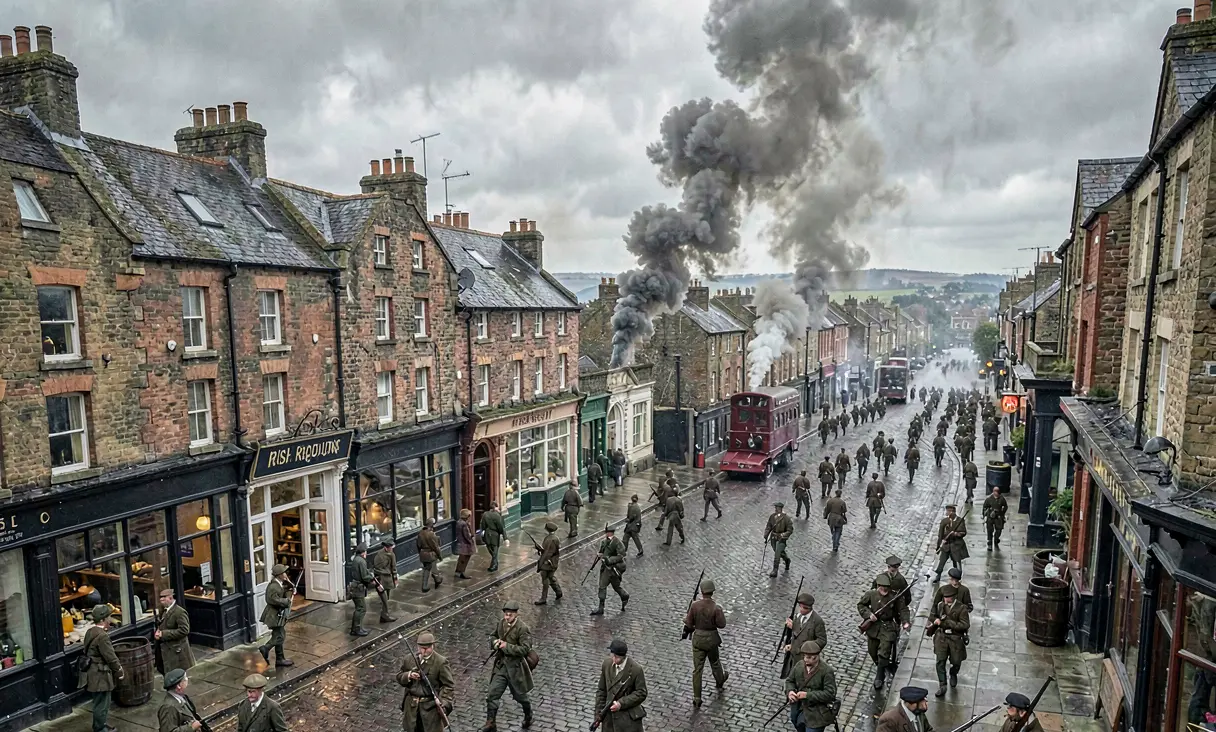
The British response was swift but initially underestimating. The garrison in Dublin, numbering only around 400 regular troops, was quickly reinforced by thousands of soldiers from the Curragh Camp and naval gunboats. By Tuesday, the city had descended into chaos as artillery fire reduced the rebel strongholds to rubble. The Four Courts, held by the Irish Citizen Army under Commandant Thomas MacDonagh, faced heavy shelling, while St Stephen's Green was subjected to sniper fire from British positions in nearby buildings. The most intense fighting occurred at the GPO, where Pearse and Connolly directed operations amidst rising flames and collapsing masonry. For six days, the rebels held their ground against overwhelming odds, utilizing the narrow streets of Dublin as a defensive labyrinth. Casualties mounted on both sides, with over 450 civilians killed, many caught in the crossfire or dying from the fires that swept through the city center.
The Surrender and the Execution
On Saturday, April 29, realizing further resistance would result only in unnecessary slaughter of his men and civilians, Patrick Pearse ordered an unconditional surrender. The rebels marched out of the ruins of the GPO as prisoners of war. In the weeks that followed, a military court-martial was convened to try the leaders. Despite initial public ambivalence or even hostility toward the uprising, the British administration's decision to execute the 15 signatories and other key figures in Kilmainham Gaol between May 3 and May 12 proved catastrophic for their political standing. The executions included Pearse, James Connolly (who was too wounded to stand and was shot while tied to a chair), and Joseph Plunkett. These deaths transformed the rebels from failed insurrectionists into martyrs, galvanizing a public sentiment that had previously been divided.
From Defeat to Revolution
The immediate aftermath of the Rising was marked by mass arrests and the internment of nearly 2,000 men in camps such as Frongoch in Wales, where a 'university of revolution' emerged among the prisoners. However, the political landscape shifted irrevocably. The moderate Irish Parliamentary Party, which had dominated Irish politics for decades, was eclipsed by Sinn Féin, a party that capitalized on the rising nationalist fervor and the memory of the executed leaders. By 1918, Sinn Féin won a landslide victory in the general election, leading to the establishment of the First Dáil Éireann and the declaration of independence that sparked the Irish War of Independence in 1919. The Easter Rising had failed militarily but succeeded politically, proving that armed resistance could alter the course of history.
A Legacy etched in Stone and Memory
Today, the Easter Rising is commemorated as the foundational event of modern Ireland. The ruins of the GPO stand as a permanent monument to the sacrifice made on Sackville Street. The event remains a subject of historical debate regarding its timing, tactics, and the proportionality of the British response, yet its status as a catalyst for Irish sovereignty is undisputed. It marked the definitive end of the era of constitutional nationalism and ushered in the age of revolutionary republicanism that would eventually lead to the establishment of the Irish Free State in 1922 and the Republic of Ireland in 1949. The Proclamation's ideals of equality, liberty, and religious freedom continue to resonate in Irish political discourse, serving as a reminder of the high cost of national self-determination.
The Easter Rising shifted Irish nationalism from constitutional politics to armed struggle, directly leading to the establishment of the Irish Free State.
Where it happened
Dublin, Ireland — see it on the interactive map →
Explore related history
 WarAlgerian War of Independence BeginsNovember 1, 1954 · Algiers, AlgeriaThe National Liberation Front launches coordinated attacks marking the start of the Algerian War against France.
 WarMau Mau Uprising Begins in KenyaOctober 20, 1952 · Nairobi, KenyaThe Kikuyu-led Mau Mau rebellion begins against British colonial rule and white settler land ownership.
 WarTurkish War of Independence BeginsMay 19, 1919 · Samsun, TurkeyMustafa Kemal Atatürk lands in Samsun to organize resistance against Allied occupation and the Ottoman Sultanate.
 PoliticsKorean March First MovementMarch 1, 1919 · Seoul, Korea (under Japanese rule)Mass non-violent protests erupt across Korea demanding independence from Japanese colonial rule.
 PoliticsEgyptian Revolution of 1919March 8, 1919 · Cairo, EgyptMass protests erupt in Egypt demanding an end to British protectorate and full independence.
 WarMexican Revolution BeginsNovember 20, 1910 · Mexico City, MexicoFrancisco I. Madero issues a call to arms against the dictatorship of Porfirio Díaz.
Discussion
Loading…