Invention of the Transistor
On December 23, 1947, Bell Labs scientists invented the transistor, replacing bulky vacuum tubes with tiny solid-state switches and igniting the digital revolution that powers modern civilization.
The Vacuum Tube Era and the Search for Solid-State Solutions
By the mid-20th century, the global electronics landscape was dominated by the vacuum tube, a fragile glass bulb that controlled electron flow through a heated filament. While revolutionary for radio, radar, and early computing, these components were inherently flawed: they consumed vast amounts of power, generated excessive heat, and failed with alarming frequency due to mechanical fragility. The ENIAC computer, completed in 1945, weighed 30 tons and contained over 18,000 vacuum tubes, requiring constant maintenance and a dedicated cooling infrastructure. Bell Telephone Laboratories, the research arm of AT&T, recognized that the future of telecommunications depended on miniaturizing these systems. Physicists at the lab began investigating semiconductors—crystalline materials like germanium whose conductivity could be manipulated—to create a solid-state amplifier that required no warm-up time and possessed near-infinite durability.
The Trio: Bardeen, Brattain, and Shockley
The breakthrough was driven by an unlikely but potent collaboration of three distinct minds within Bell Labs' Solid-State Physics Group. William Shockley, the group leader, was a brilliant theorist with a vision for a field-effect device but struggled to translate his concepts into working hardware. John Bardeen, a theoretical physicist and Nobel laureate in a later year, possessed an uncanny ability to diagnose quantum mechanical failures that stumped others. Walter Brattain, a meticulous experimentalist and skilled craftsman, was the hands-on engineer capable of manipulating microscopic materials with precision. While Shockley initially proposed a field-effect amplifier, his design proved unworkable due to surface states on the semiconductor crystals. It was Bardeen who theorized that these surface charges were trapping electrons, a realization that shifted the team's focus from a pure field effect to a point-contact approach.
The December Breakthrough
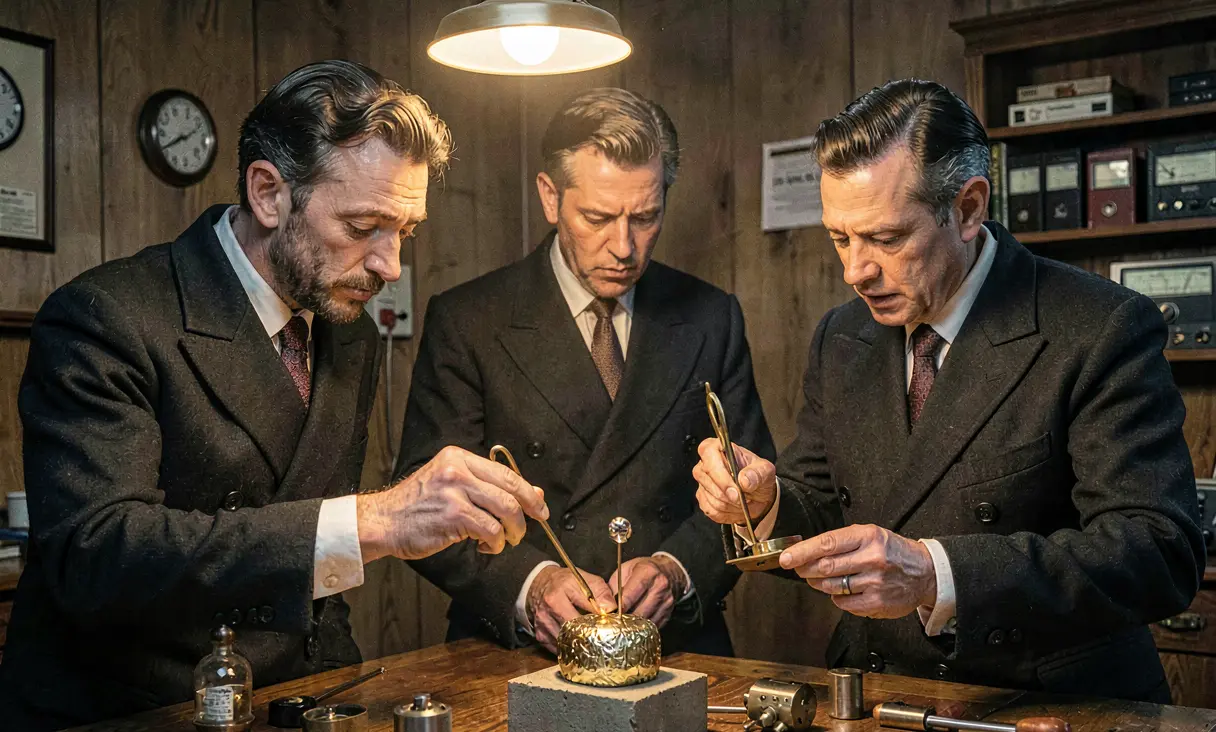
On December 10, 1947, Brattain and Bardeen began constructing a device using a triangular piece of gold foil, which they cut into two closely spaced contacts and pressed against a wedge of germanium. The setup was crude by modern standards, resembling a paperclip attached to a crystal, yet it functioned on principles that defied classical intuition. On December 23, 1947, the team achieved their historic moment: when an alternating current signal was applied to one contact, it emerged from the other with significantly greater amplitude. They had successfully demonstrated amplification without a vacuum or heated filament. The device, which they named the 'transistor' (a portmanteau of 'transfer resistor'), operated by modulating the flow of charge carriers within the solid crystal lattice, proving that a tiny piece of germanium could outperform the massive glass tubes of the past.
From Point-Contact to Planar: The Evolution of Design
The initial point-contact transistor was revolutionary but difficult to manufacture consistently; its performance varied wildly, and the fragile gold contacts often shifted position. Shockley, initially sidelined during the December experiment due to his frustration with Bardeen's surface-state theory, quickly realized the potential of the discovery and raced to develop a more robust design. By 1950, he had invented the junction transistor, which utilized layers of doped semiconductor material rather than external metal contacts. This 'sandwich' structure was far more stable and scalable. The subsequent development of the planar process by Jean Hoerni at Fairchild Semiconductor in 1959 allowed for the mass production of integrated circuits, transforming the transistor from a laboratory curiosity into the ubiquitous component of modern industry.
The Digital Dawn and Global Transformation
The immediate impact was felt first in telecommunications, where transistors replaced vacuum tubes in telephone switching systems, drastically reducing size and energy costs. However, the true explosion occurred in computing. The shift from vacuum tubes to transistors shrank computers from room-sized behemoths to desktop units within a decade, enabling the rise of mainframes, minicomputers, and eventually personal computers. By the 1960s and 70s, the ability to pack millions of transistors onto a single silicon chip led to the microprocessor, the brain of modern society. From the first handheld calculators to the smartphones in our pockets today, every digital interaction is mediated by billions of microscopic switches switching on and off at gigahertz speeds, all tracing their lineage back to that afternoon in December 1947.
A Legacy of Recognition and Unintended Consequences
In 1956, John Bardeen, Walter Brattain, and William Shockley were jointly awarded the Nobel Prize in Physics for their discovery. While the trio shared the honor, historical analysis often highlights the complex interpersonal dynamics that followed; Shockley's later management style at Shockley Semiconductor Laboratory contributed to a brain drain that ironically seeded Silicon Valley as the world's tech capital when his former employees founded Fairchild and Intel. The invention of the transistor is widely regarded as the most significant technological advancement of the 20th century, fundamentally altering human communication, commerce, warfare, and culture. It stands as the cornerstone of the Information Age, a silent engine driving global progress that has reshaped civilization more profoundly than any other single scientific breakthrough in recorded history.
It replaced vacuum tubes as the basis for all modern electronics, enabling the digital revolution.
Where it happened
Bell Labs, New Jersey, USA — see it on the interactive map →
Explore related history
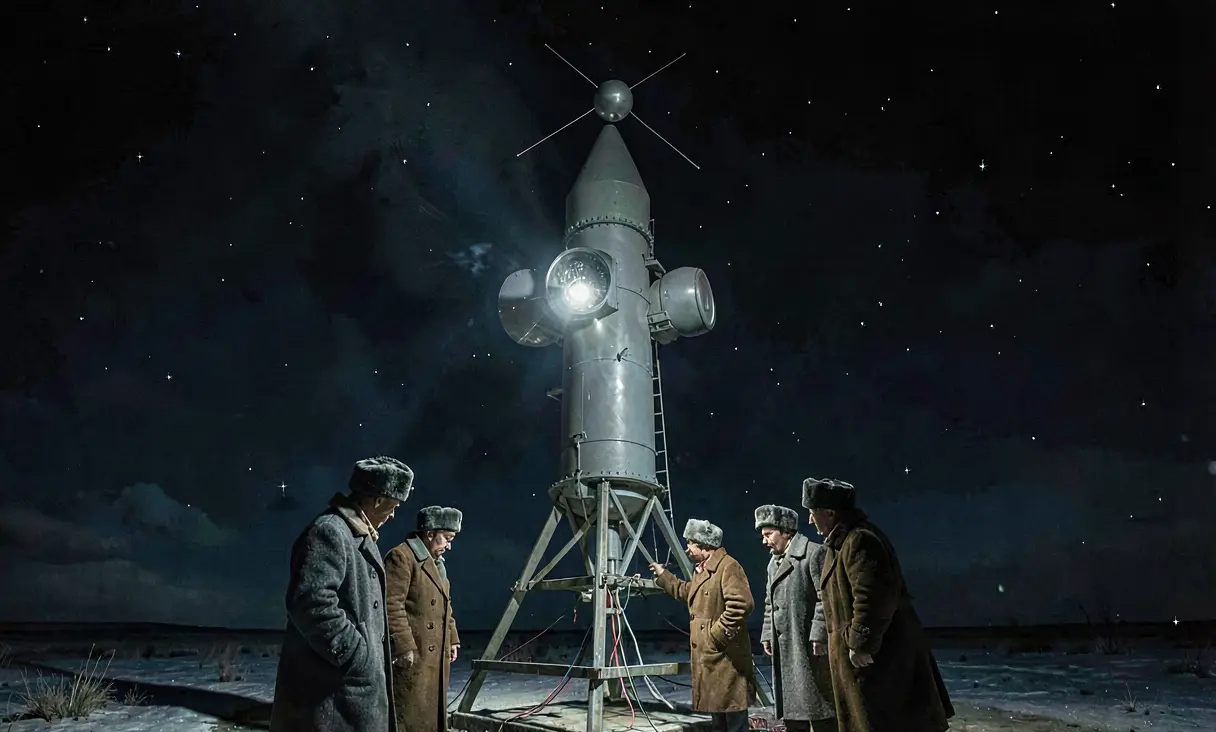 TechnologyLaunch of Sputnik 1October 4, 1957 · Baikonur Cosmodrome, Kazakhstan (USSR)Soviet Union launches first artificial satellite, starting the Space Age.
 WarAtomic Bombing of HiroshimaAugust 6, 1945 CE · Hiroshima, JapanUS drops the first nuclear weapon on a city, ending WWII and starting the atomic age.
 PoliticsFounding of the United NationsOctober 24, 1945 · San Francisco, USA (Charter signed)UN Charter ratified to prevent future global conflicts and promote cooperation.
 ScienceDiscovery of DNA StructureFebruary 28, 1953 CE · Cambridge, EnglandWatson and Crick identify the double helix structure of DNA revealing genetic code.
Discussion
Loading…