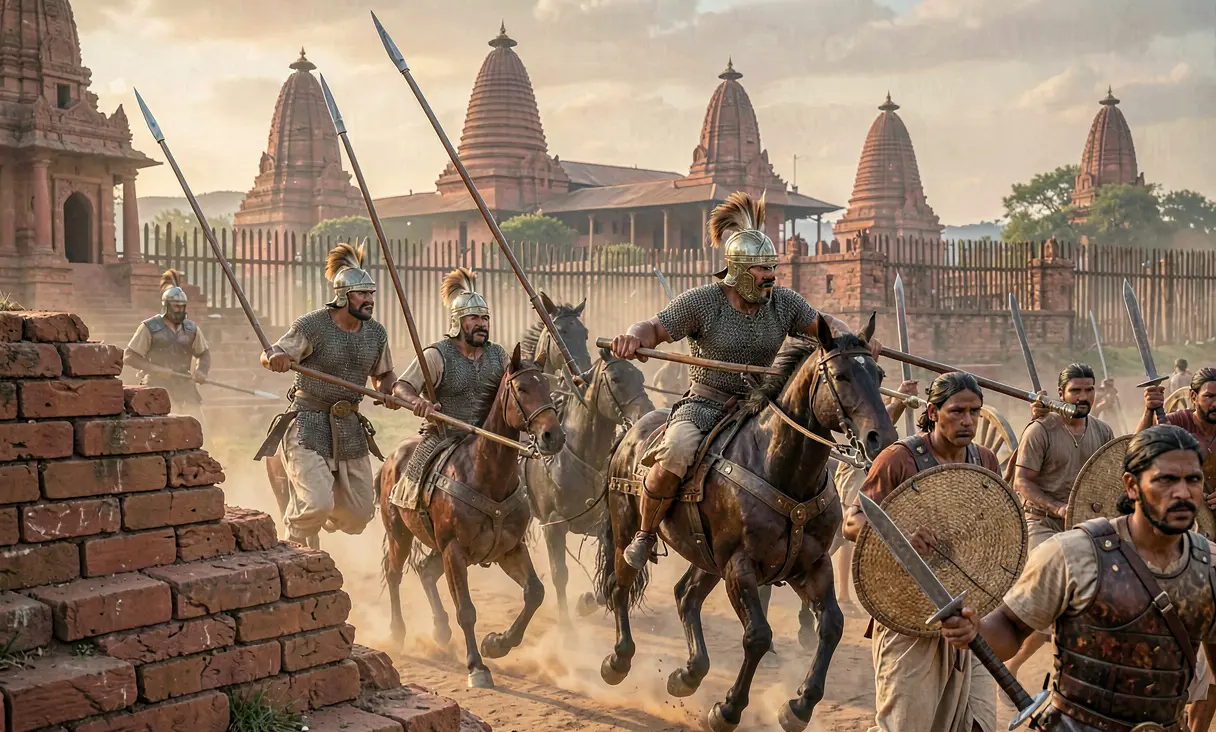
Menander I Conquers Pataliputra region
c. 160 BCE: Indo-Greek King Menander I's eastern campaign reached Pataliputra, forging a unique Greco-Buddhist cultural synthesis that reshaped Indian art and philosophy.
The Collapse of the Shunga and Greek Ascendancy
By the mid-2nd century BCE, the political landscape of northern India was in a state of flux. The Mauryan Empire had fractured, giving rise to the Shunga Dynasty under Pushyamitra Shunga, who ruled from Pataliputra but faced internal dissent and external pressures. Simultaneously, the Greco-Bactrian Kingdom, having established itself in modern-day Afghanistan and parts of Central Asia since the death of Alexander the Great, was reaching its zenith of power. King Euthydemus I had secured his throne against Seleucid forces, and his successor, Demetrius I, had already initiated the first major Indo-Greek incursions into the Indian subcontinent around 180 BCE. However, it was under Menander I Soter that these campaigns evolved from border raids into a systematic conquest aimed at the very heart of the Gangetic plain.
The Campaign East: From Bagram to Pataliputra
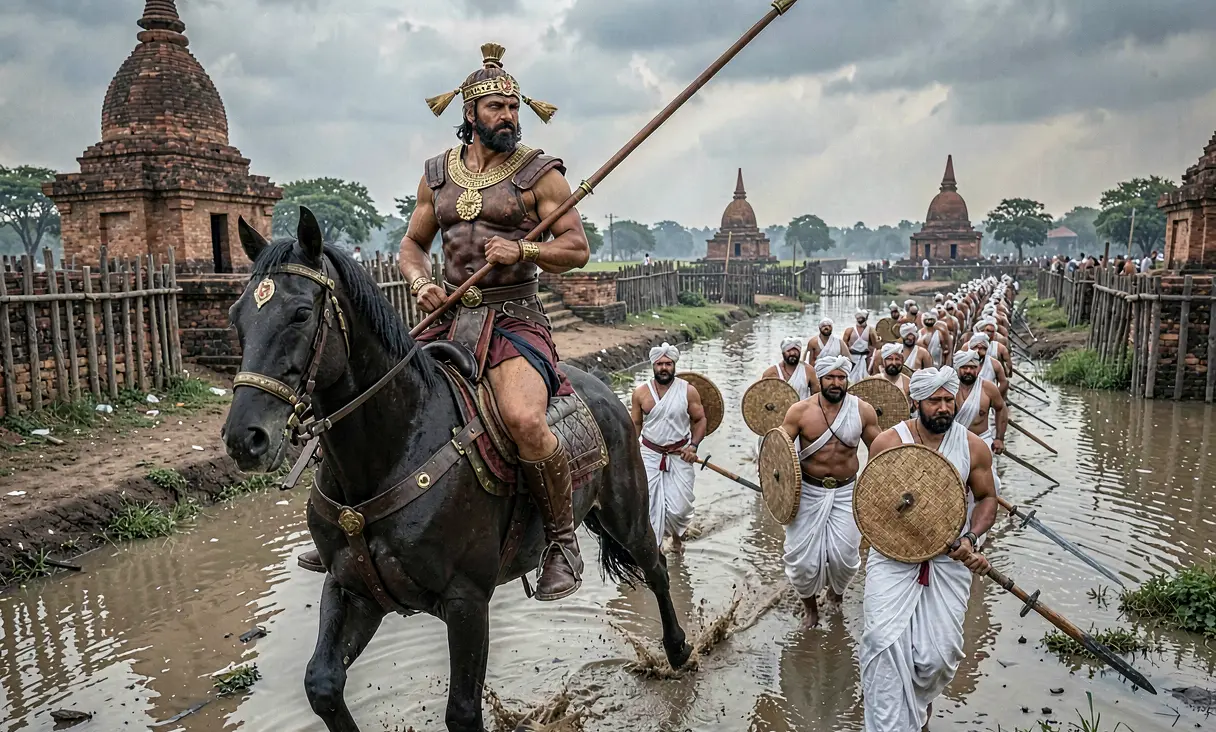
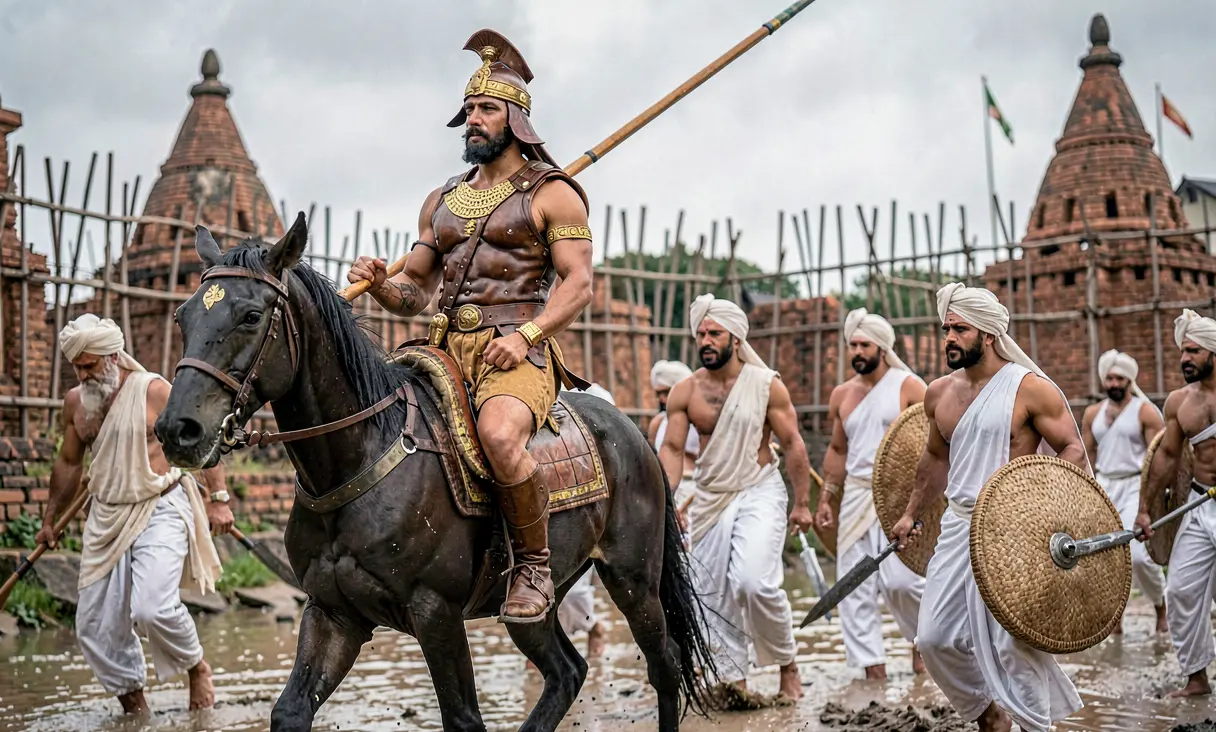
Around 160 BCE, Menander I launched his most ambitious military expedition eastward from his capital in Sagala (modern Sialkot). The campaign followed the ancient trade routes along the Ganges river system, pushing past the fortified cities of Mathura and Varanasi. While the exact extent of his control remains a subject of historical debate among numismatists and archaeologists, literary sources such as the 'Milinda Panha' and later Greek accounts suggest that Menander's forces reached the vicinity of Pataliputra, the ancient capital of the Mauryas and Shungas. This thrust represented the furthest eastern penetration of Hellenistic military power in history, challenging the authority of the Shunga king Agnimitra and temporarily destabilizing the region.
Menander I: Warrior King and Philosopher
Menander I Soter, often identified with the legendary 'Milinda' of Buddhist texts, stands as a unique figure in antiquity. Unlike many conquerors who ruled solely through military might, Menander is remembered for his intellectual engagement with Indian philosophy. Born in the Greco-Bactrian city of Alasanda (likely Alexandria in Arachosia), he was well-versed in Greek dialectics before ascending the throne. His reign is characterized by a synthesis of cultures; he adopted Indian titles while maintaining Hellenistic administrative structures. The 'Milinda Panha' records his famous dialogues with the sage Nagasena, where Menander questions the nature of the self and rebirth, eventually converting to Buddhism. This intellectual journey humanizes the conqueror, portraying him not just as a foreign invader but as a seeker of truth within the Indian spiritual tradition.
The Mechanics of Conquest and Administration
Menander's success in the Pataliputra region was likely facilitated by a combination of superior cavalry tactics, derived from Central Asian traditions, and the strategic alliances he forged with local dissident groups opposed to Shunga rule. The campaign was not merely a raid but an attempt at administration, evidenced by the rapid minting of coins bearing his image in Greek and Kharosthi scripts across the conquered territories. These coins often featured Athena Promachos on the obverse and Nike or local deities on the reverse, signaling a deliberate policy of cultural accommodation. The ability to project power so far from Bactria suggests a highly organized logistical network and a temporary vacuum of Shunga military strength in the eastern Gangetic plains.
The Withdrawal and Regional Fragmentation
Despite his initial successes, Menander's hold on Pataliputra appears to have been tenuous. Historical records indicate that he eventually withdrew his main forces back toward the northwest, likely due to overextension of supply lines and the resurgence of Shunga resistance or the threat of other nomadic invasions from the north, such as the Yuezhi. The eastern territories were not permanently annexed into a unified Indo-Greek empire; rather, they became a zone of influence where Greek garrisons may have remained for a time before being absorbed back into Indian polities. Menander's death is traditionally placed around 130 BCE, after which the Indo-Greek kingdom began to fragment into smaller regional dynasties.
Legacy: The Synthesis of East and West
The legacy of Menander's campaign extends far beyond its military duration. It catalyzed a profound cultural synthesis known as Greco-Buddhist art, where Hellenistic realism merged with Buddhist iconography to create the first anthropomorphic representations of the Buddha. The spread of Greek coinage styles influenced subsequent Indian dynasties, including the Kushans and Guptas. Furthermore, Menander's conversion story, preserved in the 'Milinda Panha', became a cornerstone of Buddhist literature, symbolizing the universality of the Dharma. His reign demonstrated that foreign rulers could not only conquer India but also be spiritually conquered by its traditions, leaving an indelible mark on the religious and artistic history of Asia.
Menander's rule represents the zenith of Indo-Greek influence in India and catalyzed the development of Greco-Buddhist art and philosophy.
Where it happened
Begram to Pataliputra axis — see it on the interactive map →
Explore related history
 WarAn Lushan Rebellion Begins755 CE · Chang'an, ChinaGeneral An Lushan revolts against Emperor Xuanzong, devastating the Tang Dynasty and population.
 WarKushite Conquest of Egypt (25th Dynasty)c. 747 BCE · Thebes, EgyptKing Piye of Kush conquers Upper and Lower Egypt, establishing the first African-led dynasty in Egyptian history.
 WarKushite Conquest of Egypt Establishes 25th Dynastyc. 744 BCE · Napata, Nubia (Modern Sudan)King Piye of Kush conquers Upper Egypt, establishing the 25th Dynasty and restoring traditional Egyptian religious practices.
 ReligionExpansion of the Great Stupa at Sanchic. 150 BCE · Sanchi, Madhya Pradesh, IndiaThe Shunga Dynasty expands the original brick stupa into a massive stone structure, adding the first elaborate gateways and railings.
 TechnologyConstruction of the Antikythera Mechanismc. 150 BCE · Antikythera Island, GreeceGreek engineers craft the world's first known analog computer for astronomical calculations.
 WarRoman Destruction of Carthage146 BCE · Carthage, TunisiaRome completely destroys Carthage at the end of the Third Punic War, ending its rivalry and enslaving its population.
Discussion
Loading…