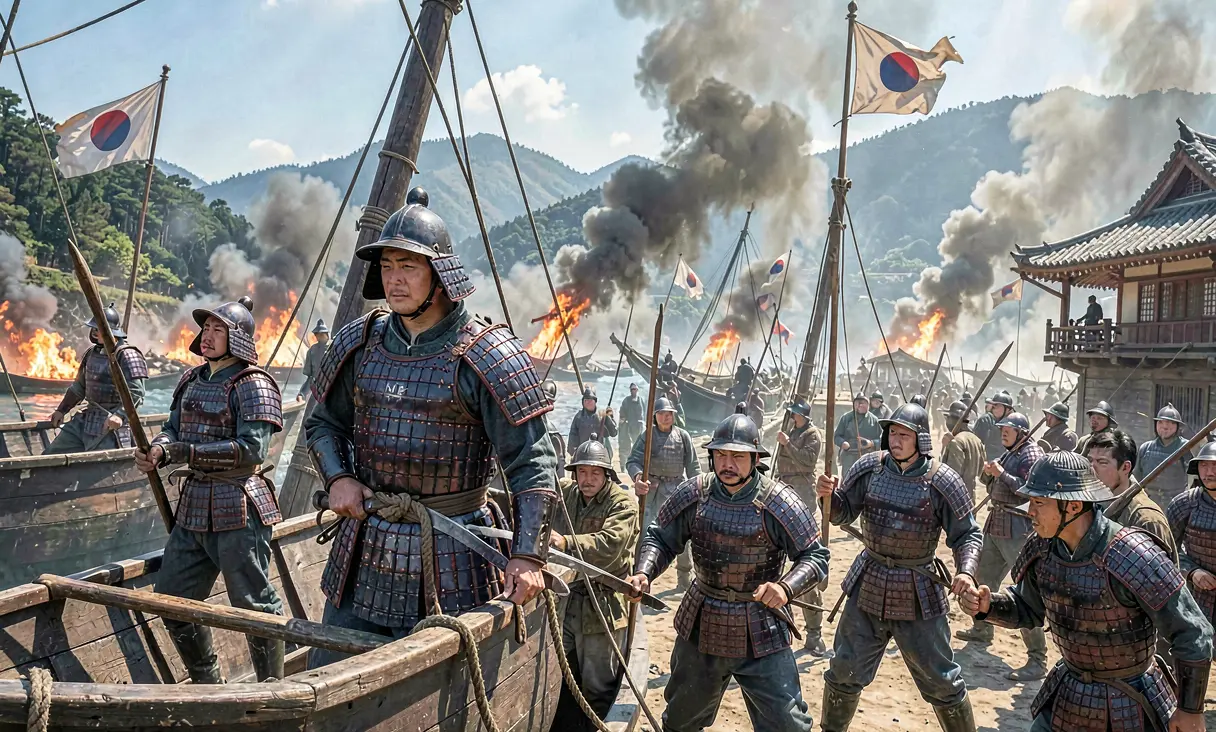
Hideyoshi's First Invasion of Korea (Imjin War)
Toyotomi Hideyoshi's 1592 invasion devastated Korea, triggering a seven-year war where Admiral Yi Sun-sin's naval victories and Ming intervention forced a stalemate before Hideyoshi's death.
The Ambition of the Taikō
By 1592, Toyotomi Hideyoshi had successfully unified Japan after centuries of civil war, creating a powerful but restless warrior class. With domestic conflicts resolved, Hideyoshi turned his gaze outward, proposing a grand strategy to conquer Ming China and establish a Japanese empire in Asia. His plan involved using the Korean peninsula as a staging ground, demanding that the Joseon Dynasty allow Japanese troops passage or face invasion. When King Seonjo of Joseon refused this impossible demand, citing Korea's status as a loyal tributary state of Ming China, Hideyoshi mobilized an unprecedented force. Approximately 158,000 soldiers, organized into nine divisions and led by veteran commanders such as Konishi Yukinaga and Katō Kiyomasa, were assembled at Busan, marking the largest amphibious operation in East Asian history up to that point.
The Lightning Campaign of 1592
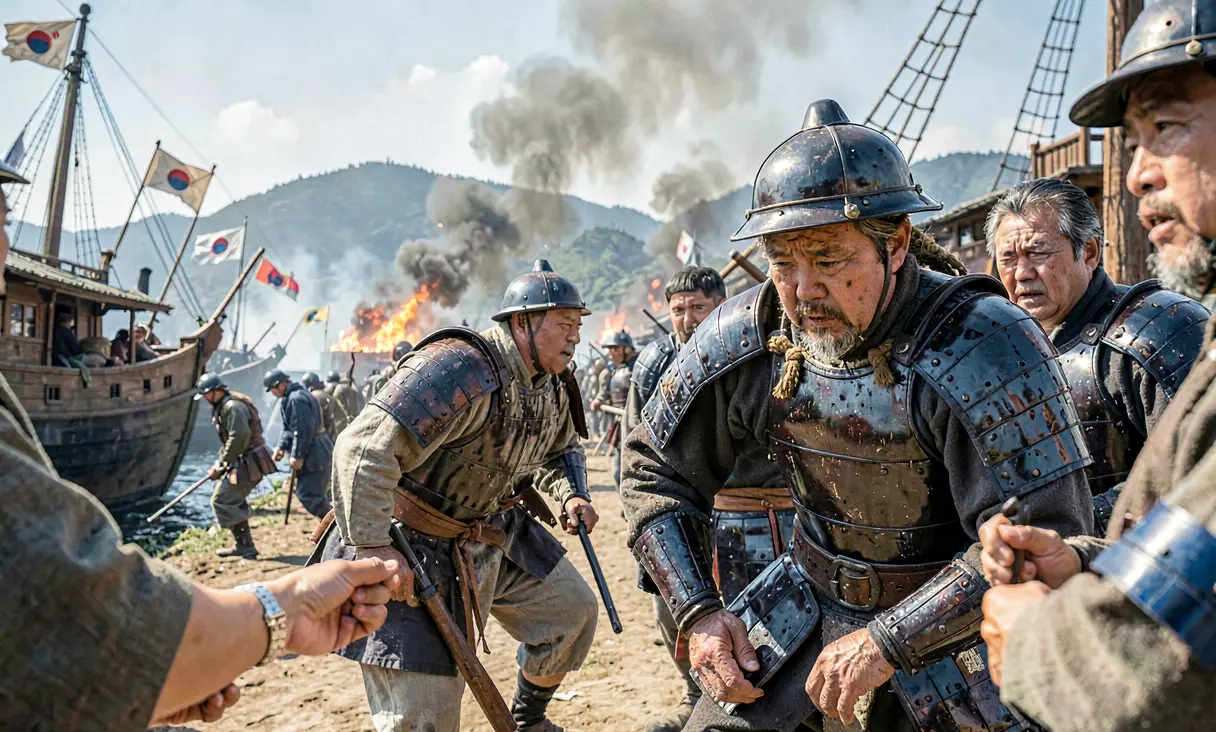
On May 23, 1592, the Japanese invasion began with a massive landing at Busan. The Joseon military, long neglected and unprepared for modern warfare, crumbled under the assault of well-armed samurai equipped with matchlock arquebuses (tanegashima). Within weeks, the Japanese forces advanced north with startling speed, capturing Seoul on June 10 and forcing King Seonjo to flee first to Pyongyang and then across the Yalu River into Ming territory. By July, Japanese troops had seized Pyongyang, effectively controlling the northern half of the peninsula. The rapid collapse of Joseon defenses was attributed not only to internal corruption but also to a lack of cavalry and artillery compared to the Japanese infantry tactics, which emphasized disciplined volley fire and aggressive close-quarters combat.
The Turning Tide: Yi Sun-sin and the Turtle Ships
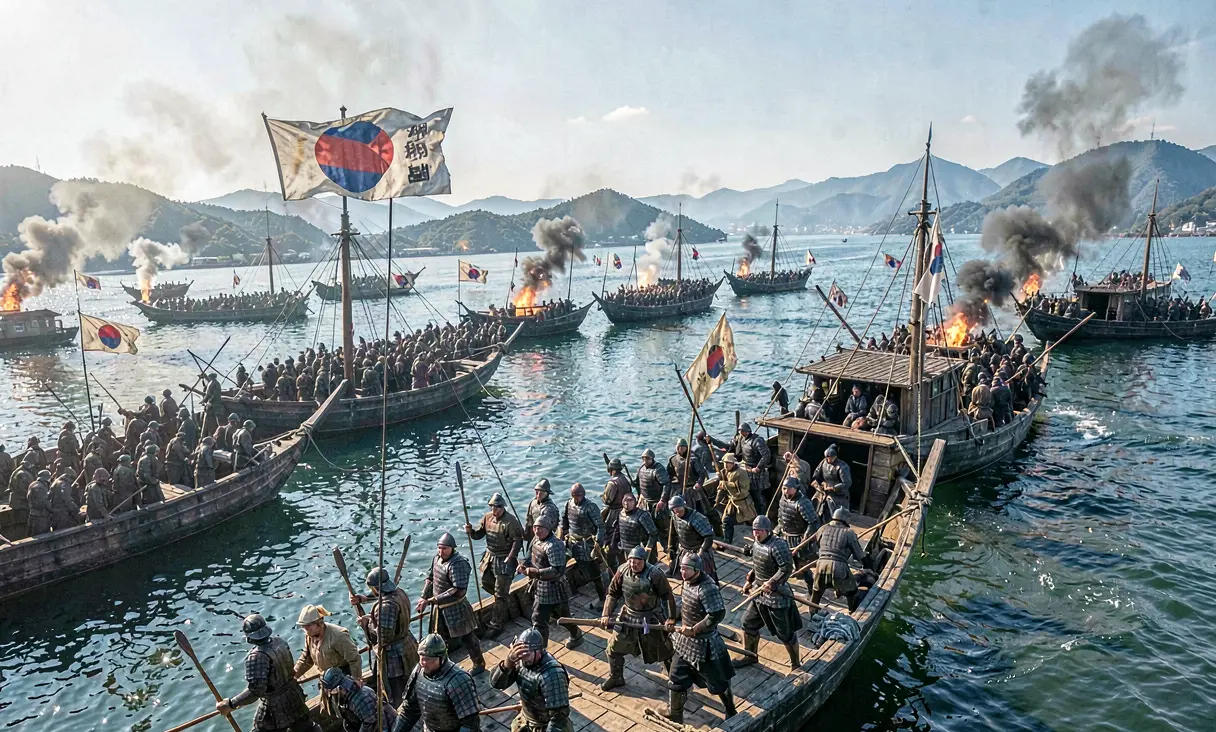
While the land war went disastrously for Korea, the naval theater became the decisive factor in preventing total annihilation. Admiral Yi Sun-sin, commanding a relatively small fleet of panokseon warships, utilized superior tactics and the revolutionary 'turtle ships' (geobukseon) to devastating effect. These armored vessels, covered with iron spikes to repel boarding parties, shattered Japanese supply lines along the southern coast. In battles such as Myeongnyang later in 1597, and earlier at Hansan Island in 1592, Yi Sun-sin destroyed hundreds of enemy ships, cutting off the Japanese army's food and ammunition from Japan. This naval blockade forced the Japanese to halt their advance toward the Yalu River and retreat to the southern provinces, turning a potential conquest into a grinding stalemate.
Ming Intervention and the Seven-Year Grind
The invasion of Korea triggered a massive response from the Ming Dynasty, which viewed Joseon as a vital buffer state. In early 1593, Ming reinforcements under General Li Rusong crossed the Yalu River, recapturing Pyongyang in February and pushing Japanese forces back to Seoul. The war evolved into a protracted conflict characterized by brutal sieges, scorched-earth tactics, and shifting front lines that devastated the Korean countryside. Despite several negotiated truces between 1593 and 1596, diplomatic talks failed due to mutual distrust and conflicting demands regarding tribute and territorial concessions. The conflict resumed in full force in 1597 (the Jeongyu War), with Japan launching a second invasion that was eventually repelled only after the death of Hideyoshi in September 1598.
Devastation and Demographic Collapse
The Imjin War left an indelible scar on the Korean peninsula, resulting in catastrophic human and cultural losses. Estimates suggest that over two million Koreans were killed or displaced, with a significant portion of the population taken as prisoners of war to Japan, including skilled artisans who would later influence Japanese pottery and ceramics. The systematic destruction of villages, libraries, and agricultural infrastructure caused widespread famine and social disintegration that took decades to heal. In Japan, the war exhausted the resources of the Toyotomi regime, contributing to its eventual collapse and paving the way for Tokugawa Ieyasu to establish the Edo Shogunate in 1603.
Legacy and Geopolitical Shifts
The war fundamentally altered the balance of power in East Asia, exposing the vulnerabilities of both the Joseon Dynasty and the Ming Empire. While Korea survived as a sovereign state, its weakened condition made it increasingly susceptible to future foreign interventions, notably by Japan in 1910. The conflict also accelerated the adoption of firearms across the region, forcing military reforms that would define warfare for centuries. Culturally, the war facilitated an unexpected exchange; Korean artisans brought to Japan introduced new techniques in celadon and porcelain production, while Japanese scholars gained exposure to Neo-Confucian texts from Korea. Ultimately, Hideyoshi's dream of a continental empire died with him, leaving behind a legacy of destruction that reshaped the political landscape of Northeast Asia.
The Imjin War devastated Korea but highlighted the importance of naval power and led to significant technological and cultural shifts across East Asia.
Where it happened
Seoul (Hanyang), Korea — see it on the interactive map →
Explore related history
 WarAlgerian War of Independence BeginsNovember 1, 1954 · Algiers, AlgeriaThe National Liberation Front launches coordinated attacks marking the start of the Algerian War against France.
 WarMau Mau Uprising Begins in KenyaOctober 20, 1952 · Nairobi, KenyaThe Kikuyu-led Mau Mau rebellion begins against British colonial rule and white settler land ownership.
 WarTurkish War of Independence BeginsMay 19, 1919 · Samsun, TurkeyMustafa Kemal Atatürk lands in Samsun to organize resistance against Allied occupation and the Ottoman Sultanate.
 DisasterEcological Collapse and Deforestation of Rapa Nuic. 1600 CE · Rapa Nui (Easter Island), ChileOverexploitation of resources leads to deforestation and societal transformation on Rapa Nui.
 WarEscalation of Inter-Tribal Warfare in New Zealandc. 1600 CE · North Island, New ZealandIntensified warfare leads to the construction of massive pā and the development of new weapons like the taiaha.
 ReligionRise of the Birdman Cult on Rapa Nuic. 1600 CE · Orongo, Rapa NuiThe Birdman cult replaces moai worship as the central religious and political institution on Rapa Nui.
Discussion
Loading…