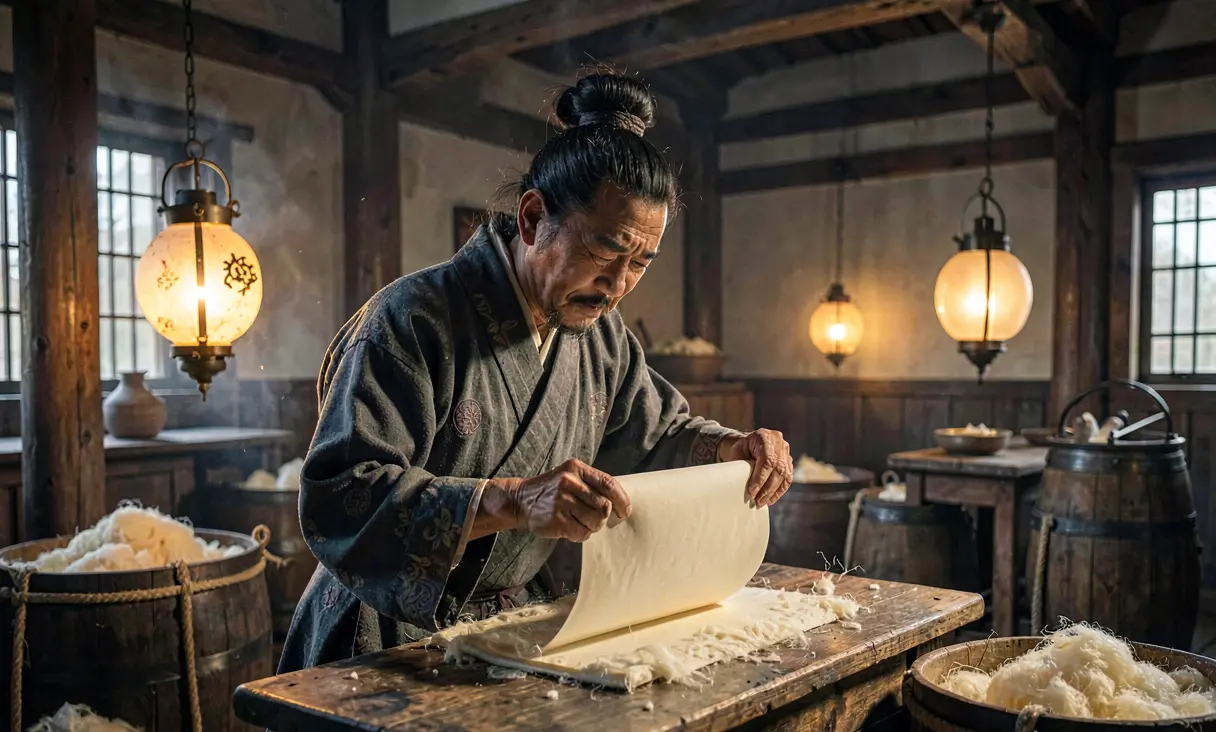
Refinement of Papermaking by Cai Lun in Han China
Cai Lun's 105 CE standardization of papermaking using mulberry bark and rags democratized writing, replacing heavy bamboo and expensive silk to ignite a global revolution in literacy and knowledge tra
The Burden of Bamboo and Silk
Prior to the second century CE, the Han Dynasty faced a significant logistical bottleneck in administration and scholarship: the materials required for writing were either prohibitively expensive or unwieldy. The elite favored silk, a luxurious fabric that was light but exorbitantly costly, limiting its use to high-level decrees and imperial correspondence. Conversely, the common scribe relied on bamboo or wooden slips, which, while durable and cheap, were heavy and cumbersome; a single book could weigh dozens of pounds, making transport and storage a nightmare for the expanding bureaucracy.
Cai Lun and the Imperial Court
The catalyst for change was Cai Lun (c. 50–121 CE), a eunuch serving as a high-ranking official in the court of Emperor He of Han. By 105 CE, Cai Lun had risen to the position of Shangfang Ling (Director of the Imperial Workshops), granting him access to the empire's finest artisans and resources. Unlike previous attempts at creating fibrous sheets which were often rough or inconsistent, Cai Lun approached the problem with a systematic engineering mindset, seeking to standardize a process that could be replicated across the vast Han territory.
The Standardization of 105 CE
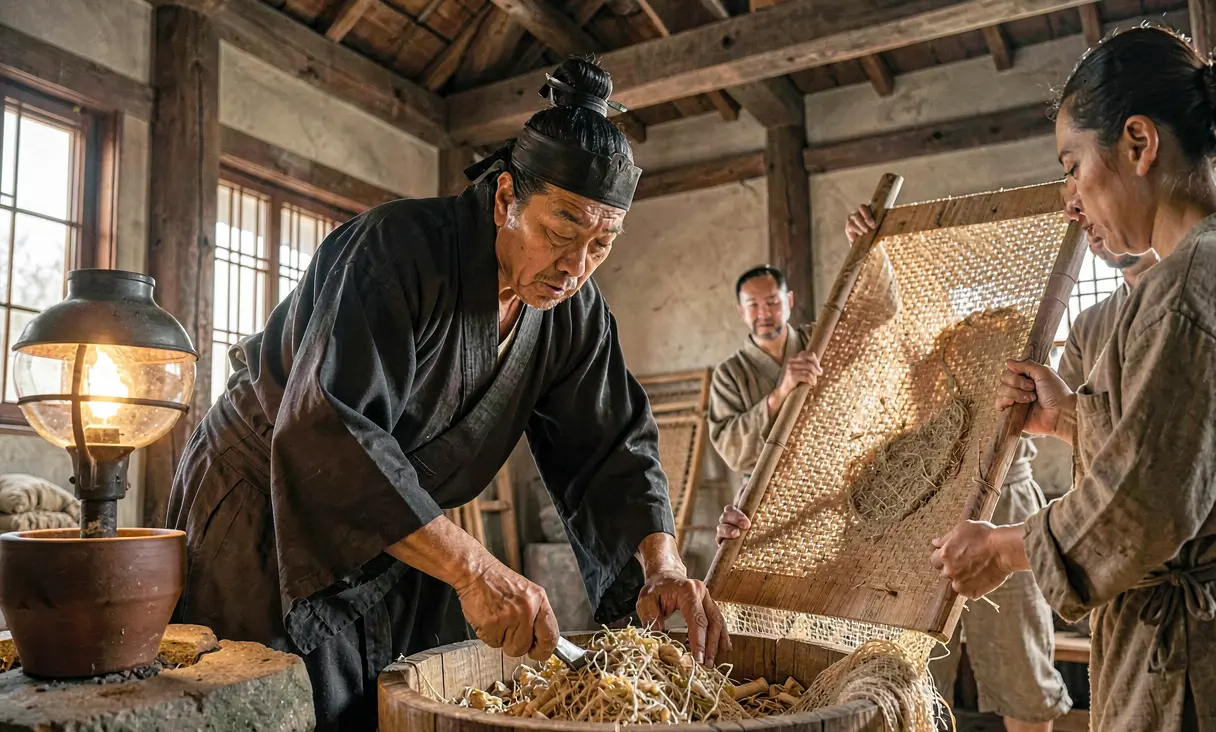
In the year 105 CE, Cai Lun presented his findings to Emperor He, detailing a revolutionary formula for producing 'Cai Hou Paper.' His method involved a four-step process: macerating a mixture of mulberry bark, hemp waste, old rags, and discarded fishnets in water; boiling these fibers with lime to break down lignin; beating the pulp into a fine suspension; and finally, spreading the slurry onto a screen mold to drain and dry. This specific combination of materials created a sheet that was smooth enough for brush ink yet durable enough to withstand handling, effectively solving the cost-versus-usability dilemma.
From Workshop to Empire
The adoption of Cai Lun's paper was not immediate but rapid within the imperial administration. The standardized nature of his process allowed for mass production in state workshops located in Chang'an and Luoyang. As the quality of the new material proved superior to the rougher, pre-existing 'primitive' papers found in archaeological sites like those at Gansu, the court began replacing bamboo slips with paper for official records. This shift drastically reduced the weight of archives and lowered the cost of literacy, enabling a more efficient flow of information throughout the 4 million square kilometer empire.
The Spread of Knowledge
The immediate aftermath of Cai Lun's innovation was a cultural renaissance within the Han Dynasty. With writing materials becoming affordable and portable, the pool of literate individuals expanded beyond the aristocracy to include lower-level officials and scholars. This democratization of the written word facilitated the compilation of massive historical texts, such as Sima Qian's earlier works which were now easier to copy and distribute, and accelerated the spread of Confucian classics. The technology also seeped into religious practices, aiding the early dissemination of Buddhism along the Silk Road.
A Legacy That Transcended Borders
Cai Lun's invention did not remain confined to China; it became one of the most significant vectors for human progress. Over subsequent centuries, the secret of papermaking traveled westward along the Silk Road, reaching Central Asia by the 8th century and eventually the Islamic world after the Battle of Talas in 751 CE. From there, it entered Europe via Spain in the 12th century, laying the material foundation for the Renaissance and the printing press. Without Cai Lun's refinement in 105 CE, the trajectory of global literacy, scientific record-keeping, and cultural exchange would have been delayed by centuries.
The standardization of papermaking revolutionized information storage and transmission, catalyzing global literacy and administrative efficiency.

Where it happened
Chang'an, China — see it on the interactive map →
Explore related history
 TechnologyGrand Canal of China Connects North and South610 CE · Luoyang to Hangzhou, ChinaEmperor Yang completes the massive waterway linking the Yellow and Yangtze rivers for transport and grain.
 TechnologyMeroitic Iron Smelting Industry Flourishesc. 500 BCE · Meroe, SudanMeroe develops a massive iron smelting industry using abundant fuel and advanced furnace technology.
 TechnologyConstruction of the Great Cloaca Maxima in Romec. 500 BCE · Rome, ItalyEarly Romans build the massive Cloaca Maxima sewer system to drain marshes and manage waste.
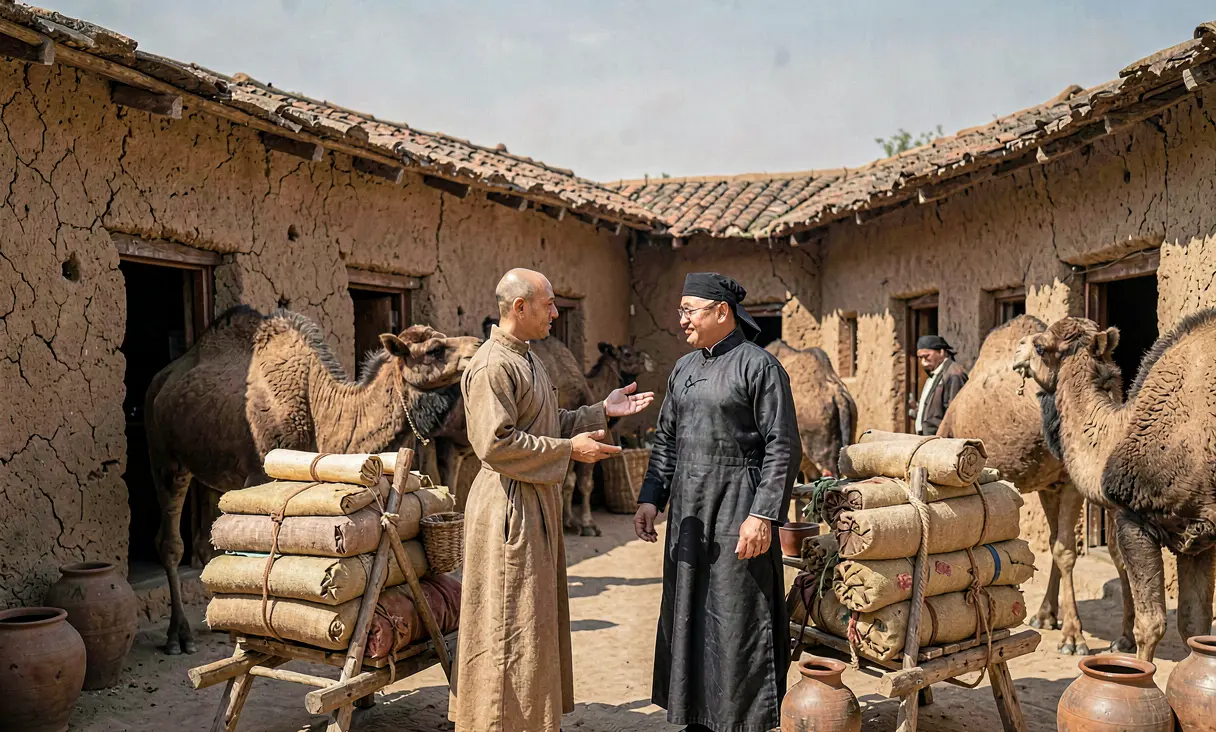 ReligionSpread of Buddhism along the Silk Road to Chinac. 100 CE · Kashgar, China (Gateway)Buddhist monks and merchants transmit the religion from India to China via Central Asian trade routes.
 ReligionKanishka I Convenes the Fourth Buddhist Councilc. 100 CE · Kundalavana Monastery, KashmirEmperor Kanishka I sponsors the Fourth Buddhist Council in Kashmir, formalizing Mahayana Buddhism and commissioning massive stupa construction.
 DisasterEruption of Mount VesuviusAugust 24, 79 CE · Pompeii, ItalyVolcano destroys Roman cities preserving them in ash for modern discovery.
Discussion
Loading…