Creation of the Code of Hammurabi
Commissioned c. 1754 BCE, Hammurabi's Code established one of history's first written legal frameworks, unifying his empire through standardized justice and divine mandate.
The Rise of Babylon and Legal Fragmentation
In the early second millennium BCE, Mesopotamia was a patchwork of rival city-states, each governed by its own local customs and ad hoc judicial decisions. The First Babylonian Dynasty, established by Sumu-abum in 1894 BCE, initially held little sway over the region's powerful neighbors like Larsa, Eshnunna, and Mari. However, under the reign of Hammurabi (r. c. 1792–1750 BCE), Babylon transformed from a minor provincial capital into the hegemon of southern Mesopotamia through a combination of shrewd diplomacy and ruthless military conquest. By the time he commissioned his great law code, Hammurabi had unified much of Sumer and Akkad, creating an empire that required a standardized administrative framework to manage diverse populations and complex economic interactions.
The Commissioning of the Stele
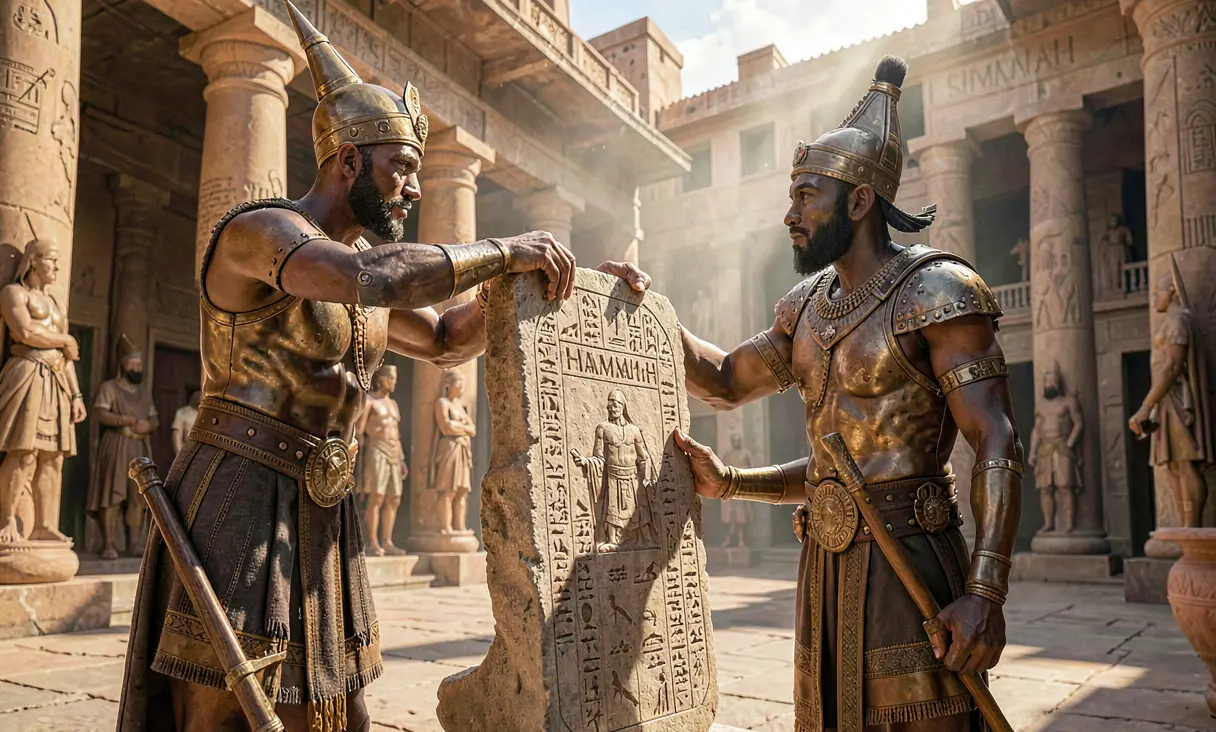
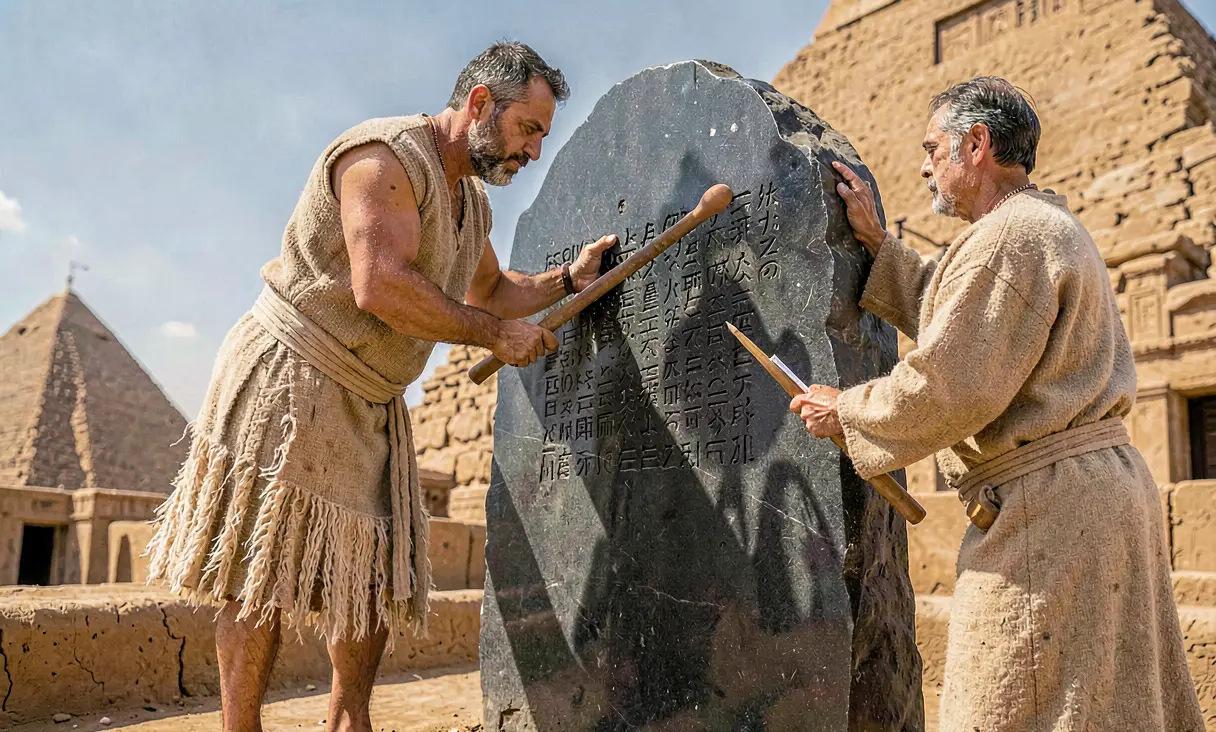
Around 1754 BCE, near the end of his reign, King Hammurabi ordered the creation of a monumental diorite stele standing approximately 2.25 meters (7 feet) tall. This was not merely a legal document but a piece of royal propaganda and religious art intended to project the king's piety and authority. The stone was carved with cuneiform script in the Akkadian language, featuring a bas-relief at the top depicting Hammurabi standing before Shamash, the sun god and deity of justice. In this iconic imagery, Shamash is shown handing the laws directly to the king, visually cementing the narrative that these statutes were divinely ordained rather than merely human inventions.
Structure and Content of the Laws
The inscription contains 282 distinct case laws covering a vast array of societal functions, including commerce, agriculture, family law, slavery, and criminal justice. The text is structured as conditional sentences: 'If a man does X, then he shall suffer Y.' These laws address specific scenarios, such as the liability of builders for collapsing houses, regulations on marriage dowries, and penalties for theft or assault. A defining characteristic of the code is its reliance on lex talionis, the principle of retributive justice where the punishment mirrors the crime, famously summarized by the phrase 'an eye for an eye.' However, the application of this principle was not egalitarian; penalties were strictly stratified based on social class, distinguishing between the awilum (free men), mushkenum (commoners), and wardum (slaves).
Divine Mandate and Centralization
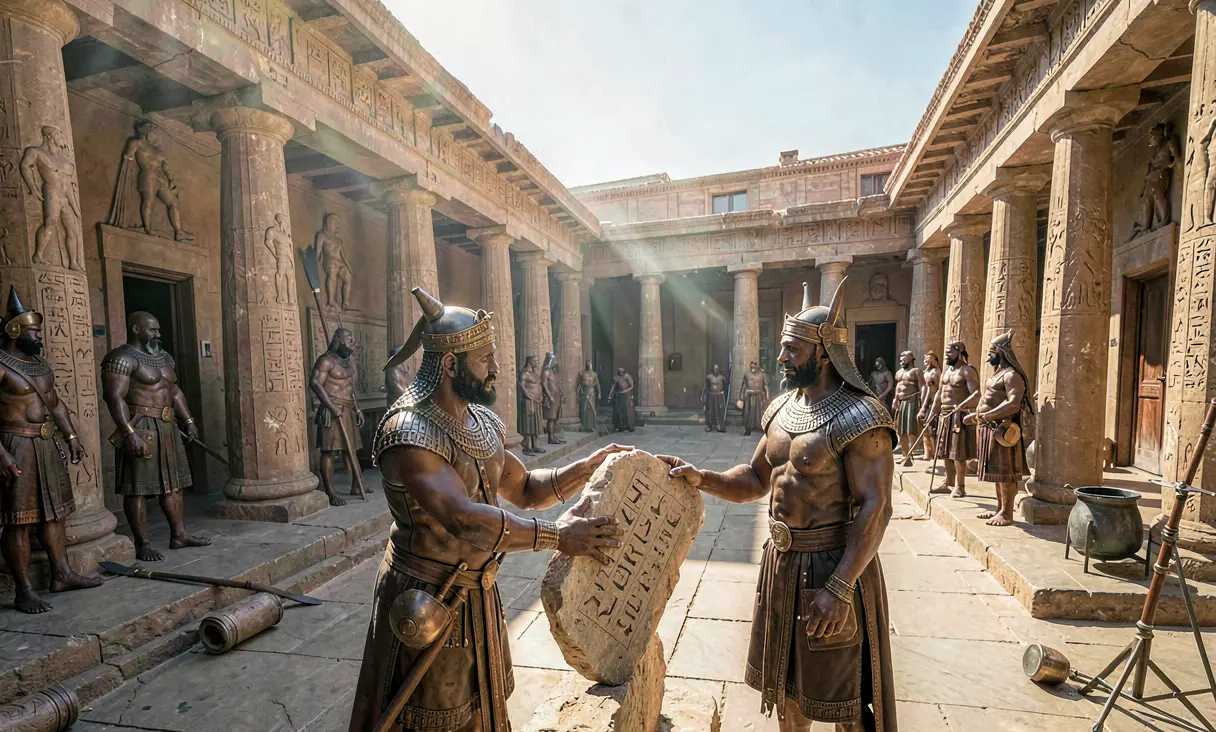
The prologue and epilogue of the code serve as a theological justification for Hammurabi's rule, asserting that the gods Anu and Bel had called him to 'cause justice to prevail in the land' and to destroy the wicked. By framing his legal reforms as a divine mandate, Hammurabi elevated the status of Babylonian law above local traditions. The code was designed to be copied and distributed; while the original stele was likely placed in a public sanctuary or palace courtyard in Babylon, copies were presumably erected in other major cities across the empire. This dissemination aimed to ensure that judges and administrators in distant provinces applied uniform standards, thereby reducing corruption and strengthening the central authority of the king over his newly conquered territories.
Discovery and Historical Rediscovery
The original stele vanished from historical record for millennia until its dramatic rediscovery in 1901 by French archaeologists Jean-Vincent Scheil and Gustave Jéquier at the ancient Elamite city of Susa, modern-day Iran. The artifact had been taken as war booty by the Elamite king Shutruk-Nahhunte around 1200 BCE, centuries after Hammurabi's death. Upon its excavation, the stele was found to be partially damaged, with some laws erased, likely in an attempt to replace them with the conqueror's own decrees before being abandoned. Today, the intact monument resides in the Louvre Museum in Paris, serving as one of the most significant artifacts from the ancient Near East and providing a rare, detailed window into the social fabric of Bronze Age Mesopotamia.
Legacy and Enduring Significance
The Code of Hammurabi stands as a watershed moment in the history of jurisprudence, representing one of the earliest examples of written law that sought to regulate society comprehensively. While it did not invent the concept of law—earlier codes like those of Ur-Nammu and Lipit-Ishtar predate it—it was unprecedented in its scope, detail, and public visibility. The code influenced subsequent legal traditions in the region, including the biblical laws found in the Torah, which share structural similarities and specific statutes regarding restitution and injury. Its emphasis on written transparency and the idea that a ruler is bound by the law he promulgates remains a foundational concept in modern legal systems, marking the transition from arbitrary rule to codified justice.
This stele became the most famous symbol of ancient law, influencing legal traditions throughout the Near East.
Where it happened
Babylon, Mesopotamia (Iraq) — see it on the interactive map →
Explore related history
 PoliticsSargon of Akkad Establishes the First Empirec. 2334 BCE · Akkad (Location uncertain, near Baghdad, Iraq)Sargon unifies Sumerian city-states to create the world's first multi-ethnic empire.
 PoliticsPromulgation of the Code of Ur-Nammuc. 2100 BCE · Ur, Southern Mesopotamia (Iraq)The earliest known surviving law code is established in the Sumerian city of Ur.
 PoliticsNelson Mandela Elected President of South AfricaApril 27, 1994 · Cape Town, South AfricaSouth Africa holds its first democratic election, ending the apartheid regime and establishing a multiracial government.
 WarFall of Ayutthaya to Burma1767 CE · Ayutthaya, ThailandBurmese forces sack and burn Ayutthaya, ending the kingdom after four centuries.
 WarTay Son Rebellion Overthrows Le Dynasty1771 CE · Tay Son, VietnamThe Tay Son brothers launch a peasant revolt that overthrows the ruling dynasties.
 PoliticsTúpac Amaru II Rebellion BeginsNovember 4, 1780 · Tungasuca, Viceroyalty of PeruJosé Gabriel Condorcanqui leads a massive indigenous uprising against Spanish colonial rule in the Andes.
Discussion
Loading…