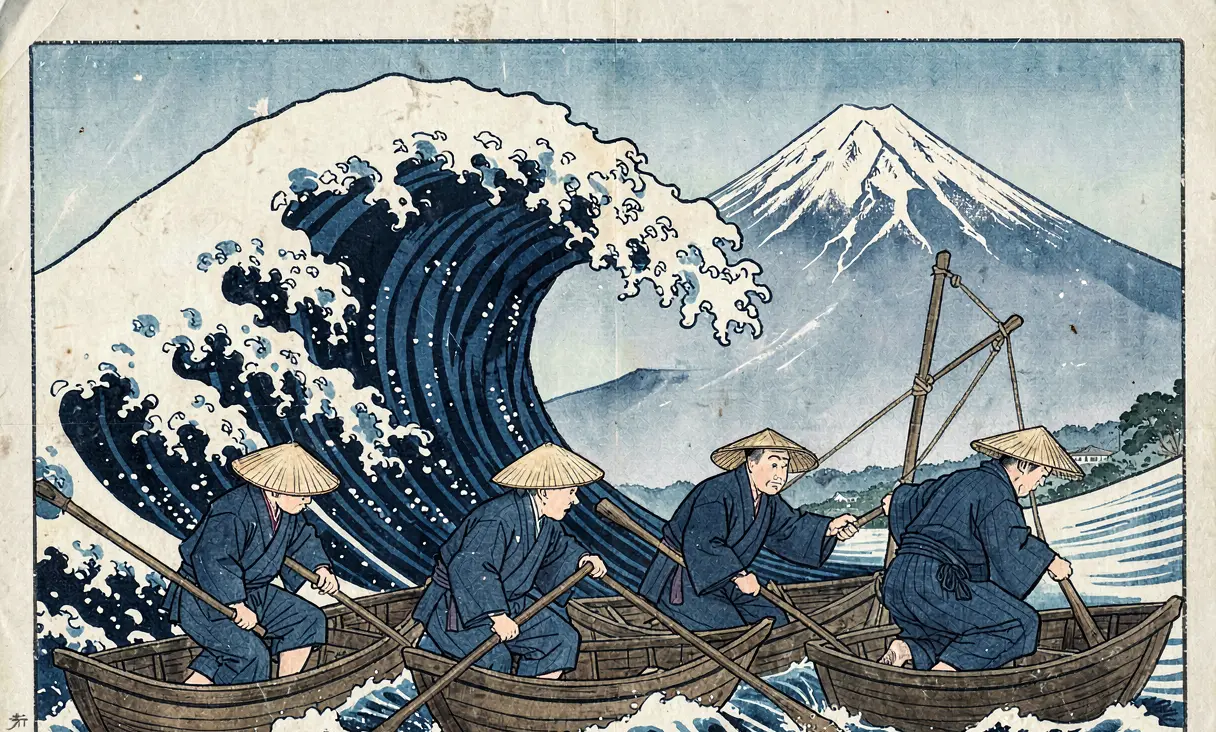
Creation of The Great Wave off Kanagawa
Hokusai's 1831 masterpiece revolutionized global art by merging Prussian blue innovation with spiritual symbolism, inspiring generations from Van Gogh to modern pop culture.
The Edo Context and the Rise of Ukiyo-e
By the early 19th century, Japan was in the late Edo period under the rigid rule of the Tokugawa shogunate. While political isolationism (sakoku) restricted foreign contact, a vibrant domestic culture flourished in urban centers like Edo and Osaka. The merchant class, though socially low-ranked, possessed significant economic power and fueled a demand for 'ukiyo-e,' or 'pictures of the floating world.' These woodblock prints depicted kabuki actors, beautiful women, and travel scenes, serving as affordable mass media for the literate populace. It was within this commercial and artistic ecosystem that Katsushika Hokusai, then in his early seventies, sought to redefine landscape art, a genre previously dominated by Chinese-inspired ink wash painting rather than popular color prints.
The Artist: Katsushika Hokusai at His Peak
Born in 1760, Katsushika Hokusai was a prolific and restless artist who changed his studio name over thirty times throughout his life. By the time he created *The Great Wave off Kanagawa* around 1831, he had already established himself as a master of diverse styles, from manga sketches to intricate erotica. His fascination with Western perspective and anatomy was well-documented; he famously stated in his later years that if he could live another ten years, he might truly understand the structure of nature. This specific work emerged during a period of intense productivity following his move to Edo's Honjo district, where he produced the series *Thirty-Six Views of Mount Fuji*, aiming to capture the sacred mountain from every conceivable angle and in every season.
The Innovation of Prussian Blue
The visual impact of the print relied heavily on a technological breakthrough: the introduction of synthetic Prussian blue, known in Japan as *bero-ai*. Imported from Europe via China and the Dutch trading post at Dejima, this pigment offered a depth and stability that traditional organic blues could not match. Hokusai utilized this new color with masterful gradation, or *bokashi*, to create the terrifying yet rhythmic swell of the wave. The contrast between the electric blue of the water and the pale, almost ghostly white foam created a dynamic tension that had never been seen in Japanese art before, transforming a simple seascape into a dramatic narrative of human vulnerability against nature's power.
Composition and Symbolism
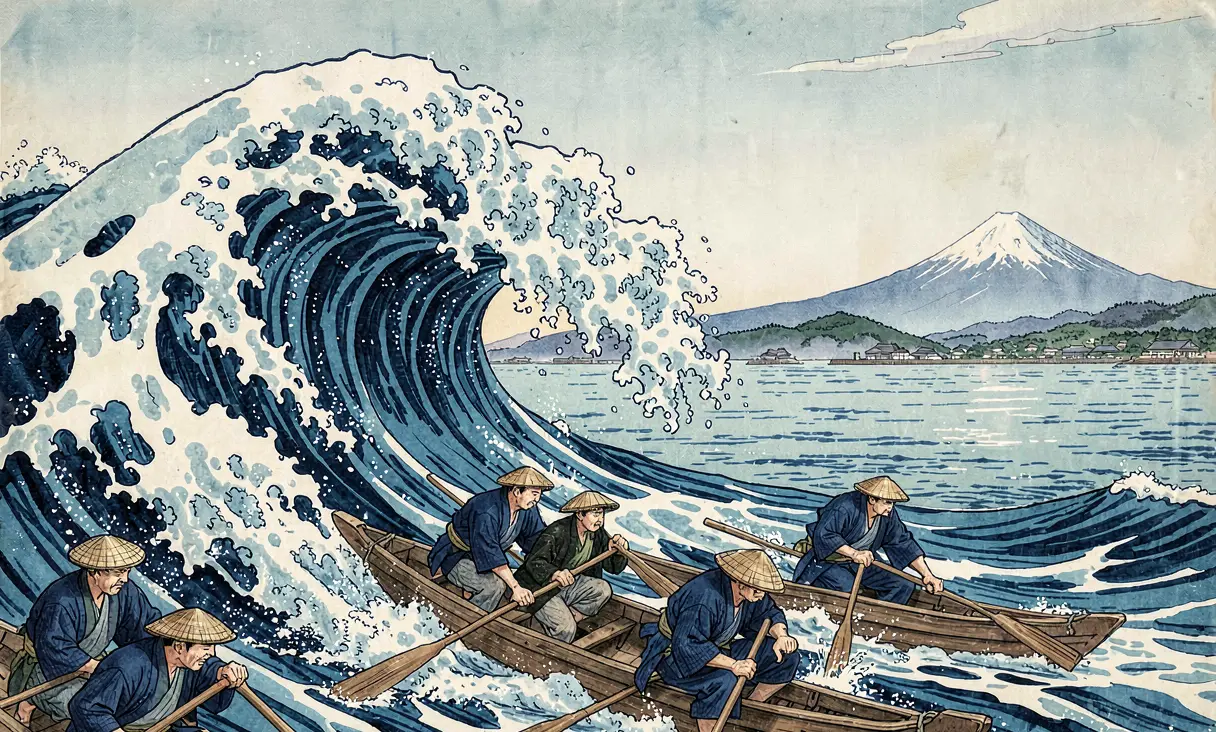
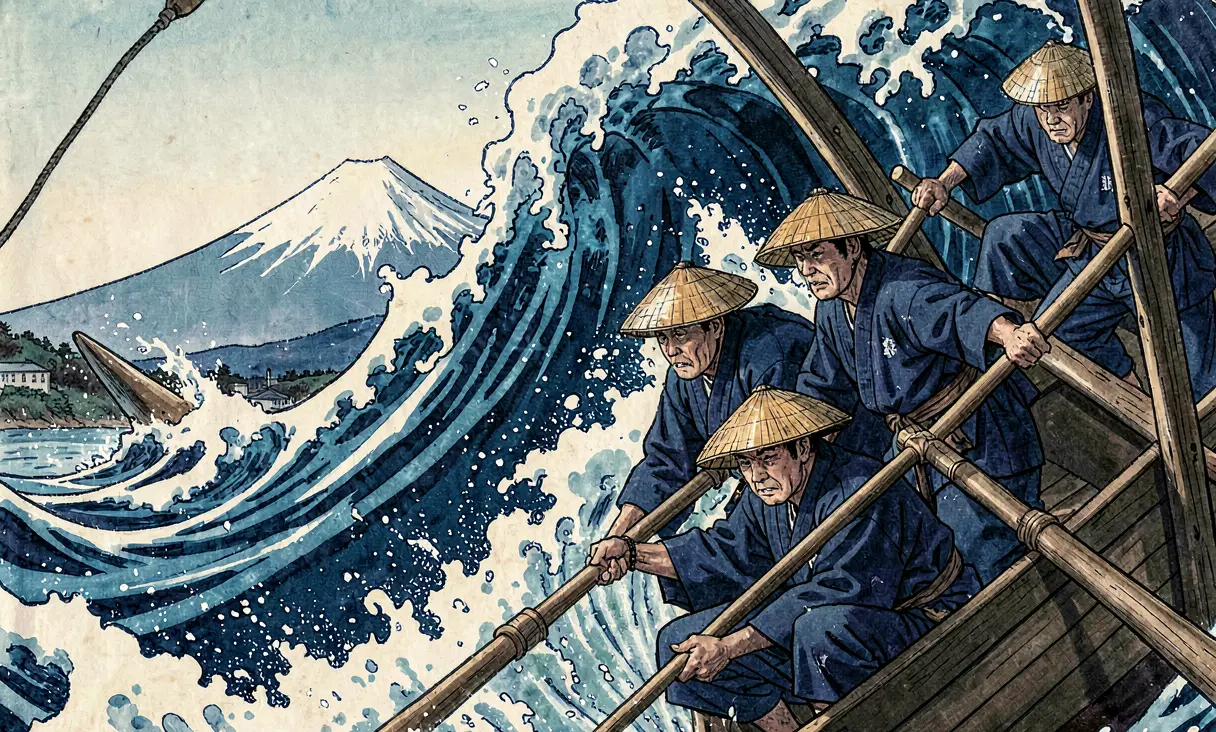
The composition is a study in geometric contrast. The massive wave, claw-like crests reaching toward the sky, dominates the foreground, threatening three small fishing boats known as *oshiokuri-bune*. These vessels, used for transporting live fish to Edo markets, are depicted with terrified fishermen huddled low, emphasizing their fragility. In stark opposition to the chaotic motion of the water stands Mount Fuji in the background. Rendered small and static in a pyramid shape, the volcano represents permanence, divinity, and the unchanging order of the universe. This juxtaposition captures the dual nature of the Japanese worldview: the transience of human life set against the eternal presence of the sacred landscape.
Production and Dissemination
Created as part of a woodblock print series, *The Great Wave* was not a unique painting but one of thousands produced through a collaborative process involving the artist (designer), the carver, and the printer. The publisher, Nishimuraya Yohachi (also known as Eiraku Hozen), released the series *Thirty-Six Views of Mount Fuji* starting in 1830 or 1831. Due to its immense popularity, the series was eventually expanded to forty-six prints. The efficiency of the woodblock printing press allowed for rapid distribution across Japan, making high art accessible to commoners and establishing a visual language that would soon cross oceans.
Global Legacy and Artistic Influence
In the late 19th century, Japanese prints began arriving in Europe via trade routes, sparking the phenomenon known as *Japonisme*. The Great Wave became a primary catalyst for this movement, profoundly influencing the Impressionists and Post-Impressionists. Vincent van Gogh explicitly copied the wave's composition in his painting *The Starry Night*, while Claude Monet collected Japanese prints and incorporated their flat perspectives into his work. The image transcended its origins to become a universal symbol of nature's sublime power, appearing on everything from modernist posters to pop culture icons. It remains the most recognizable piece of Asian art globally, defining the Western perception of Japan for over a century.
It bridged Eastern and Western artistic traditions through mass reproduction.
Where it happened
Kanagawa, Japan — see it on the interactive map →
Explore related history
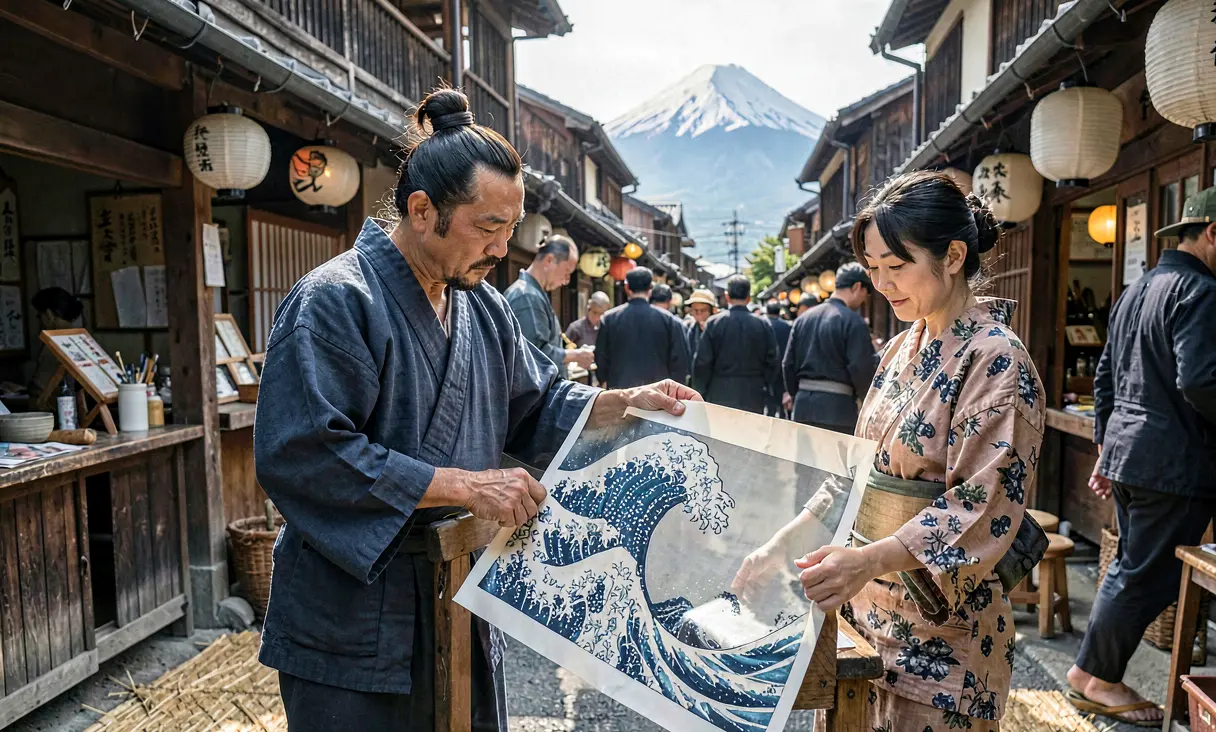 ArtPublication of Hokusai's Great Wavec. 1831 CE · Edo (Tokyo), JapanKatsushika Hokusai releases the iconic woodblock print of Mount Fuji.
 ArtCreation of The Starry NightJune 1889 · Saint-Rémy-de-Provence, FranceVincent van Gogh paints his most famous masterpiece from an asylum window.
 ArtFounding of the Bengal School of Artc. 1905 CE · Calcutta (Kolkata), IndiaAbanindranath Tagore pioneers a new indigenous Indian art style.
 WarFirst Opium War BeginsSeptember 4, 1839 · Guangzhou, ChinaBritain forces open Chinese trade via war, beginning the Century of Humiliation.
 WarBattle of WaterlooJune 18, 1815 · Waterloo, BelgiumNapoleon Bonaparte is defeated, ending the Napoleonic Wars.
 SciencePublication of Origin of SpeciesNovember 24, 1859 CE · London, EnglandCharles Darwin proposes natural selection as the mechanism for evolution of life.
Discussion
Loading…