Wall Street Crash and Great Depression
The 1929 Wall Street Crash triggered a decade-long global depression, reshaping economics, ending laissez-faire policies, and fueling the rise of totalitarian regimes that led to World War II.
The Roaring Twenties and the Bubble
In the decade preceding the collapse, the United States experienced an unprecedented economic boom characterized by industrial expansion, consumerism, and a speculative frenzy in the stock market. By 1929, the New York Stock Exchange had become the epicenter of global finance, with margin buying allowing investors to purchase stocks with as little as 10% down. This leverage inflated asset prices far beyond their intrinsic value, creating a fragile bubble detached from economic fundamentals. While industrial production and corporate profits were strong, wealth distribution remained highly unequal, leaving the broader economy vulnerable to any disruption in consumer spending or credit availability.
Black Tuesday: The Crash
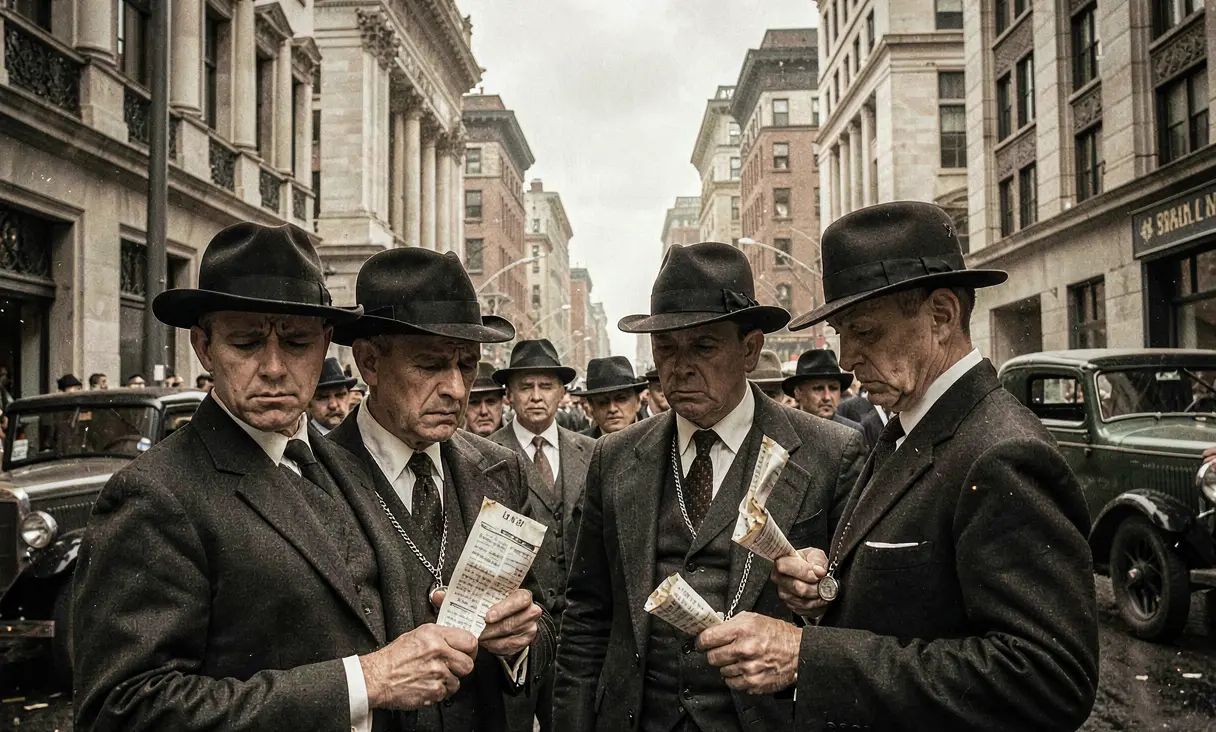
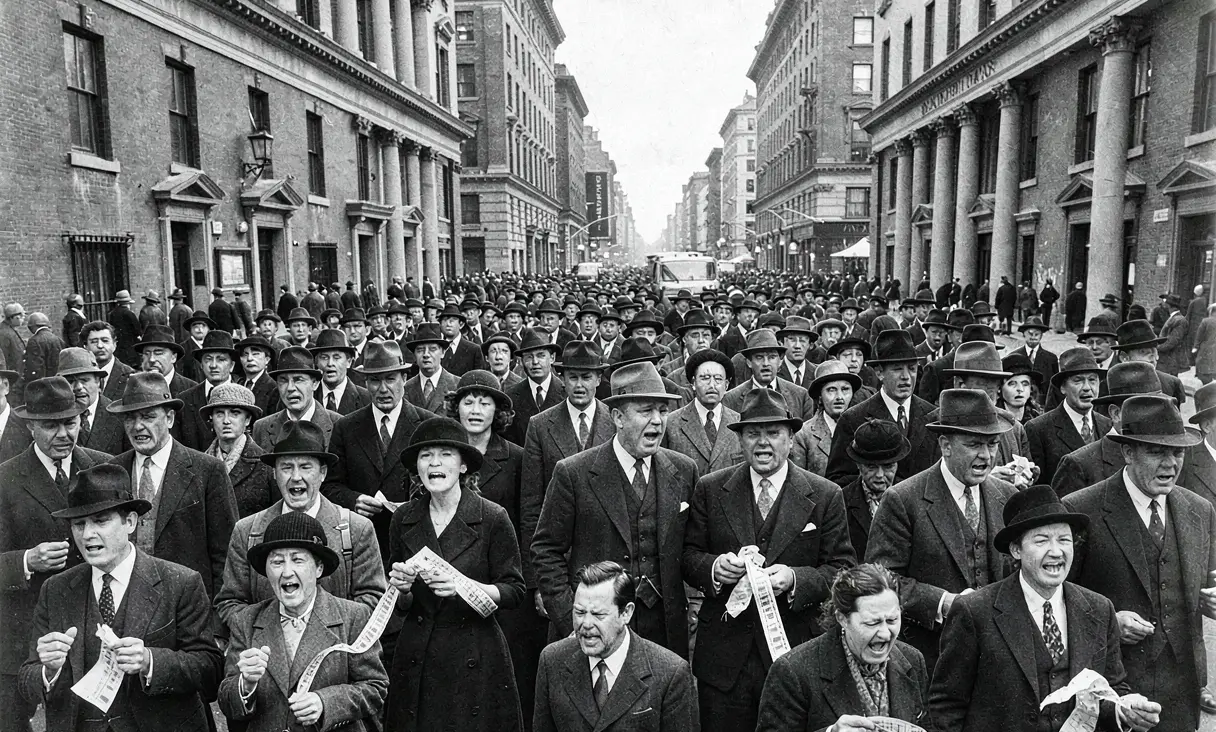
The illusion of perpetual growth shattered on October 24, known as 'Black Thursday,' when panic selling began, though a temporary stabilization by banking consortiums offered false hope. The true catastrophe arrived on October 29, 1929, or 'Black Tuesday.' On this day, the market saw a record-breaking volume of 16 million shares traded as investors rushed to liquidate positions. The Dow Jones Industrial Average plummeted nearly 12%, wiping out approximately $14 billion in value—equivalent to over $200 billion today. Prominent figures like J.P. Morgan and Thomas Lamont attempted to halt the slide by buying blue-chip stocks, but the sheer magnitude of selling pressure rendered their efforts futile.
From Crash to Depression
The stock market crash was not merely a financial correction; it acted as the catalyst for a systemic collapse that transformed into the Great Depression. As asset values evaporated, banks holding these stocks or loans collateralized by them faced insolvency. A wave of bank runs ensued, with depositors rushing to withdraw cash, causing thousands of financial institutions to fail between 1930 and 1933. The Federal Reserve's failure to provide adequate liquidity exacerbated the crisis, leading to a contraction in the money supply. Consequently, credit dried up, businesses could not finance operations or payroll, and unemployment rates soared from roughly 3% in 1929 to nearly 25% by 1933.
Global Contagion and Political Instability
The economic devastation quickly transcended American borders due to the interconnected nature of global finance, particularly through war debts and reparations from World War I. The United States had been a primary creditor nation; when American banks called in foreign loans and trade plummeted by over 50%, economies in Europe, Latin America, and Asia crumbled. In Germany, the collapse of the Dawes Plan and hyperinflation fueled social unrest, creating fertile ground for extremist movements. This economic despair directly facilitated the rise of Adolf Hitler and the Nazi Party, demonstrating how financial instability could dismantle democracies and reshape the geopolitical landscape toward totalitarianism.
The New Deal and Government Intervention
In response to the unprecedented crisis, President Franklin D. Roosevelt assumed office in 1933 with a mandate for radical change, abandoning the prevailing laissez-faire approach that had dominated the previous century. The 'New Deal' introduced a series of programs including the Civilian Conservation Corps (CCC), the Works Progress Administration (WPA), and the Social Security Act, fundamentally altering the relationship between the federal government and its citizens. Regulatory bodies such as the Securities and Exchange Commission (SEC) were established to oversee financial markets and prevent future speculative excesses. These measures did not immediately end the Depression but provided a safety net and restored public confidence in the economic system.
Enduring Legacy
The Wall Street Crash of 1929 remains the defining economic event of the 20th century, serving as a permanent cautionary tale regarding speculation, leverage, and the necessity of regulatory oversight. It fundamentally shifted macroeconomic theory, validating John Maynard Keynes' arguments for government intervention during downturns and influencing fiscal policies worldwide for decades. The Great Depression redefined the social contract in Western democracies, establishing expectations that governments must ensure full employment and economic stability. Its lessons continue to inform central banking practices, financial regulation, and crisis management strategies in the modern era.
It caused the deepest global economic depression in history, reshaping government roles in economies worldwide.

Where it happened
New York City, USA — see it on the interactive map →
Explore related history
 DisasterGreat Famine of India (1876-1878)November 1, 1876 · Southern IndiaDrought and British policy cause mass starvation in India.
 ArtCreation of Guernica by PicassoMay 1, 1937 CE · Paris, FrancePicasso paints anti-war masterpiece depicting bombing of Basque town during Spanish Civil War.
 PoliticsTreaty of Versailles SignedJune 28, 1919 · Versailles, FrancePeace treaty ends WWI but imposes harsh terms on Germany, sowing seeds for WWII.
 PoliticsOctober RevolutionNovember 7, 1917 · Petrograd (St. Petersburg), RussiaBolsheviks overthrow the Provisional Government, creating the first socialist state.
Discussion
Loading…