
Egyptian Revolution of 1919
The 1919 Revolution united Egyptians across class and faith in a massive uprising against British occupation, forcing nominal independence in 1922 and birthing modern Egyptian nationalism.
The Spark of National Awakening
By early 1919, Egypt was a powder keg of nationalist sentiment, simmering under the weight of British military occupation since 1882 and formal protectorate status declared in 1914. The end of World War I had raised hopes for self-determination among Egyptian elites, particularly those who had served in the Egyptian Expeditionary Force or worked with the Allied war effort. Saad Zaghloul, a charismatic former minister and lawyer, organized the Wafd delegation (Wafd meaning 'delegation') to present Egypt's case for independence at the Paris Peace Conference. When British High Commissioner Sir Reginald Wingate refused their request, Zaghloul and his colleagues were arrested on March 8, 1919, and deported to Malta. This act of political suppression did not quell dissent; instead, it ignited a spontaneous, nationwide uprising that would redefine the trajectory of modern Egyptian history.
A United Front Against Colonial Rule
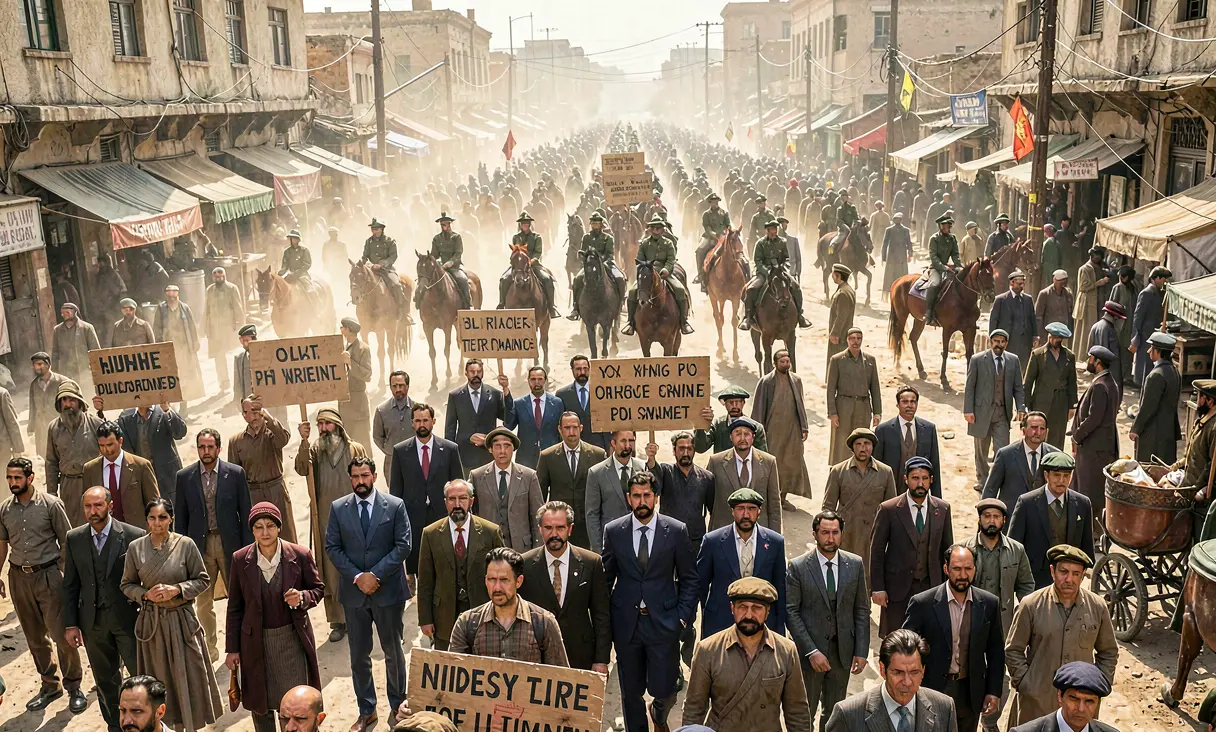
The revolution was remarkable for its unprecedented social cohesion, transcending traditional divides of class, religion, and gender. The Wafd Party, led by Zaghloul's associates Saad Pasha Zaghloul, Muhammad Ali Pasha, and others, became the focal point of resistance, but the movement quickly outgrew party lines. Students from Cairo University (then known as the Egyptian University) were among the first to strike, followed rapidly by railway workers, telegraph operators, and civil servants who paralyzed the country's infrastructure. Uniquely for the era, women played a visible and vocal role; Huda Sha'arawi led demonstrations in Cairo and Alexandria, while rural peasant women joined urban protesters, chanting slogans that demanded 'Independence or Death.' The slogan 'Long live the Wafd!' became a unifying cry across mosques and churches alike, symbolizing a rare moment of Muslim-Christian unity against a common colonial occupier.
The Mechanics of Civil Disobedience
From March 1919 through the summer, Egypt experienced a total paralysis of daily life. Strikes shut down railways, halting the movement of British troops and supplies, while boycotts targeted British goods and businesses. In Cairo, Alexandria, and the Delta provinces, crowds swelled into the tens of thousands, often facing brutal force from British military units. The British response was swift and severe; they declared martial law, deployed armored trains to crush demonstrations, and executed hundreds of protesters. Despite the violence, the resistance remained largely non-violent in its core strategy, relying on mass civil disobedience rather than armed insurgency. By April 1919, the unrest had spread to Upper Egypt, where local leaders organized their own contingents, demonstrating that the revolution was not merely an urban phenomenon but a genuine national movement.
The Road to Nominal Independence
Faced with the impossibility of governing a paralyzed country and under pressure from international observers, Britain relented. In November 1919, they released Zaghloul and allowed him to travel to London for negotiations, though these talks ultimately failed to satisfy Egyptian demands for full sovereignty. However, the sheer scale of the uprising forced a strategic shift in British policy. On February 28, 1922, Britain unilaterally declared Egypt an independent sovereign state, ending the protectorate. Yet, this independence was heavily qualified; Britain reserved control over four critical areas: defense, foreign affairs, the protection of foreign interests and minorities, and the Sudan. This 'reserved points' policy meant that while King Fuad I ascended to the throne in 1922, Egypt remained effectively under British suzerainty, a compromise that satisfied neither the Wafd nor the British completely.
Enduring Legacy and National Identity
The Revolution of 1919 is widely regarded as the birth of modern Egyptian nationalism. It established the Wafd Party as the dominant political force for the next two decades and created a template for mass mobilization that would influence anti-colonial movements across the Arab world and beyond. The event cemented the concept of 'Egyptianness' (Misriyya) as a civic identity that could bridge religious sectarianism, a legacy that continues to resonate in Egyptian political discourse. Although full sovereignty was not achieved until the 1952 Revolution led by the Free Officers Movement, which finally expelled British forces and abolished the monarchy, the 1919 uprising provided the foundational mythos of independence. It transformed Egypt from a passive colony into an active subject of history, proving that organized civil resistance could force even the world's greatest empire to negotiate.
The 1919 Revolution mobilized Egypt's diverse society against colonial rule, laying the groundwork for full sovereignty and the rise of mass politics.

Where it happened
Cairo, Egypt — see it on the interactive map →
Explore related history
 PoliticsSargon of Akkad Establishes the First Empirec. 2334 BCE · Akkad (Location uncertain, near Baghdad, Iraq)Sargon unifies Sumerian city-states to create the world's first multi-ethnic empire.
 PoliticsPromulgation of the Code of Ur-Nammuc. 2100 BCE · Ur, Southern Mesopotamia (Iraq)The earliest known surviving law code is established in the Sumerian city of Ur.
 PoliticsNelson Mandela Elected President of South AfricaApril 27, 1994 · Cape Town, South AfricaSouth Africa holds its first democratic election, ending the apartheid regime and establishing a multiracial government.
 WarTurkish War of Independence BeginsMay 19, 1919 · Samsun, TurkeyMustafa Kemal Atatürk lands in Samsun to organize resistance against Allied occupation and the Ottoman Sultanate.
 PoliticsKorean March First MovementMarch 1, 1919 · Seoul, Korea (under Japanese rule)Mass non-violent protests erupt across Korea demanding independence from Japanese colonial rule.
 WarEaster Rising in IrelandApril 24, 1916 · Dublin, IrelandIrish republicans launch an armed insurrection against British rule in Dublin during Easter Week.
Discussion
Loading…