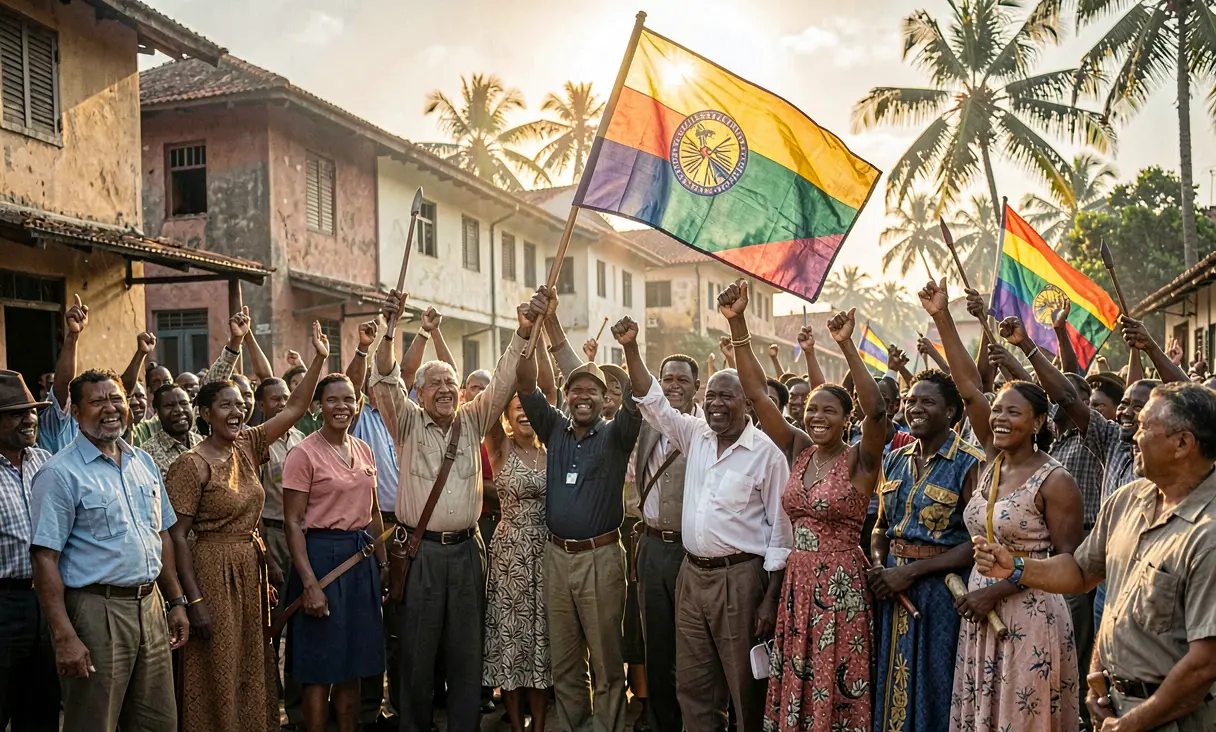
Congo Gains Independence from Belgium
The abrupt 1960 independence of the Belgian Congo triggered immediate civil war, Cold War intervention, and the assassination of Patrice Lumumba, setting a tragic precedent for post-colonial state-bui
The Colonial Legacy and the Rush to Independence
For nearly eighty years, the Belgian Congo stood as the personal fiefdom of King Leopold II before becoming a formal colony in 1908. Under this administration, the territory was subjected to an extractive regime characterized by forced labor, brutal quotas for rubber and ivory production, and a rigid racial hierarchy that denied Africans any meaningful political agency or education beyond elementary vocational training. By the late 1950s, however, the winds of change were blowing across Africa; the independence of Ghana in 1957 and rising nationalist sentiment within the Congo's urban centers forced Brussels to reconsider its policy of gradual assimilation. In a stunning reversal of decades of paternalism, Belgian Prime Minister Gaston Eyskens abruptly announced on January 13, 1960, that full independence would be granted by June 30, merely six months later, leaving the Congo woefully unprepared for self-governance.
The Round Table and Political Mobilization
The path to sovereignty was paved in Brussels during a frantic Round Table Conference held from January 20 to February 20, 1960. Delegates from various Congolese political parties, including the nationalist Mouvement National Congolais (MNC) led by Patrice Lumumba and the federalist Alliance des Bakongo (ABAKO) under Joseph Kasa-Vubu, clashed with Belgian officials over the timeline and structure of the new state. The negotiations resulted in a compromise that established a parliamentary republic with a ceremonial president and a powerful prime minister. The first national elections were held on May 22, 1960, producing a fragmented parliament where no single party secured an absolute majority, necessitating a fragile coalition government. Lumumba's MNC emerged as the largest single party, while Kasa-Vubu's ABAKO dominated in the capital region of Léopoldville.
The Ceremony at Palais de la Nation
On June 30, 1960, the Belgian Congo officially ceased to exist, replaced by the Republic of the Congo. The ceremony took place in the capital, Léopoldville (now Kinshasa), at the Palais de la Nation, attended by King Baudouin I of Belgium and a host of international dignitaries. In his opening address, King Baudouin praised Leopold II as the 'civilizer' who brought order to the land, a statement that ignited immediate outrage among Congolese attendees. Patrice Lumumba, speaking impromptu after the King's speech, delivered a fiery rebuttal that became a defining moment of African decolonization. He condemned the 'humiliating slavery' and 'iron laws' imposed by Belgian rule, declaring, 'We have known the ironies, the insults, the blows which we had to endure morning, noon, and night because we were Negroes.' This unscripted speech signaled a radical break from colonial deference and set a confrontational tone for the new nation's foreign policy.
The Immediate Crisis: Mutiny and Secession
Independence arrived with catastrophic speed, leaving the state without experienced administrators or officers. On July 5, just five days after independence, the Force Publique, the colonial army, mutinied against their Belgian officers, demanding immediate Africanization of the command structure. The resulting chaos saw widespread violence and the flight of thousands of Belgians. Simultaneously, mineral-rich regions moved to secede: Moïse Tshombe declared the State of Katanga independent on July 11 with Belgian military support, followed by South Kasai in August. The central government in Léopoldville collapsed into paralysis as Lumumba and Kasa-Vubu struggled to maintain authority. In a desperate bid to restore order, Lumumba requested Soviet military aid, while Belgium intervened under the guise of protecting its citizens, effectively turning the internal crisis into an international Cold War proxy conflict.
The Assassination of Patrice Lumumba
The political instability culminated in a power struggle between President Kasa-Vubu and Prime Minister Lumumba. In September 1960, Kasa-Vubu dismissed Lumumba from office; Lumumba countered by dismissing the president. This constitutional deadlock was exploited by Colonel Joseph-Désiré Mobutu, who staged his first coup on September 14, suspending parliament and placing Lumumba under house arrest. Despite being protected by United Nations peacekeepers, Lumumba attempted to flee to his political stronghold in Stanleyville but was captured by Mobutu's forces on December 1, 1960. Transferred to the secessionist province of Katanga, he was executed on January 17, 1961, under the supervision of Belgian officers and with the tacit approval of Western intelligence agencies fearing his alignment with the Soviet Union.
Legacy and the Long Shadow of Instability
The independence of the Congo marked a pivotal moment in the history of decolonization, yet it also exposed the perils of abrupt transitions without institutional preparation. The death of Lumumba plunged the country into a prolonged period of civil war known as the Congo Crisis, which lasted until 1965 and resulted in hundreds of thousands of deaths. The crisis paved the way for Mobutu Sese Seko to seize absolute power in 1965, establishing a dictatorship that would last thirty-two years and drain the nation's resources. The fragmentation of the state, fueled by external interference and internal ethnic divisions, set a precedent for post-colonial instability across Central Africa. Today, the Democratic Republic of the Congo continues to grapple with the structural weaknesses and geopolitical scars inflicted during those tumultuous first months of sovereignty.
Congo's independence marked a critical moment in African decolonization but exposed the complexities of transitioning from colonial rule to sovereign nationhood amidst Cold War interference.
Where it happened
Kinshasa, Congo (DRC) — see it on the interactive map →
Explore related history
 PoliticsSargon of Akkad Establishes the First Empirec. 2334 BCE · Akkad (Location uncertain, near Baghdad, Iraq)Sargon unifies Sumerian city-states to create the world's first multi-ethnic empire.
 PoliticsPromulgation of the Code of Ur-Nammuc. 2100 BCE · Ur, Southern Mesopotamia (Iraq)The earliest known surviving law code is established in the Sumerian city of Ur.
 PoliticsNelson Mandela Elected President of South AfricaApril 27, 1994 · Cape Town, South AfricaSouth Africa holds its first democratic election, ending the apartheid regime and establishing a multiracial government.
 PoliticsGhana Gains Independence from BritainMarch 6, 1957 · Accra, GhanaKwame Nkrumah leads the Gold Coast to become the first sub-Saharan African nation to gain independence from colonial rule.
 WarAlgerian War of Independence BeginsNovember 1, 1954 · Algiers, AlgeriaThe National Liberation Front launches coordinated attacks marking the start of the Algerian War against France.
 WarMau Mau Uprising Begins in KenyaOctober 20, 1952 · Nairobi, KenyaThe Kikuyu-led Mau Mau rebellion begins against British colonial rule and white settler land ownership.
Discussion
Loading…