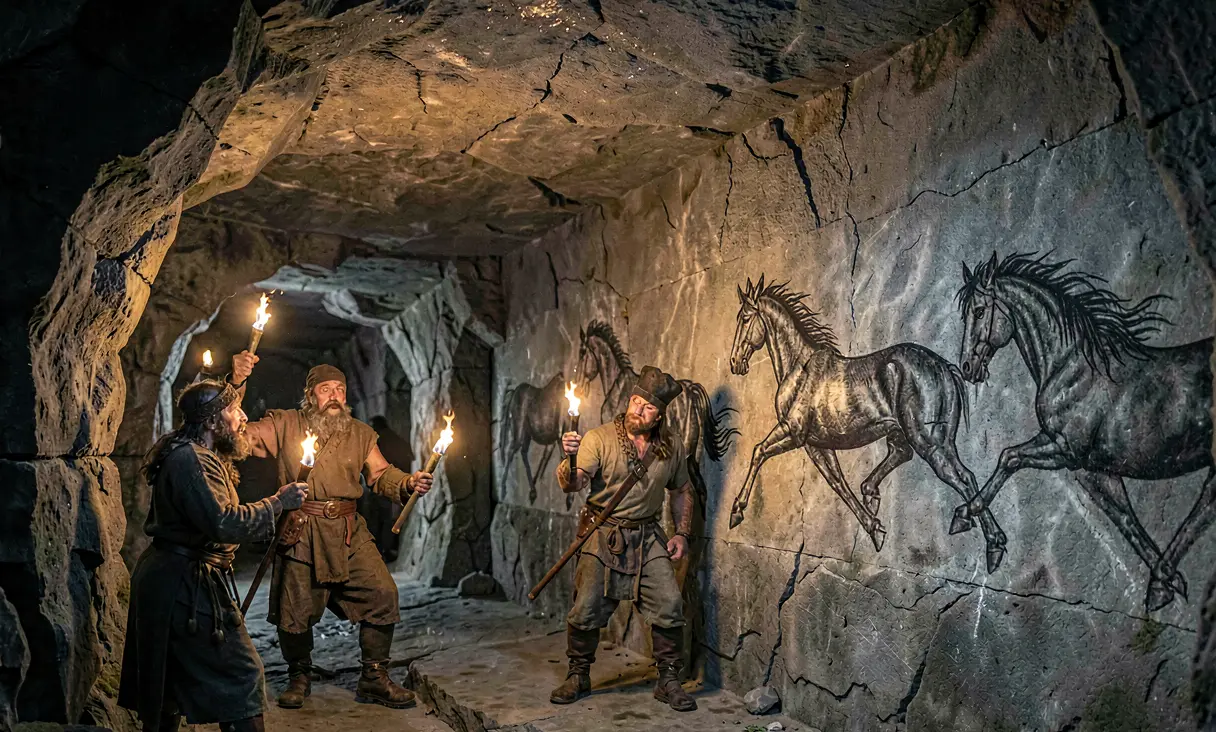
Creation of Chauvet Cave Paintings
Discovered in 1994, Chauvet Cave houses the world's oldest known figurative art from 30,000 BCE, proving that early humans possessed advanced artistic sophistication far earlier than previously believ
The Aurignacian Context
Around 32,000 to 30,000 BCE, during the early Upper Paleolithic era known as the Aurignacian period, Homo sapiens had firmly established a foothold in Western Europe. This was a time of profound cultural and technological innovation, marked by the development of sophisticated stone tools, bone harpoons, and the earliest evidence of long-distance trade networks. It is within this dynamic milieu that the first unequivocal explosion of figurative art occurred in human history. Unlike the abstract signs or simple engravings found in earlier periods, these artists began to render the natural world with a startling degree of realism and emotional depth, challenging previous assumptions about the cognitive evolution of our species.
Discovery of the Grotte Chauvet
The cave itself remained undisturbed for nearly 23,000 years until December 18, 1994, when speleologists Jean-Marie Chauvet, Éliette Brunel Deschamps, and Christian Hillaire explored the limestone cliffs near Vallon-Pont-d'Arc in the Ardèche region of southern France. While investigating a potential prehistoric site, they descended into a narrow fissure that opened into a vast underground chamber. There, illuminated by their headlamps, they encountered walls covered in hundreds of paintings and engravings depicting lions, woolly rhinoceroses, mammoths, bison, and horses. The sheer density and quality of the imagery immediately signaled that this was not merely a local curiosity but a site of unparalleled significance.
Artistic Mastery and Technique
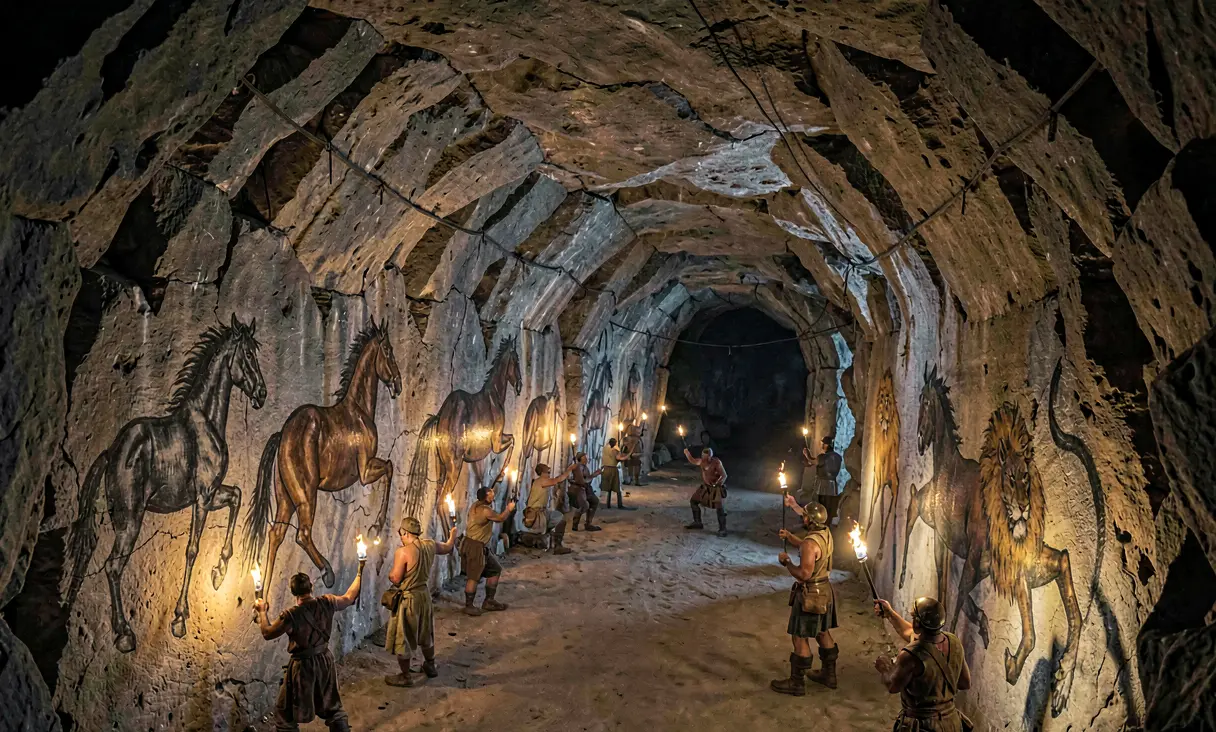
The creators of the Chauvet Cave paintings employed techniques that would remain unmatched for millennia. Using charcoal derived from pine wood and red ochre pigment, they utilized the natural undulations of the cave walls to give their subjects three-dimensional volume. The artists demonstrated a sophisticated understanding of anatomy and movement; horses are depicted with flowing manes and muscular tension, while lions are shown in dynamic poses that suggest hunting or social interaction. Perhaps most remarkably, the painters mastered perspective, overlapping figures to create depth and using 'twisted perspective'—where bodies are shown in profile but horns or antlers are viewed from the front—to convey a complete sense of the animal's form.
Chronological Verification
Initial skepticism regarding the age of the site was swiftly dispelled through rigorous scientific analysis. Radiocarbon dating performed on charcoal samples taken directly from the drawings, as well as on torch marks and calcite deposits overlying the art, consistently placed the earliest phase of occupation between 32,000 and 30,000 years Before Present (BP). This confirmed that the cave was active during the Aurignacian period, making it significantly older than the famous Lascaux Cave (c. 17,000 BCE) and the Altamira Cave in Spain. The dating established Chauvet as containing the oldest known figurative art in the world, pushing back the timeline of human symbolic expression by at least 15,000 years.
Sealing and Preservation
The cave's survival is attributed to a catastrophic geological event that occurred around 29,000 BCE. A massive rockfall sealed the entrance, creating an hermetically closed environment that stabilized temperature and humidity levels while excluding light and oxygen. This natural seal preserved the pigments in near-pristine condition, preventing the fading and biological degradation common in other prehistoric sites. The darkness remained unbroken until 1994, allowing modern viewers to see the art as it appeared when the last handprint was pressed against the wall, offering a rare, unmediated connection to the Upper Paleolithic mind.
Legacy and Global Significance
The discovery of Chauvet fundamentally altered the narrative of human cognitive evolution. It proved that complex symbolic thought, artistic sophistication, and sophisticated planning were present in Europe from the very beginning of Homo sapiens' arrival, rather than evolving gradually over tens of thousands of years. The site has since been designated a UNESCO World Heritage Site and is strictly off-limits to the public to prevent damage; instead, an exact replica, the Caverne du Pont-d'Arc, was constructed nearby to allow for study and appreciation without compromising the original.
These paintings represent a pivotal moment in human cognitive evolution and artistic expression during the Upper Paleolithic.

Where it happened
Vallon-Pont-d'Arc, France — see it on the interactive map →
Explore related history
 PrehistoryFirst Human Settlement of Australiac. 65,000 BCE · Central AustraliaFirst humans arrive in Sahul via sea crossings, marking the earliest migration out of Africa into Oceania.
 PrehistoryLascaux Cave Paintings Createdc. 17,000 BCE · Dordogne, FranceUpper Paleolithic artists create stunning animal frescoes deep inside limestone caves using natural pigments.
 PrehistoryConstruction of Gobekli Tepec. 9500 BCE · Sanliurfa, TurkeyHunter-gatherers build massive stone circles predating agriculture and pottery, challenging assumptions about civilization origins.
 PrehistoryDomestication of Wheatc. 9500 BCE · Fertile Crescent, Syria/IraqWild grasses are cultivated for food in the Fertile Crescent, sparking the Neolithic Revolution.
 CivilizationEmergence of Ubaid Culture in Southern Mesopotamiac. 6500 BCE · Tell al-Ubaid, Southern Mesopotamia (Iraq)The Ubaid culture establishes the first widespread agricultural settlement pattern in southern Iraq.
 CivilizationDomestication of Rice in the Yangtze Valleyc. 4000 BCE · Yangtze River Valley, ChinaRice cultivation begins in the Yangtze River valley, transforming East Asian agriculture and supporting massive population growth.
Discussion
Loading…