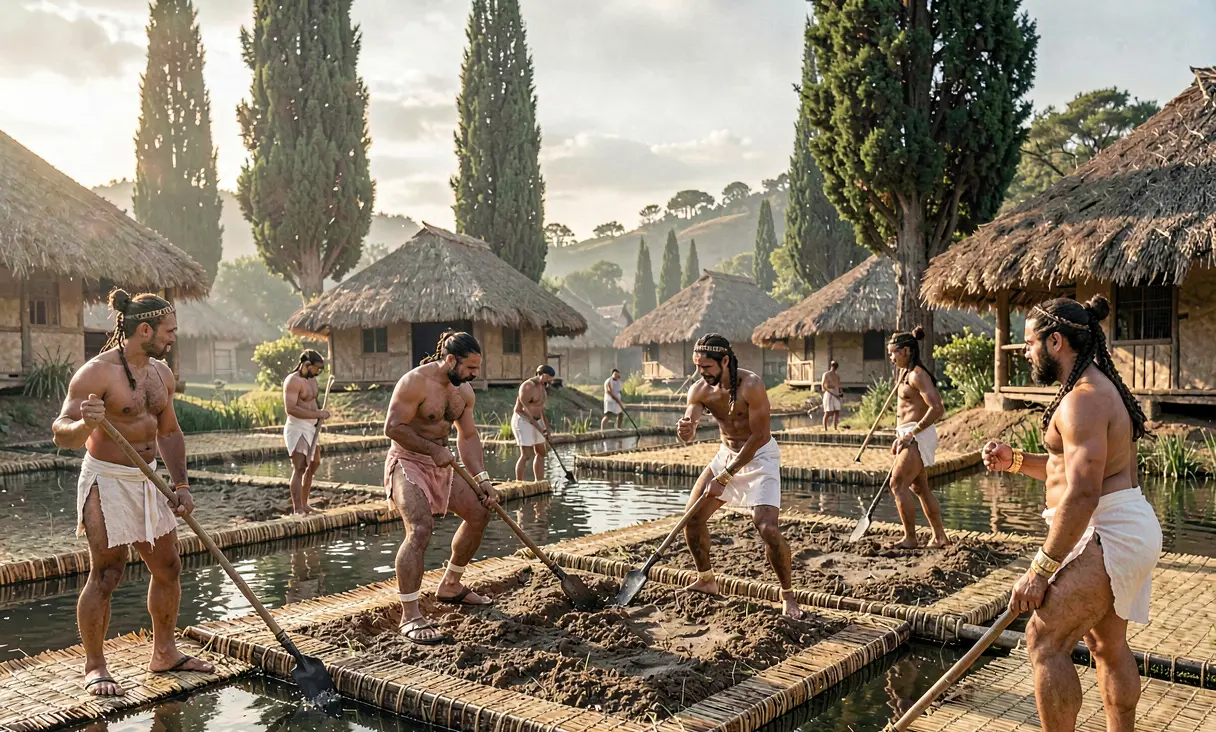
Expansion of Chinampa Agriculture in the Valley of Mexico
The expansion of chinampa agriculture around 1400 CE transformed Lake Xochimilco into a hyper-productive agricultural engine, sustaining the massive population of Tenochtitlan and enabling the rise of
The Lacustrine Challenge
By the early 15th century, the Valley of Mexico presented a paradoxical environment for human settlement: a fertile basin surrounded by high mountains but dominated by shallow, saline lakes that rendered traditional agriculture nearly impossible. The rising power of the Mexica people, centered on the island city of Tenochtitlan, faced an imminent demographic crisis as their population surged toward half a million within a few decades. Conventional dry-land farming was insufficient to support such density in a region where arable soil was scarce and water management was critical. The solution lay not in conquering new territories for grain, but in fundamentally altering the hydrology of Lake Xochimilco and Lake Chalco to create a sustainable, high-yield food source directly beneath their urban footprint.
Engineering the Floating Gardens
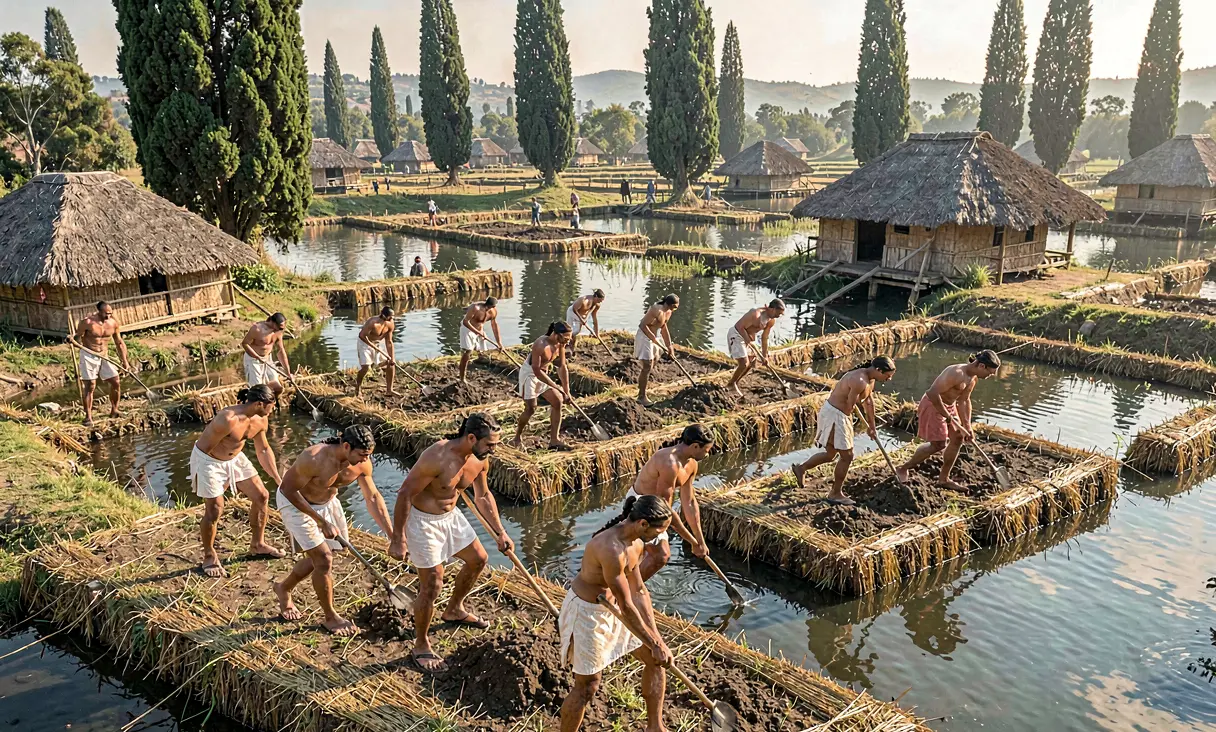
The expansion of chinampa agriculture around 1400 CE represented a masterpiece of pre-Columbian hydraulic engineering. Unlike mere floating rafts, these were stationary artificial islands constructed by driving wooden stakes into the lakebed to form rectangular enclosures measuring roughly 30 meters by 2.5 meters. Within these frames, farmers wove dense mats of reeds and willow branches, then piled layers of nutrient-rich sediment dredged from the lake bottom, alternating with decaying aquatic vegetation. This process created soil that was perpetually moist via capillary action from the surrounding water, effectively eliminating the need for traditional irrigation systems while preventing drought stress.
The Mechanics of Intensive Cultivation
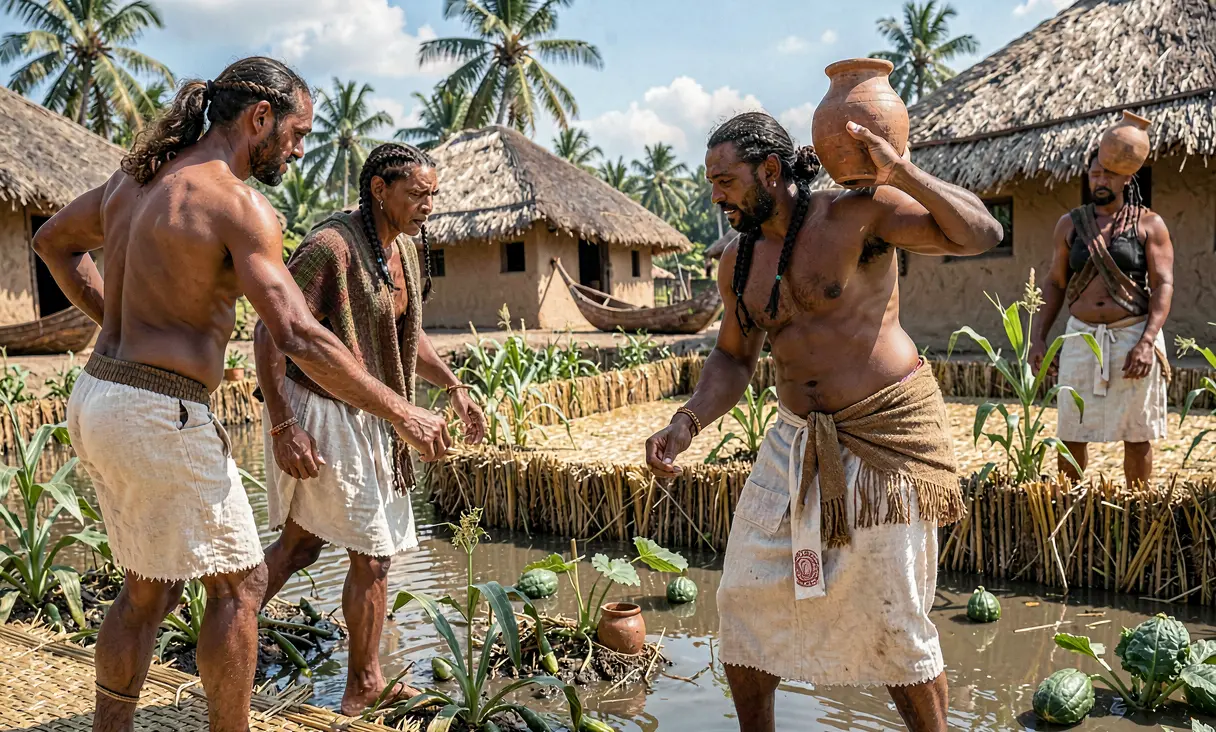
The genius of the chinampa system lay in its ability to support an unprecedented intensity of cultivation. The constant moisture and annual replenishment of nutrients from the lake mud allowed for a continuous growing cycle, yielding up to seven harvests annually for crops such as maize, beans, squash, amaranth, and chili peppers. Farmers utilized small canoes to navigate the narrow canals that separated each plot, transporting compost made from human waste (night soil) collected in Tenochtitlan back to the fields, creating a closed-loop nutrient cycle. Willow trees were often planted along the perimeter of the plots; their roots stabilized the banks against erosion and provided shade, while their branches offered materials for further construction.
State-Sponsored Expansion
While indigenous communities had utilized small-scale chinampas for centuries, the massive expansion circa 1400 CE was driven by the strategic imperatives of the emerging Aztec Empire. As the Triple Alliance consolidated power under rulers like Itzcoatl and later Moctezuma I, the state organized labor drafts (tequitl) to systematically reclaim vast tracts of the lake surface. This was not merely a local farming initiative but a calculated imperial strategy to feed the growing capital without relying on volatile tribute shipments from distant provinces. The expansion transformed Lake Xochimilco into a highly productive agricultural zone that could sustain the urban core of Tenochtitlan, effectively turning the city's immediate surroundings into a massive, self-sustaining breadbasket.
Demographic and Urban Consequences
The success of this agricultural revolution directly enabled the explosion of urbanization in the Valley of Mexico. By providing a reliable, high-calorie food surplus, chinampas supported a population density that rivaled or exceeded contemporary European cities like London or Paris, yet without the accompanying famine risks common in agrarian societies dependent on rainfall. The system allowed Tenochtitlan to function as a true metropolis with specialized artisans, soldiers, and administrators who did not need to farm for their own subsistence. This surplus also fueled the empire's military campaigns, as the state could provision armies efficiently from the heart of the valley rather than stretching supply lines across difficult terrain.
Legacy and Modern Resilience
Although the Spanish conquest in 1521 led to the draining of much of Lake Xochimilco for urban expansion, fragments of the chinampa system survive today as a UNESCO World Heritage site, offering a rare glimpse into this sophisticated technology. The resilience of these plots is evident in their continued productivity; modern farmers still utilize traditional methods to grow crops with minimal chemical inputs. Historians regard the chinampa system as one of the most successful examples of sustainable intensification in human history, demonstrating how indigenous engineering could harmonize with natural ecosystems to support complex civilization long before the arrival of European technology.
Chinampas represent one of history's most sustainable and productive forms of intensive agriculture.
Where it happened
Lake Xochimilco, Mexico City, Mexico — see it on the interactive map →
Explore related history
 TechnologyIndustrialization of Sericulture in Ancient Chinac. 2600 BCE · Shaanxi Province, ChinaChinese artisans perfect the reeling and spinning of silk from silkworm cocoons.
 TechnologyAdvanced Irrigation Systems of the Indus Valley Civilizationc. 2600 BCE · Harappa, PakistanEngineers construct sophisticated canal networks and water reservoirs for urban agriculture.
 TechnologyBenin Acquires Cannon Technology from Portugalc. 1500 CE · Benin City, NigeriaThe Kingdom of Benin integrates Portuguese cannon technology into its military arsenals.
 ExplorationGreat Zimbabwe Dominates Gold Trade with Kilwac. 1400 CE · Great Zimbabwe, ZimbabweArchaeological evidence confirms extensive gold trade between Great Zimbabwe and Swahili coastal cities.
 ArtMass Production of Moai Statues at Rano Rarakuc. 1400 CE · Rano Raraku Quarry, Rapa NuiThe peak period of moai carving begins at the Rano Raraku quarry under the direction of clan chiefs.
 PoliticsBreaking of the Tapu by High Chiefsc. 1400 CE · North Island, New ZealandHigh chiefs challenge and modify traditional tapu rules to consolidate power and redistribute resources.
Discussion
Loading…