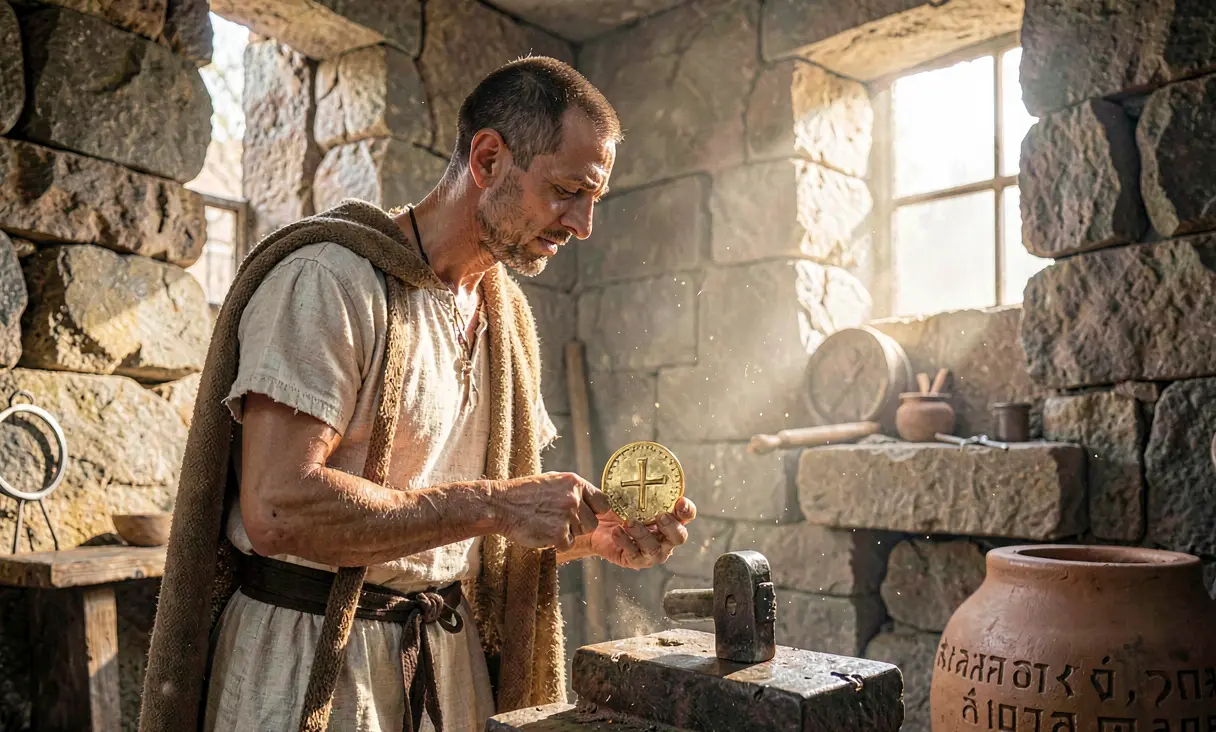
Aksum Issues Gold Coins with Christian Imagery
King Ezana's c. 350 CE introduction of gold coins bearing Christian crosses established Aksum as the first sub-Saharan African state to issue sovereign currency, cementing its role as a major Christia
Context of a Rising Power
By the mid-fourth century CE, the Kingdom of Aksum had already established itself as the dominant commercial and political force in the Horn of Africa. Situated at the strategic nexus of the Red Sea trade routes, Aksum controlled the flow of ivory, gold, frankincense, and exotic animal skins moving between the African interior, the Roman Empire, the Sassanian Persian Empire, and India. The kingdom's capital, also named Aksum, was a bustling cosmopolitan hub where merchants from Alexandria, Antioch, and Ctesiphon converged. Prior to this era, trade in the region relied heavily on barter or foreign coinage, primarily Roman denarii and aurei, which circulated widely but lacked local legitimacy. The need for a sovereign currency that could assert Aksum's economic independence while facilitating seamless international commerce became increasingly urgent as the kingdom expanded its territorial reach and diplomatic influence.
The Reign of King Ezana
Central to this monetary revolution was King Ezana, whose reign (c. 320–360 CE) marks a watershed moment in African history. A formidable ruler and military strategist, Ezana is perhaps best known for his conversion to Christianity, likely influenced by his tutor, the Syrian Christian Frumentius, who later became the first Bishop of Axum. Ezana's reign was characterized by a deliberate policy of state-building that integrated religious identity with political authority. Unlike many contemporary rulers who relied solely on military might or traditional animist rituals, Ezana sought to align Aksum with the rising Christian powers of the Mediterranean world, particularly Rome under Constantine and his successors. This ideological shift provided the theological and cultural impetus for a new numismatic program that would visibly distinguish Aksumite sovereignty from its pagan neighbors and rivals.
Minting a New Sovereignty
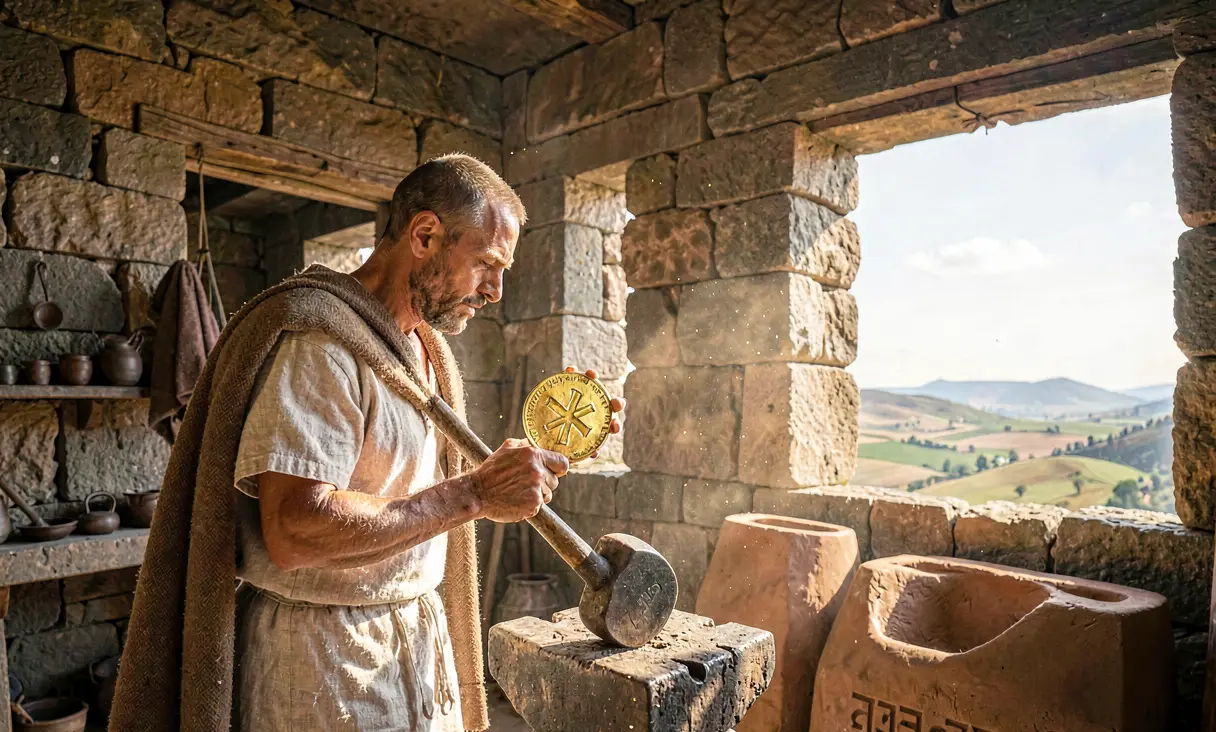
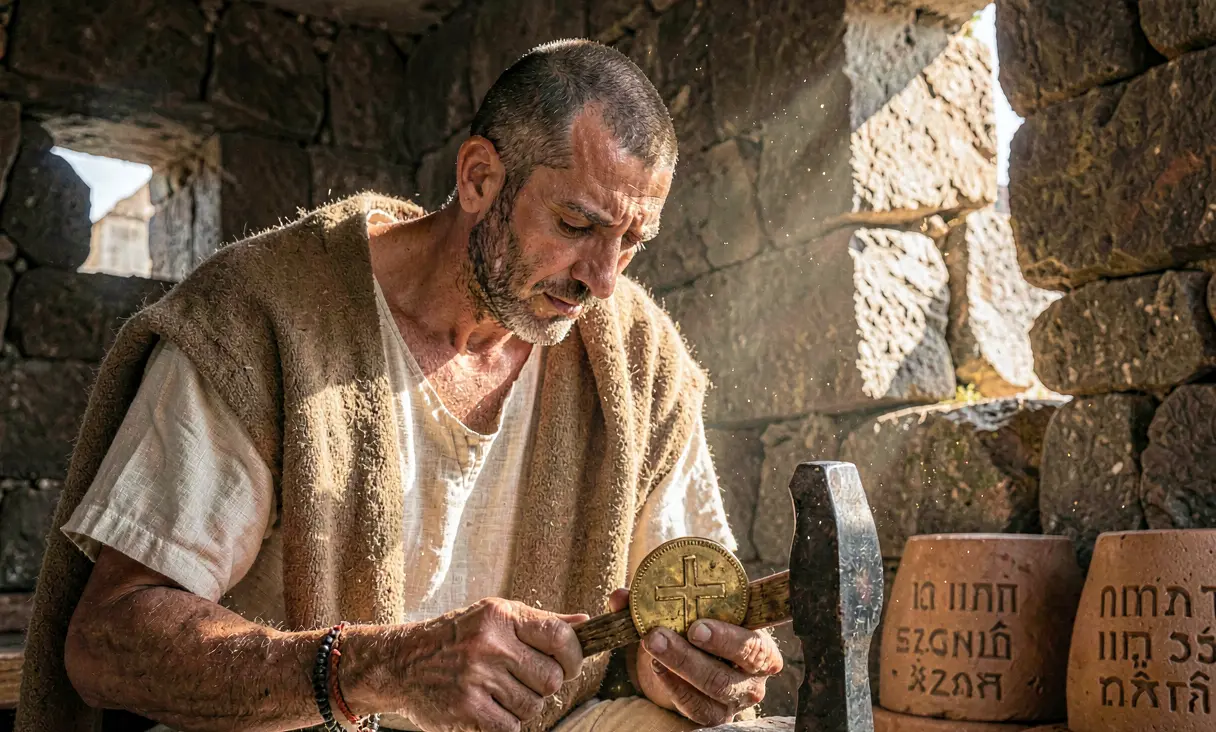
Around 350 CE, the royal mint in Aksum began producing a sophisticated tri-metallic coinage system consisting of gold solidi, silver denarii, and bronze fractions. These coins were technically advanced for their time, featuring high-relief portraits of King Ezana on the obverse, often depicted wearing a diadem and military regalia that echoed Roman imperial iconography but with distinct local stylistic nuances. The reverse side marked a profound departure from tradition: instead of pagan deities or dynastic symbols common in earlier Aksumite issues, the coins bore Christian crosses, sometimes accompanied by rays of light or crescent-and-disc motifs that were being phased out. This visual transformation was not merely decorative; it served as a mobile proclamation of faith and state power, circulating daily in markets from Adulis to Constantinople.
Multilingual Inscriptions and Global Reach
The Aksumite coins were unique in their trilingual inscriptions, reflecting the kingdom's intricate diplomatic web. The legends appeared in Ge'ez (the indigenous Semitic language), Greek (the lingua franca of international trade and diplomacy), and Sabaean (an Old South Arabian script used by earlier ruling elites). These inscriptions typically declared Ezana as 'King of Aksum,' 'King of the Habashat,' and 'King of the Himyarites' or 'Sabeans,' asserting his dominion over a vast sphere that extended across the Red Sea into southern Arabia. The use of Greek ensured immediate recognition by Roman and Byzantine merchants, while Ge'ez solidified internal legitimacy. This linguistic strategy facilitated standardized transactions across vast distances, allowing Aksumite traders to operate with confidence in foreign markets without the friction of currency conversion or trust deficits.
Economic Integration and Standardization
The introduction of this gold coinage had an immediate and profound impact on the regional economy. By issuing a stable, high-purity gold standard, Aksum effectively created its own economic zone that rivaled the Roman solidus in reliability. This innovation reduced transaction costs for long-distance trade, encouraging a surge in the export of ivory and the import of luxury goods such as silk, glassware, and wine from the Mediterranean and India. The coins served as both a medium of exchange and a store of value, allowing Aksum to accumulate wealth that funded further military campaigns and monumental architecture, including the famous stelae fields. Furthermore, the standardization of weights and measures associated with these coins brought a level of bureaucratic sophistication previously unseen in sub-Saharan Africa, integrating the kingdom more tightly into the global economic system of Late Antiquity.
Legacy of African Christian Sovereignty
The coinage of King Ezana stands as one of the earliest and most significant examples of state-issued currency in Africa, predating many European medieval minting traditions. It symbolizes the first time an African nation explicitly declared its Christian identity on a medium that circulated globally, asserting parity with Rome and Persia. Although the specific production of these coins ceased after Ezana's death, the precedent they set endured for centuries, influencing the economic and religious landscape of the Ethiopian highlands. Today, surviving specimens in museums from London to Addis Ababa serve as tangible proof of Aksum's status as a 'superpower' of Late Antiquity, challenging historical narratives that often marginalize African contributions to global economic and religious history.
Established Africa's first national currency system, integrating the region into global economic networks.
Where it happened
Aksum, Ethiopia — see it on the interactive map →
Explore related history
 PoliticsAscension of the Nanda Dynastyc. 345 BCE · Pataliputra (modern Patna/India)Mahapadma Nanda overthrows the Shishunaga dynasty, establishing a vast empire and creating the first large-scale state in India.
 ScienceRefinement of the Maya Long Count Calendar Systemc. 361 BCE · Chiapa de Corzo, MexicoMaya scholars formalize the Long Count calendar for tracking deep historical time.
 ScienceFormal Adoption of Zero as a Placeholder in Maya Mathematicsc. 361 BCE · Chiapas, MexicoMaya mathematicians independently invent and use zero in their vigesimal numeral system.
Discussion
Loading…