
Prehistory
First Human Settlement of Australia
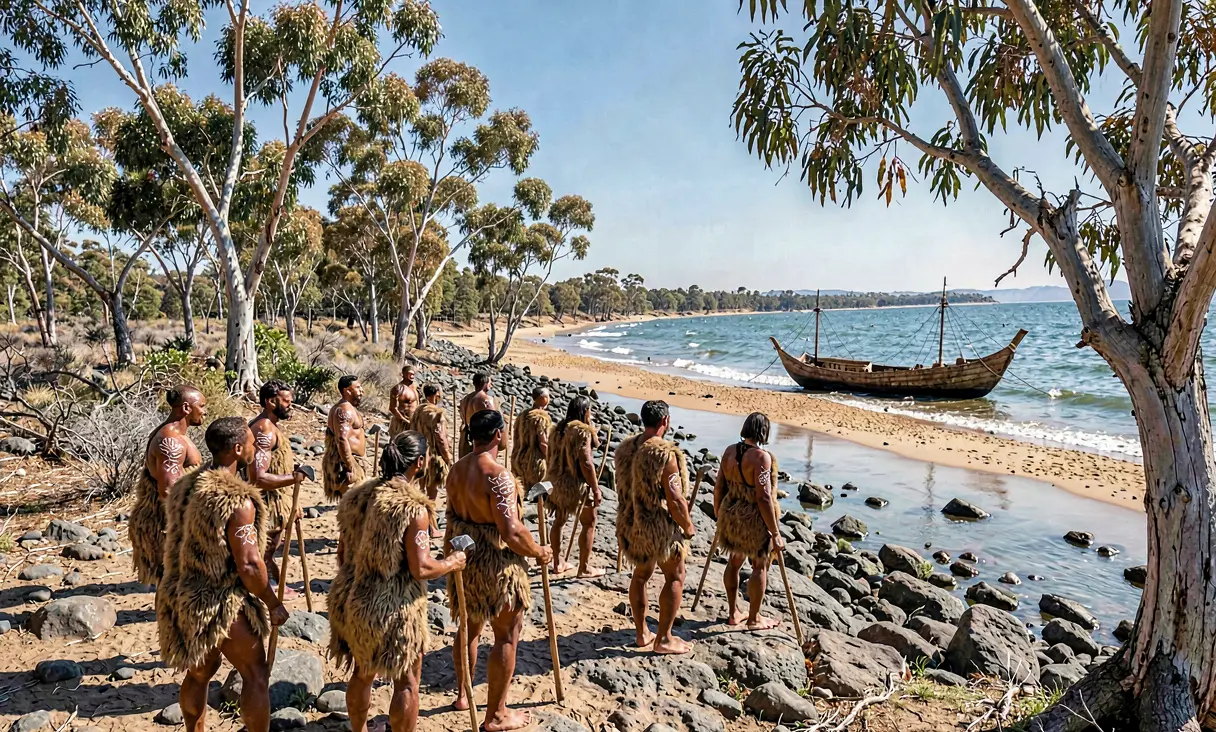
First humans arrive in Sahul via sea crossings, marking the earliest migration out of Africa into Oceania.
Archaeological evidence from sites like Madjedbebe indicates modern humans reached the Australian continent approximately sixty-five thousand years ago. This achievement required sophisticated maritime technology to cross deep-water channels separating islands from mainland Asia. These early voyagers adapted rapidly to diverse environments, hunting megafauna and developing complex toolkits. Their arrival fundamentally altered human geographic distribution and initiated a continuous cultural lineage spanning millennia before European contact.
This migration represents the first major expansion of humanity into isolated continents beyond Afro-Eurasia.

Where it happened
Central Australia — see it on the interactive map →
Explore related history
 PrehistoryCreation of Chauvet Cave Paintingsc. 30,000 BCE · Vallon-Pont-d'Arc, FranceEarly humans create sophisticated animal paintings in deep limestone caves.
 PrehistoryLascaux Cave Paintings Createdc. 17,000 BCE · Dordogne, FranceUpper Paleolithic artists create stunning animal frescoes deep inside limestone caves using natural pigments.
 PrehistoryConstruction of Gobekli Tepec. 9500 BCE · Sanliurfa, TurkeyHunter-gatherers build massive stone circles predating agriculture and pottery, challenging assumptions about civilization origins.
 PrehistoryDomestication of Wheatc. 9500 BCE · Fertile Crescent, Syria/IraqWild grasses are cultivated for food in the Fertile Crescent, sparking the Neolithic Revolution.
 CivilizationEmergence of Ubaid Culture in Southern Mesopotamiac. 6500 BCE · Tell al-Ubaid, Southern Mesopotamia (Iraq)The Ubaid culture establishes the first widespread agricultural settlement pattern in southern Iraq.
 CivilizationDomestication of Rice in the Yangtze Valleyc. 4000 BCE · Yangtze River Valley, ChinaRice cultivation begins in the Yangtze River valley, transforming East Asian agriculture and supporting massive population growth.
Discussion
Loading…