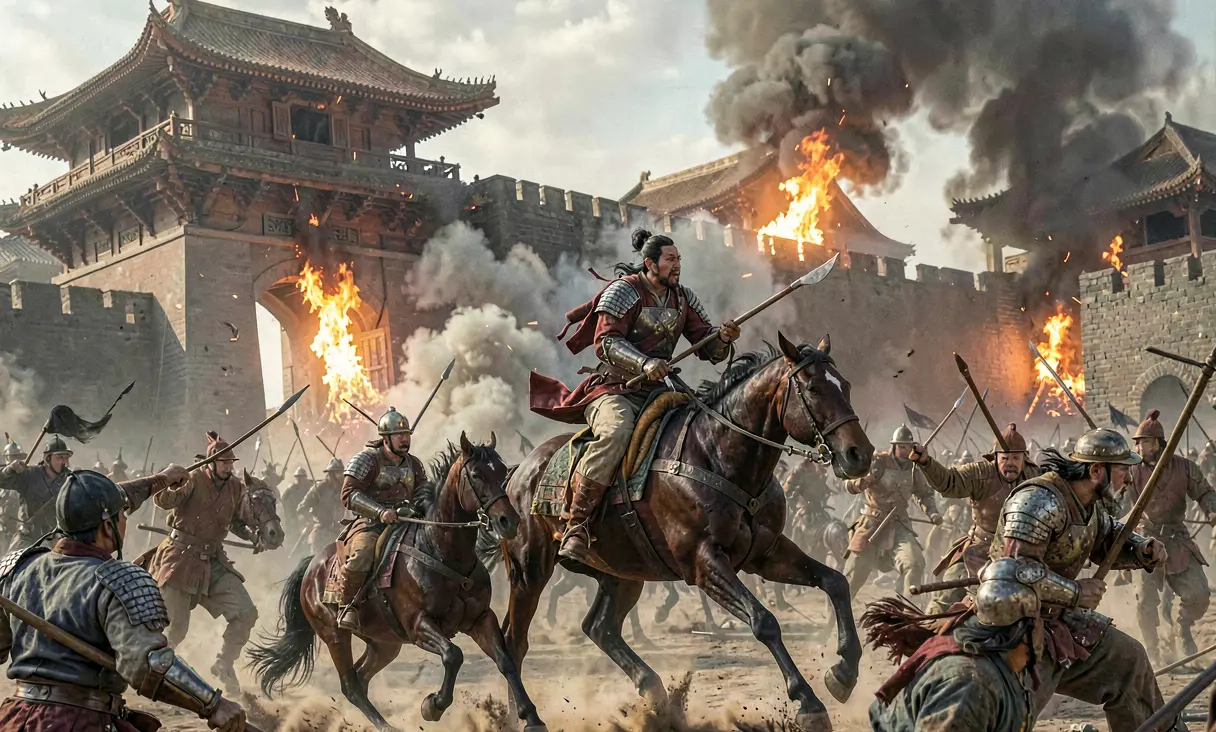
An Lushan Rebellion Begins
The An Lushan Rebellion shattered Tang central authority, depopulated northern China, and ushered in an era of warlordism that permanently altered the empire's political and economic landscape.
The Cracks in the Golden Age
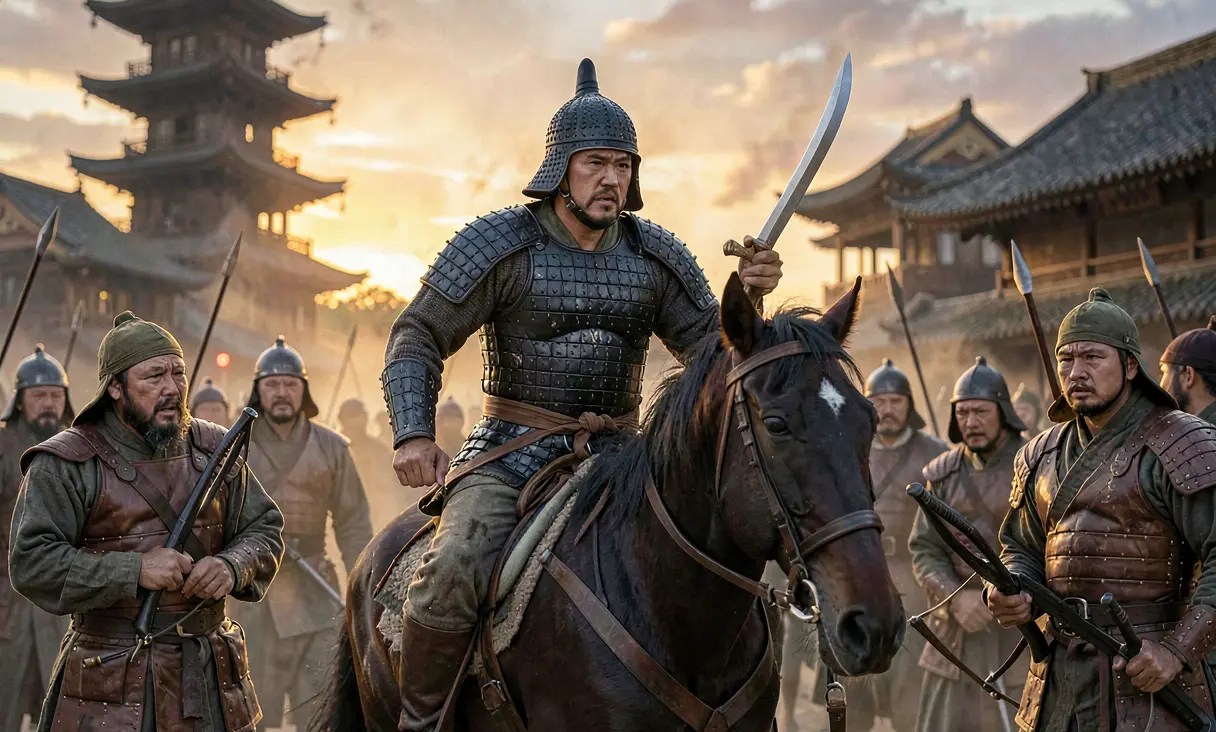
By the mid-8th century, the Tang Dynasty stood at the zenith of its cultural and economic power, with Chang'an serving as the cosmopolitan heart of Eurasia. However, beneath this glittering surface, systemic vulnerabilities had festered. Emperor Xuanzong, having retreated into a life of artistic indulgence and romance with the concubine Yang Guifei, delegated critical military authority to regional governors known as Jiedushi. This decentralization was intended to secure the vast frontiers but inadvertently created autonomous warlord states. An Lushan, a Sogdian-Turkic general who mastered three languages and commanded immense loyalty from diverse ethnic troops, was appointed Jiedushi of three northern circuits: Pinglu, Fanyang, and Hedong. Controlling nearly 20% of the empire's total military strength, he amassed a force of 150,000 battle-hardened soldiers while the central government in Chang'an remained dangerously undermanned.
The Spark at Fanyang
On December 16, 755 CE, An Lushan launched his rebellion from Fanyang (modern-day Beijing), citing the false pretext of removing corrupt officials around the throne, specifically targeting the powerful chancellor Yang Guozhong. Unlike previous localized uprisings, this was a coordinated, massive invasion aimed directly at the imperial capital. The rebel army, composed largely of Khitan, Xi, and other northern tribesmen alongside Han Chinese defectors, swept south with terrifying speed. Local garrisons, unprepared for such a scale of conflict and demoralized by years of peace, either surrendered immediately or collapsed without resistance. Within weeks, the rebellion had engulfed the Yellow River valley, severing the vital grain supply lines that sustained Chang'an.
The Fall of Chang'an
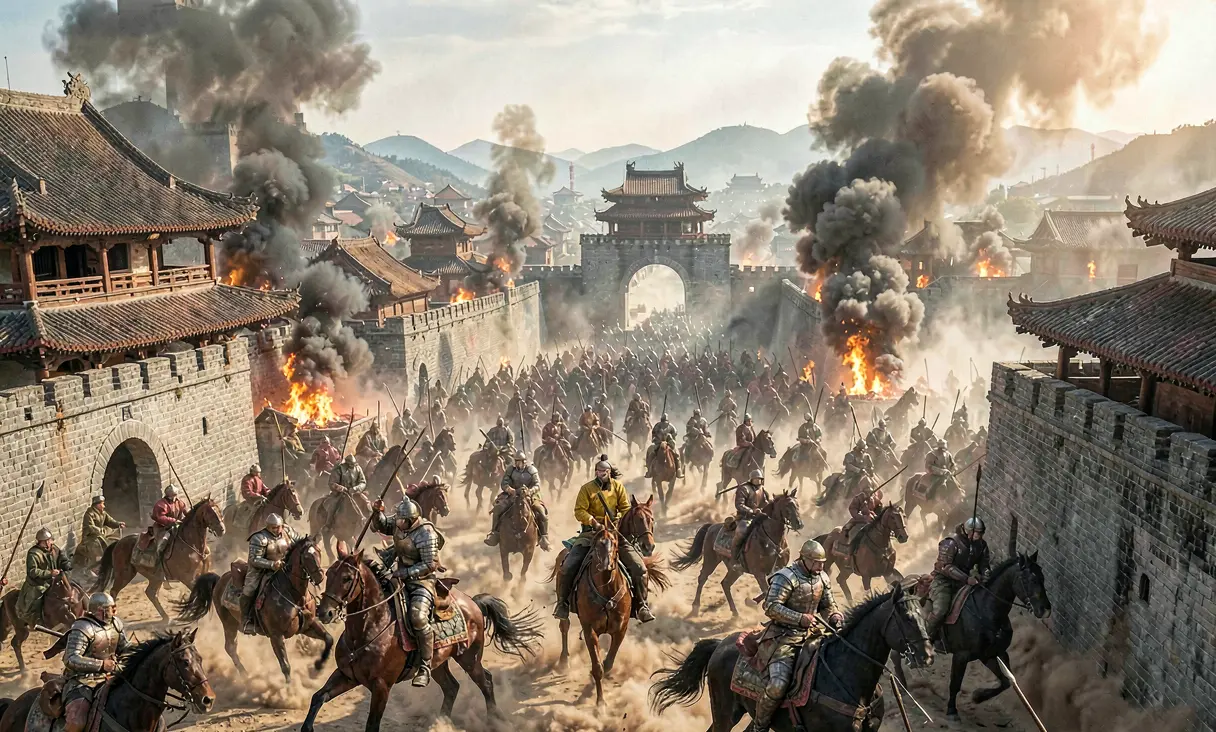
By June 756 CE, the rebel forces had breached the defenses of Tong Pass, the final strategic barrier protecting the capital. The panic in Chang'an was absolute; Emperor Xuanzong, realizing the city could not be held, ordered an immediate evacuation. Accompanied by his court, Yang Guifei, and a fraction of the imperial guard, he fled west toward Sichuan under the cover of darkness. The retreat turned into a rout at Mawei Station, where mutinous soldiers forced the Emperor to execute Yang Guozhong and strangle Yang Guifei to restore order. Shortly after, An Lushan's troops entered Chang'an unopposed, declaring the new Yan Dynasty with himself as emperor. The flight of the sovereign shattered the myth of Tang invincibility and plunged the empire into a state of existential crisis.
A War of Attrition and Tragedy
The conflict that followed was not a swift conquest but a brutal, decade-long war of attrition that devastated northern China. The Tang court, under the new Emperor Suzong, rallied with the help of Uighur mercenaries and loyalist generals like Guo Ziyi and Li Guangbi. However, the fighting was indiscriminate and savage. Major cities such as Luoyang changed hands multiple times, suffering repeated sackings that left them in ruins. The human cost was catastrophic; historical census data suggests China's population plummeted from approximately 53 million to 17 million over the course of the conflict and its immediate aftermath, a loss attributed not only to battlefield casualties but also to famine, disease, and mass displacement. The rebellion effectively depopulated the agricultural heartland of the north.
The Shattered Mandate
Although An Lushan was assassinated by his own son in 757 CE, the war raged on until 763 CE. The rebellion was eventually suppressed through a combination of internal dynastic strife within the Yan leadership and relentless Tang counter-offensives aided by foreign allies. Yet, the victory came at the cost of central authority. To end the fighting, the Tang court was forced to recognize many rebel generals as legitimate Jiedushi in the north, granting them hereditary control over their territories, armies, and tax revenues. These warlords operated as semi-independent kings, paying only nominal allegiance to the emperor while maintaining private militias that often rivaled or exceeded imperial forces.
Legacy of Fragmentation
The An Lushan Rebellion marks the definitive end of the High Tang era and the beginning of a prolonged period of political fragmentation. The economic center of gravity shifted permanently from the north to the south, as the latter remained relatively untouched by the devastation while the former lay in ruins. The rise of powerful regional warlords eroded the imperial bureaucracy's ability to collect taxes and enforce laws, setting a precedent for the chaotic Five Dynasties and Ten Kingdoms period that would follow the Tang's eventual collapse in 907 CE. Culturally, the cosmopolitan confidence of the early Tang was replaced by a more introspective and defensive Chinese identity, fundamentally altering the trajectory of East Asian history.
This catastrophic revolt ended the cosmopolitan zenith of the Tang Dynasty, permanently weakening central imperial control and altering China's demographic center.
Where it happened
Chang'an, China — see it on the interactive map →
Explore related history
 WarKushite Conquest of Egypt (25th Dynasty)c. 747 BCE · Thebes, EgyptKing Piye of Kush conquers Upper and Lower Egypt, establishing the first African-led dynasty in Egyptian history.
 WarKushite Conquest of Egypt Establishes 25th Dynastyc. 744 BCE · Napata, Nubia (Modern Sudan)King Piye of Kush conquers Upper Egypt, establishing the 25th Dynasty and restoring traditional Egyptian religious practices.
 WarDeath of Ah Cacao and Fall of Copán's Dynasty738 CE · Copán, HondurasThe king of Copán is captured and executed by his rival from Quiriguá, ending a golden age.
 DisasterCatastrophic Floods and Collapse of Moche San José de Moroc. 750 CE · Lambayeque Valley, PeruEl Niño floods devastate Moche infrastructure leading to societal transformation.
 CivilizationRise of the Etruscan League in Central Italyc. 750 BCE · Tarquinia (Cerveteri), ItalyEtruscan city-states form a powerful confederation dominating central Italy and influencing Rome.
 ScienceEstablishment of the Babylonian Astronomical Observatoriesc. 747 BCE · Babylon, IraqBabylonian priests begin systematic nightly recording of planetary movements and eclipses.
Discussion
Loading…